Fin’s Motocross Crash and Teo’s Rescue
Gente que viene y ¡Bah!Fin’s Motocross Crash and Teo’s Rescue turns a race into a sudden struggle between life and death, then makes survival the beginning of a lasting bond. When fifteen-year-old Fin is trapped beneath fallen motorcycles on a muddy course, Bea’s terror is sharpened by the thought that she had urged him to keep racing despite his doubts. Teo’s decision to enter the still-active track and free him changes the scene from helpless watching to rescue—and gives Fin a friend who remains part of his life after the immediate danger has passed.
The Crash and Its Stakes
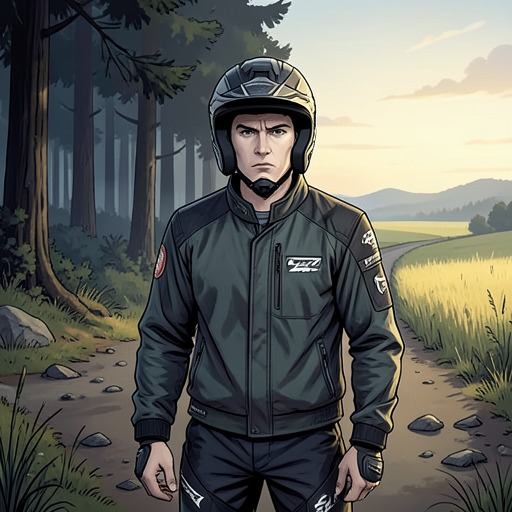
The crash begins when mud causes Fin to lose control. He strikes the motorcycle ahead, whose rider has also fallen. The impact is severe, and another motorcycle coming from behind cannot stop in time and lands on Fin. It pins his chest and head, leaving him unable to move. The danger is not only the force of the pile-up: other motorcycles are still moving around him, making any attempt to reach him hazardous.
For Bea, the sight turns into a sequence of feared possibilities. She cannot tell whether Fin can breathe or whether he has been fatally injured. Her thoughts keep circling the possibility that he might die, even as she tries to insist to herself that he will get up and that the crash is only an accident. The account holds the uncertainty in that gap between what she can see—Fin motionless beneath the motorcycles—and what she desperately needs to believe.
Bea’s Fear and Self-Blame
The accident also brings Bea’s earlier encouragement back against her. Fin had been uncertain about racing that day, but she had urged him not to give it up and to continue. As he lies trapped, she imagines the guilt she would carry if he were badly hurt: in her panic, the decision to encourage him becomes a possible cause of an outcome she cannot bear to contemplate. She shakes her head to stop these thoughts, but the fear has already overtaken her ability to reason calmly.
Her alarm draws on two other anxieties. Bea wonders whether Fin might be the person her mother had pleaded with in her dreams not to die, and whether her mother’s unusual mood that morning had been a warning. She also connects the danger to Fin’s recurring anguish about death, asking herself whether his fear might reflect an intuition of an early end or a gift inherited from his grandmother. These are Bea’s frightened conjectures, not explanations confirmed by the accident. Their force lies in how the crisis makes earlier fears seem newly urgent.
Teo Enters the Course
Teo’s intervention begins while the danger is still unfolding. Bea’s mother warns him to be careful as he runs down the slope and onto the track, where motorcycles are still in motion. Bea’s father wants to go down too, but her mother stops him because his injured hand would prevent him from lifting the motorcycles. Two riders fly over Teo as he advances; to avoid being struck, he crawls along the ground until he reaches Fin.
Juan also tries to reach the boy, but the racing motorcycles slow his progress. Teo’s small stature, which Bea had never imagined would help in such a circumstance, lets him move through the danger differently. With remarkable strength, he shifts the motorcycles off Fin. He speaks to him, and Fin raises his head and answers. That response changes the scene at once: Fin is alive. Bea’s legs begin to tremble so badly that she has to hold on to her mother to keep from falling.
Once the riders manage to stop, team personnel, Juan, and his firefighter friends reach the injured racers. Bea and her family make their way down the uneven slope as two ambulances arrive. Fin says his leg and chest hurt and tries to sit up, but Teo prevents him from doing so. When blood is visible at Fin’s knee and he tries to remove his helmet, Teo tells him to leave it on. The caution continues the rescue beyond the moment of freeing him: Fin is hurt, and he needs to be handled carefully rather than hurried to his feet.
Medical Outcome and Aftermath
Teo offers to accompany Fin because he is a nurse. Fin asks him to come, explaining that the motorcycle had pinned him and he could not move; he recognizes that Teo saved his life. The ambulance crew takes Fin and another injured rider away on stretchers, with Teo going with him. At the hospital, Irene arrives frightened and asks after her son. Bea learns that Fin has a broken tibia and a small burn on his chest. Doctors are performing a CT scan as a precaution, but have described it as routine, and the family is told that reaching him so quickly was fortunate.
Three days later, the doctors rule out further complications and discharge Fin. His leg is in a cast, and he can barely get around even with crutches, so the family decides he should stay at Bea’s parents’ home, where several relatives can help look after him. Irene cannot be with him all day, making the shared household a practical source of care as well as a place of relief for the family.
A Rescue That Becomes a Friendship
The rescue does not end when Fin leaves hospital. He develops a close friendship with Teo over Skype, to Débora’s frustration. Their conversations last for hours. When Débora appears on camera, Teo greets her and asks her to bring Fin closer; she does not always agree, but sometimes gives in because Fin keeps asking. Bea’s mother also uses the calls to greet Teo and talk with him. The family has a meal with him still to arrange.
The scene’s decisive reversal is physical and immediate: a boy who cannot move is freed, answers, and survives. But its aftermath gives that reversal a wider meaning. Teo’s courage is inseparable from practical care—his presence in the ambulance, his nursing knowledge, and his continued contact with Fin. The accident also transforms Bea’s panic and guilt into visible relief, while the later calls show how a life-saving act can establish a friendship that continues in ordinary family life after the race is over.