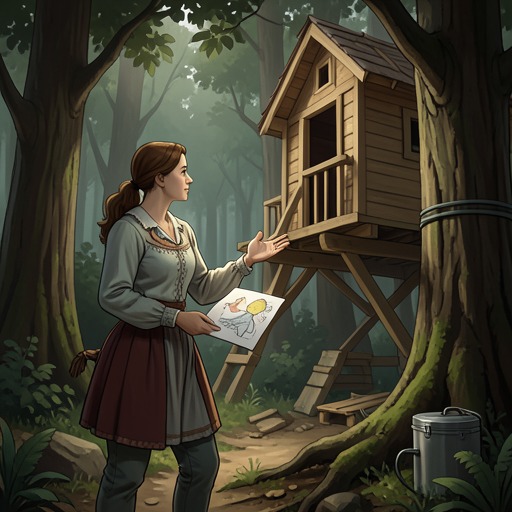
Ingrid
Gente que viene y ¡Bah!Ingrid is a village architect whose intimidating reputation precedes her, but whose professional judgment becomes an important opening for Bea. First cast as a warning against pursuing architecture, she later offers Bea a chance to show her final project on professional terms. Her curt manner remains consistent, yet her place in Bea’s story shifts from feared example to gatekeeper, colleague, and witness to a conflict she declines to manage.
Identity and Reputation
When Bea tells her sisters that she wants to study architecture, they invoke Ingrid as the fate she should avoid. Ingrid has moved to the village and established an architecture studio there. She is known for her talent, her fierce temper, her marked Czech accent, and her uncompromising dealings with clients and construction professionals. Stories about her private life, including accounts of several divorces and many relationships, add to the image of a woman who unsettles the people around her. The sisters’ portrait is deliberately daunting: Ingrid becomes less a colleague than a cautionary figure in their attempt to dissuade Bea.
Bea’s own account complicates that portrait. She did not choose architecture to imitate Ingrid; she was drawn to imagining, shaping, and drawing spaces, and to the possibility that someone might build them. She leaves for Madrid to study, putting the stories aside. Years later, Débora suggests that Bea visit Ingrid, and Bea finds the suggestion strange precisely because the old reputation has endured. Débora, who now encounters Ingrid through the organic-products association, describes her as civil rather than monstrous: still dry, cold, and sparing with words, but polite. That distinction does not make Ingrid warm. It replaces a childhood caricature with a more exact account of her reserve.
Bea’s First Professional Opening
Ingrid arrives punctually at five, when Bea has come to Débora’s consultation despite initially insisting that she does not need anyone to arrange work or favors for her. Débora introduces Bea as her architect sister, mentioning her work at an important Madrid studio and describing her as being on holiday. Ingrid asks which studio Bea works for, and Bea corrects the account: she has been laid off. Débora quickly explains that the dismissal resulted from staff cuts and that the profession is in difficulty. Ingrid’s direct question has already made the distinction between a flattering introduction and Bea’s actual circumstances unavoidable.
Ingrid has heard about Bea’s final-year project from Ángela. She tells Bea to bring it the next evening, at eight, adding that such projects are never good. The remark is blunt, but it comes with a concrete invitation to submit the work for examination. Ingrid does not promise a job or soften her standards; she gives Bea a chance to show what she can do. When she returns for a forgotten bag, she states that she does not do favors and leaves. The scene holds both gestures together: Ingrid has made an opening, but insists that it not be mistaken for personal patronage. Her help, as far as the evidence shows, takes the form of professional scrutiny rather than reassurance.
Professional Presence and Personal Entanglements
Later, Ingrid encounters Bea during a strained period in Bea’s personal life. After Bea has seen the television presenter enter Hotel Cantábrico, she tries to hide her unsettled mood. Ingrid notices that something is wrong and asks whether anything has happened with Diego. Bea denies it. Ingrid’s question establishes that she is attentive to Bea’s emotional state, though it does not establish how much she knows or what she suspects.
The professional and personal strands meet directly at the Andrada Estate. Bea is at work discussing a solution with a builder after the wrong insulating material has been delivered, when Ingrid arrives accompanied by Víctor. Víctor has come to Ingrid’s studio because he urgently needs to speak with Bea. Ingrid explains that she had not known Bea had a boyfriend or was about to marry, and asks whether bringing him was a mistake. Her arrival with Víctor turns a workplace visit into an unexpected confrontation, while her questions show that Bea’s relationship has not been part of what Ingrid understood about her.
Conflict and Narrative Role
At the construction site, Víctor and Diego become involved in a fight, and Bea tells them that their struggle is not making either of them attractive to her. She then asks Ingrid to help separate them. Ingrid refuses. Instead, she points to the confrontation as the consequence she had feared when she opposed Bea’s involvement with Diego. Her response is not neutral: she has a position on the relationship and uses the moment to affirm her earlier warning. But she also declines Bea’s immediate request for intervention, remaining an observer rather than taking responsibility for ending the dispute.
Ingrid’s narrative function rests on the tension between the legend and the person who appears in scenes. The sisters’ old warnings make her a measure of the dangers Bea supposedly risks by becoming an architect; her actual conduct is severe, but grounded in work, judgment, and explicit limits. She neither flatters Bea nor offers unqualified rescue. She gives Bea a professional opportunity, insists that it is not a favor, notices when Bea is concealing distress, and speaks plainly when romantic conflict reaches the building site. Ingrid does not undergo a clearly documented transformation. Instead, Bea’s understanding of her becomes more particular: the supposed ogre remains formidable, but is also a working architect whose standards and boundaries are legible.