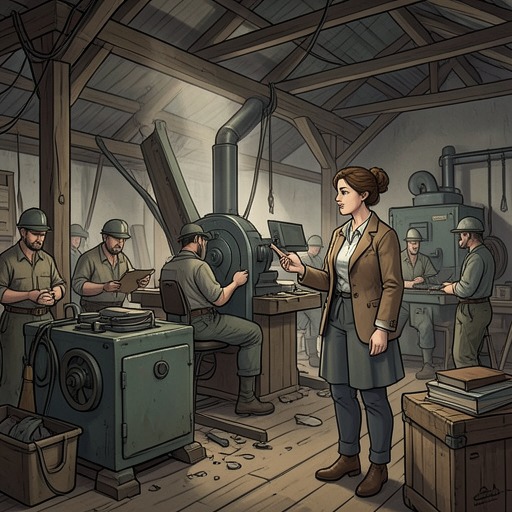
Irene–Diego political and business alliance
Gente que viene y ¡Bah!Irene and Diego’s political and business alliance is the partnership at the center of San Esteban’s contested biomass-energy project: Irene champions the plant as a route to jobs and energy independence, while Diego’s timber business is directly involved in supplying and developing it. Their cooperation promises to turn forest resources into electricity, but the project also divides the town, unsettles landowners, and exposes a gap between Irene’s public assurances and decisions made in her name. When a revised agreement reveals that pollution controls have been weakened without her consent, the alliance becomes a crisis of trust with consequences for Irene’s mayoralty and Diego’s business.
A shared project and competing promises
Irene presents the project as more than an industrial expansion. A pellet factory beside the Andrada sawmill is already operating, and a much larger electrical plant is under construction. The planned plant depends on drawing together private forests, using public woodland, and establishing short-rotation plantations harvested on a three-year cycle. Irene argues that the system could produce electricity for 50,000 people, create employment, and make the region less dependent on fossil fuels. In her account, otherwise neglected forest material would gain a new use, while the town could become a pioneer in renewable energy.
The partnership rests on an alignment between those civic promises and the Andrada timber business’s expansion. Irene supports the development through the municipal government, while Diego’s company has a commercial stake in the plant and its wood supply. The arrangement joins public planning to private enterprise, and Irene treats the business’s participation as evidence that even a traditional timber family recognizes the direction of the future. The project’s scale is visible at the sawmill: Bea sees the existing biomass factory dwarfed by the immense electrical plant under construction, amid piles of logs and a vast field where a shredder turns timber into chips.
That scale also makes the project difficult to separate from the forest it depends on. Supporters describe the feedstock as residue, brush, and organic waste that can be put to productive use; opponents, including Débora, see the plant as a threat to woodland. Their disagreement is not merely about whether biomass can be called clean energy. It concerns how much timber the project will require, who controls access to forests, and who bears the costs if the promised benefits do not materialize. Irene’s confidence that trees and energy can coexist is therefore both the alliance’s public rationale and the claim most exposed to challenge.
Forest rights and political pressure
The project’s material requirements become a direct source of conflict when a representative at the forest identifies the timber around the family’s chestnut grove as belonging to the sawmill. He points to a map and locates the group about 200 meters north of forest track seven, explaining that the wood in the surrounding area has been purchased and will be divided between the biomass factory and timber suitable for boards. Bea and her family believe the chestnuts are theirs; the representative maintains that the purchase included the right to remove the trees. The dispute makes the project’s procurement system tangible: a broad plan for forest aggregation reaches into particular parcels and collides with local understandings of ownership.
Bea calls for a public confrontation, asking Débora to bring environmental activists and the press. The family’s challenge is not simply a rejection of renewable energy; it follows a claim that the sawmill has secured the wood and extraction rights despite the family’s belief that the land’s trees remain theirs. The incident helps expose the political vulnerability of a scheme that requires cooperation among private owners, the timber business, and municipal authorities. Public support for development cannot by itself settle whether particular sales were voluntary or whether affected owners consider the process legitimate.
That vulnerability grows when a newspaper reports that two landowners were threatened with expropriation if they would not sell their trees to the biomass factory. Irene rejects the report’s account of coercion and says she would never expropriate land. Yet she acknowledges that she can become heated and has used expropriation as a way of speaking when trying to convey the project’s importance. She points to the earlier decision to divert a road rather than expropriate adjacent land as evidence of her policy. The distinction she draws between forceful rhetoric and actual policy does not erase the political damage: the report connects the town’s dispute over trees to the mayor’s authority and to the credibility of her partnership with Diego.
The alliance under scrutiny
As the reporting spreads, Diego is occupied with trying to persuade Emerge to remain involved and limit the damage to the project. When Bea encounters him at the construction site, he is markedly downcast, and he tells her that everything is connected to the plant. His cordial but distant manner contrasts with the earlier confidence surrounding the scheme. The business partnership has become precarious not only because of public opposition but because the project now depends on maintaining an investor’s confidence amid allegations and adverse publicity.
The decisive blow comes in a television interview with Irene. The presenter challenges the project’s environmental case through questions about the combustion of biomass, the fossil fuel used to transport forest material by truck, the waste left after burning, carbon-dioxide emissions, and the many thousands of hectares that might be needed to supply a plant of this size. The program also questions whether comparable plants have delivered their promised jobs or remained economically viable without heavy subsidies. Irene has answers, but the presenter’s accumulation of examples and figures makes her defense less convincing and shifts the interview from technical debate to political accountability.
The presenter then displays a copy of the revised agreement. According to the document, a four-percent reduction from the original offer is tied to cheaper boiler and filtration equipment, with pollutant emissions consequently increasing by 20 percent. Irene says the claim is false, but the agreement shows that the specifications have changed without her knowledge. The interview frames the project as serving the plant’s profit at the expense of neighbors’ health and casts Irene’s political support as part of the problem. The betrayal is especially consequential because the mayor had publicly defended the project’s environmental credentials while the deal’s revised terms undercut those assurances.
Rupture and consequences
After the interview, Irene returns home defeated and suspects that Diego has misled her. Her family initially hopes she is exaggerating the scale of the setback, but a preview on the evening news confirms that the broadcast will make the controversy national. Irene is furious that a cost-saving revision affecting emissions was made without consultation. She can understand Diego’s desire to secure a lower price, she says, but not a reduction that increases pollution or a decision taken behind her back. The account does not present this as a simple disagreement over tactics: it is a rupture over whether she can trust the business partner whose project she has made a political priority.
The timing magnifies the consequences. The television report promotes a demonstration already scheduled for the next day, bringing national media to a protest Irene had expected to attract little attention. The project that was meant to signify renewable development becomes, in the broadcast’s framing, an ecological and economic liability; the mayor who made it her flagship initiative is portrayed as aligned with a ruthless business interest. Irene fears the end of her political career, while Diego’s efforts to retain Emerge and protect his investment continue in the background. The partnership’s original promise of mutual benefit has thus become an entanglement in which political credibility, commercial survival, forest rights, and public health are judged together.
The alliance gives the novel’s energy debate its personal and institutional stakes. Irene’s case for progress is not presented as detached from the project’s costs, and the reporting does not leave her original hopes untouched: the revised emissions terms reveal that a supposedly green development can reproduce the very environmental risks its public language claims to overcome. At the same time, the land dispute and the accusations of pressure make clear that the conflict concerns who gets to define progress and who has a voice in decisions over the forest. Irene and Diego’s cooperation first gives the plant political backing and commercial reach; once their trust breaks, that same interdependence makes the project’s contradictions impossible to contain.