Jonás’s Drunken Approval Helps León and Jacobo Reconcile
Gente que viene y ¡Bah!Jonás’s drunken approval helps León and Jacobo move from a defensive argument toward reconciliation. The change unfolds not in private but in the middle of a household roused at three in the morning: Jacobo arrives in uniform, old hurt resurfaces, and Jonás—after previously insulting León—interrupts the quarrel to say that Jacobo is right for him. The family’s joking, imperfect welcome turns approval into a practical invitation: the two men are sent outside to talk, and Bea soon sees them kissing in the garden.
A Nighttime Visit and a Household Awakened
At three in the morning, persistent ringing brings Bea to the front door. Gollum’s hysterical barking, unfamiliar with callers at that hour, and the noise of the doorbell wake the rest of the household as she opens it. The late interruption promises a bad reception from her father, whose temper is known to flare when his sleep is disturbed. Instead, the visitor is Jacobo, dressed in his Guardia Civil uniform. His presence at that hour makes the visit feel urgent, although the scene does not give a separate explanation for his arrival beyond his concern about León.
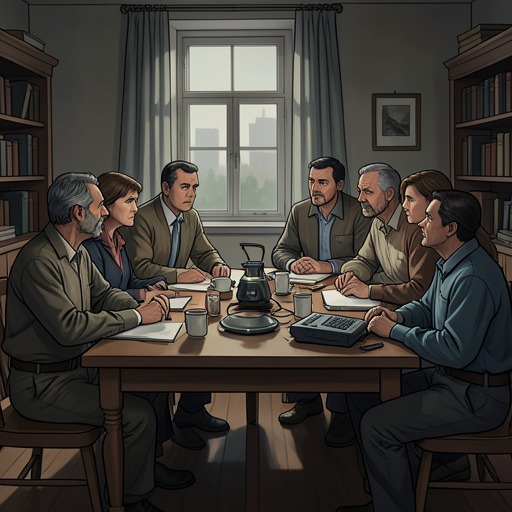
The encounter gathers the family downstairs before the conversation between the two men can remain private. That setting matters to the reconciliation: Jacobo has come to see León, but the family becomes an audience and, increasingly, a chorus. Their attention exposes what the couple’s argument is about while also giving them a route out of it. The episode’s domestic frame is comic and untidy—late-night irritation, barking, and a father who has been woken—yet the visit carries a serious purpose. Jacobo’s concern has brought him to the house; whether León will accept that concern is still in question.
From Accusation to Mutual Forgiveness
León initially treats Jacobo’s involvement as interference, pointing out that he is always getting involved in other people’s trouble. Jacobo answers that this is part of being a Guardia Civil. Their exchange keeps the conflict between them in view: León suspects that Jacobo’s actions are calculated to impress him and win forgiveness. Jacobo reverses that charge. He says that he is the one who should forgive León, for being stubborn and speaking out of turn. The argument therefore shifts from a simple demand for reconciliation to an acknowledgment that both men have grounds to feel wronged.
Jonás breaks into the dispute with a command to stop arguing and a plainly stated judgment: he thinks Jacobo is good for León. His intervention does not settle the past between them, and León immediately reminds his father that he called him a slur earlier that night. Jonás does not deny it. Instead, he distinguishes the insulting term from the respectful words León asks people to use, apologizes in a deliberately overformal manner, and repeats his support for Jacobo. The sequence holds two facts together: Jonás has hurt his son, and he is willing, in this moment, to correct himself and affirm León’s relationship. His approval is not polished, but it is explicit.
The Family Makes Room for the Couple
Jonás’s endorsement changes the temperature of the encounter without making the family’s own relationships seem effortless. He turns to Ángela and insists that their marriage works, even if it is unusual; she agrees, then tells him to stop threatening to return to the sea. Her response answers his joke with equal familiarity. From that exchange, the scene pivots back to León and Jacobo: Ángela suggests that they go to the garden or León’s room and talk. The parents’ own affectionate banter is not presented as a perfect model, but it helps establish the family’s capacity to accommodate an imperfect relationship rather than demand that it look conventional.
León protests that his family is being tiresome, while Jacobo admits that, since he is already there, the suggestion does not seem so bad; he says he has missed León. Jonás then pushes them to stop standing around and go. León takes Jacobo to the garden reluctantly, but sets a boundary on where they should talk: not León’s room, because Jacobo is on duty and might get carried away in his uniform. The remark keeps the scene playful while acknowledging the immediate constraint of Jacobo’s work. Their move outside is therefore not a dramatic escape from the family so much as a small, permitted space in which they can speak without the household gathered around them.
A Visible Reconciliation
The final image completes the movement the argument began. Ángela asks whether Jonás is snoring and wonders if she has made decaffeinated coffee, having mixed up the Nespresso capsules; Bea identifies the red capsule as extra-decaffeinated. Ángela then looks fondly at her sleeping husband and asks, with hopeful interest, how León and Jacobo are getting on. Bea points toward the garden, where the two men are kissing at length. The long kiss is the clearest evidence that the argument has given way, at least for the moment, to renewed intimacy.
Ángela is pleased, and also relieved that Jonás has fallen asleep before witnessing the kiss. Bea points out that he has already given them his blessing, making the joke affectionate rather than a withdrawal of support. Jonás’s approval has been delivered while he was awake, even if tiredness and drunkenness shape the way he expressed it. The episode thus closes on both reconciliation and family recognition: Jacobo came to check on León, León challenged his motives and recalled his father’s insult, and Jonás nevertheless made his acceptance unmistakable. The garden kiss does not erase the earlier hurt, but it turns the family’s noisy intervention into a passage back toward the couple’s closeness.