Microtopía: A Micro-Utopia
Gente que viene y ¡Bah!Microtopía: A Micro-Utopia is the movement for creating small spaces at a human scale rather than building on a grand scale and wasting space. Bea uses the idea to explain the purpose of her treehouse design, a compact refuge shaped around a living chestnut tree. When Ingrid dismisses the model as a toy, the concept becomes more than a design preference: it gives Bea language for defending a different, equally valid vision of architecture and for returning to work that excites her.
Definition and Design
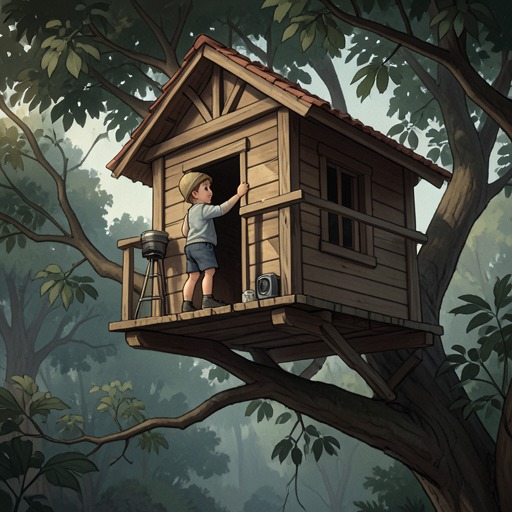
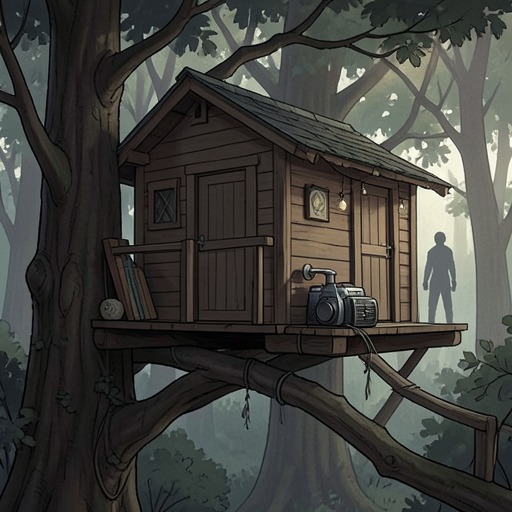
In Bea’s explanation, microtopia means making spaces that are small and proportionate to human needs, instead of constructing expansively for its own sake. Her student model gives that principle a specific form: a wooden house made of oak, built on a chestnut, with twenty square metres carefully used. Its small size is not presented as a deficiency to overcome. The design accommodates a bed, a table, and even a shower, while a skylight and a broad lookout open the compact interior to its surroundings.
The house is imagined as shelter from the world, set apart among the tree’s leaves and branches. Its setting changes with the seasons: red leaves in autumn, green ones in spring, and bare branches in winter. The chestnut also bears large nuts. Rather than treating the tree as an obstacle to a building, the design makes the living tree and its changing environment central to the experience of the space.
A low structure extends the house into a terrace, where someone could take the spring sun or dance in autumn rain. The model thus combines practical accommodation with room for leisure and contact with the weather. Its promise of a new perspective comes from its placement among the branches, not from height or scale alone. The compact dimensions, ordinary furnishings, lookout, skylight, and terrace together demonstrate Bea’s idea that limited space can still be hospitable and carefully considered.
The Model as a Recovered Ambition
The design returns to Bea when she searches the attic for work that might represent her better than the project she had considered showing Ingrid. She finds three old, somewhat crushed and worn models. Two seem almost as bad to her as her final-degree project; the third, the treehouse, still has the qualities she wants to claim as her own. Its rediscovery shifts the question from whether she can meet someone else’s professional expectations to what originally drew her to architecture.
Bea recognizes in the model the beginning of her desire to design buildings. She remembers how much she enjoyed making it and how often she imagined building it for real. That memory stands against the way daily work had distanced her from the wish to make things that moved or delighted her, and from the hope of making the world—or a small place within it—more beautiful. Microtopia is therefore tied to a personal recovery: the modest building lets her identify an architectural aspiration that had been obscured by dissatisfaction with her more recent work.
Conflict over What Counts as Serious Architecture
When Bea presents the model to Ingrid, the movement supplies a rationale for the design, but it does not persuade her. Ingrid interrupts the explanation and treats the house as childish, insisting that architecture is serious and not for girls. Bea leaves humiliated and angry, including with herself for failing to defend either the model or her understanding of architecture in the moment.
Her subsequent response makes the disagreement explicit. She admires many of Ingrid’s buildings and projects, but does not accept that their scale or style should define the limits of legitimate architecture. In Bea’s view, the profession does not need to consist only of enormous projects, hundred-storey buildings, or imposing museums. She also challenges the gendered implication that a woman architect must make work as massive and phallic as a man’s to be taken seriously. The treehouse, she insists in her own reasoning, is solid without being either feminine or childish; even those qualities would not make it worthless.
From Microtopia to a Building Project
Bea’s answer to dismissal is not simply to preserve the model as a private reminder. She decides to build the house, improving on the original design, and announces that intention to her family when she gets home. She does not expect architectural prizes to be the necessary measure of success. What matters is demonstrating that another way of designing is possible and as valid as the dominant alternatives.
The project consequently gives the idea of microtopia a practical and professional stake. A model discovered among old toys and clothes becomes the basis for a proposed real building; the small, human-scaled design becomes Bea’s way of asserting that architecture can be more intimate and more responsive to its setting. Its significance lies not in a claim that every building should be small, but in Bea’s insistence that there is no single correct way to build. The treehouse makes that pluralism concrete: it offers shelter, everyday amenities, seasonal views, and a terrace within a limited space, while allowing Bea to reconnect architectural practice with pleasure and purpose.