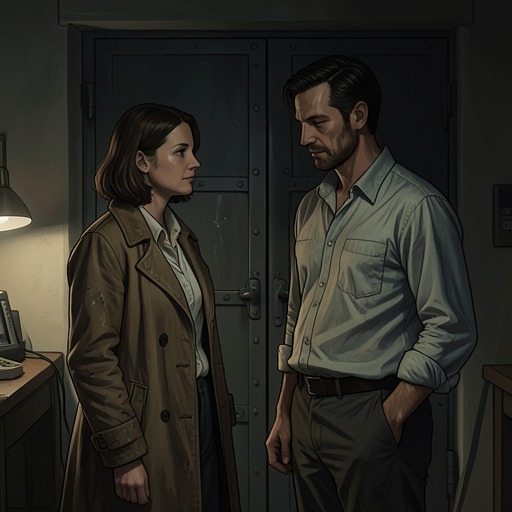
Pacheco Uses Román’s Help to Launch a Media Attack on Irene
Gente que viene y ¡Bah!Pacheco Uses Román’s Help to Launch a Media Attack on Irene is a developing campaign in which a dispute over the San Esteban Biomass Plant becomes a struggle over who can define the project—and Irene’s conduct as mayor—to the public. Román, her former husband, supplies Pacheco with information as he pursues his stated aim of driving her from the town government. Pacheco’s reporting moves from allegations about land expropriation to a promised story about Bea and the Guardia Civil, while later television scrutiny deepens the political crisis around the plant.
The plant and the divided town
The controversy takes shape against the town’s division over the biomass factory beside the Andrada family sawmill. Irene supports the project through the municipal government, although she says she is not personally involved in the factory. She presents it as a source of clean, inexpensive energy, employment, and a use for otherwise unwanted forest timber. At this stage, the plant produces pellets for heating boilers, while the project’s supporters anticipate further development.
Irene’s defense is also a response to personal attacks. She says that people have painted insults against her and accused her of betraying Cantabria because, as a left-wing woman, she is expected to defend every tree. She argues that forest protection and green energy need not be opposites: the project, in her view, could generate electricity for 50,000 people, reduce dependence on fossil fuels, and make Spain more self-sufficient. She dismisses some local opposition as resistance to progress, even as she insists that both trees and energy can be protected. This confident framing becomes politically vulnerable when critics recast the factory as a threat to forests and residents rather than a route to jobs and energy independence.
Román’s information and Pacheco’s first report
Román’s threat to go after Irene soon takes a public form. After leaving Ingrid’s studio, Bea is approached by Pacheco, who asks for her account of a recent encounter with the Guardia Civil. He has already published a story in El Diario Montañés and shows Bea the article. It alleges that Irene threatened two landowners with expropriation if they would not agree to sell their trees to the biomass factory.
Pacheco makes the source of his campaign explicit: Irene, he says, has an enemy inside her own home, and her former husband is providing him with information. He describes the article as only the beginning and promises a second story in which Bea will be one of the central figures. His approach thus links a political attack on Irene to the family’s earlier conflict over the chestnut trees. The reporting does not merely challenge the mayor’s public case for the plant; it threatens to make her sister’s experience part of the same controversy.
The threatened story and the family’s response
Pacheco says he knows about the chestnut trees, Bea’s treehouse, and the Guardia Civil’s intervention when the family tried to stop the factory workers from destroying the structure. He presents the arrests as evidence of an excessive response and alleges that Irene tried to cover up the incident by coercing the Guardia Civil. Bea disputes his account, saying the events did not happen as he describes and denying that Irene coerced anyone. Pacheco refuses to wait for Irene’s explanation, treating that offer as an attempt to buy him off and insisting that his reporting cannot be stopped.
The threat quickly enters the household. Irene gathers the family, including Jacobo, while holding the newspaper open to its report about the alleged expropriation threat. That published allegation already damages her political interests; Bea’s account of Pacheco’s planned follow-up makes the stakes more immediate, because he claims to have sources within the Guardia Civil and photographs of the chestnut-grove confrontation. Irene turns to Jacobo, asking who has spoken after he had assured her that his colleagues would remain silent. León’s opposition to Jacobo’s presence, and the silence between the two men, expose a separate strain within the gathering, but no one pursues it: Irene’s political emergency has taken precedence.
From newspaper allegations to televised scrutiny
The attack expands beyond Pacheco’s articles. In a later television interview, the presenter initially approaches Irene through flattery, then subjects her to a sustained challenge once the cameras are recording. The program questions whether biomass energy is truly clean, raising the fuel consumed in transporting forest material, the disposal of combustion residue, carbon emissions, and the scale of woodland needed to supply a power plant. It also cites examples of plants that closed, the reliance of biomass energy on subsidies, and promised employment that allegedly fell far short of delivery. These are arguments deployed against Irene in the interview; the scene shows her attempting to answer, while the presenter overwhelms her with figures and questions.
The questioning then shifts from the plant’s environmental and economic claims to the political arrangements behind it. The presenter asks what concessions or deals were required to assemble the project’s support. When Irene says the accusation is false, the presenter shows her a copy of an agreement that modifies the plant’s parameters—an alteration Irene says she did not know about. The presenter frames the document as evidence that the plant seeks profit at the expense of neighbors’ health and that Irene’s government has made the project its political banner. Caught off guard, Irene angrily denies the accusation, a response that leaves her less able to defend herself in the interview.
Bea’s recognition of the media struggle
At the demonstration, Bea finds herself pursued by reporters and cameras while the television presenter covers the protest. Bea sees the encounter as part of a wider chain of consequences: in her view, the controversy threatens Irene’s mayoralty and Diego’s fortune, while the press has made her own private life a public spectacle. She also recognizes that news can be redirected by changing its frame. Instead of trying to escape the cameras, Bea decides to call out Rebeca Ramos, hoping the celebrity press following her will turn attention away from the demonstration and toward a more sensational story. The moment sharpens the campaign’s central conflict: the biomass project is contested not only through competing claims about energy, forests, and public health, but through the power of journalists and those they cover to determine which account commands attention.