San Esteban Sawmill
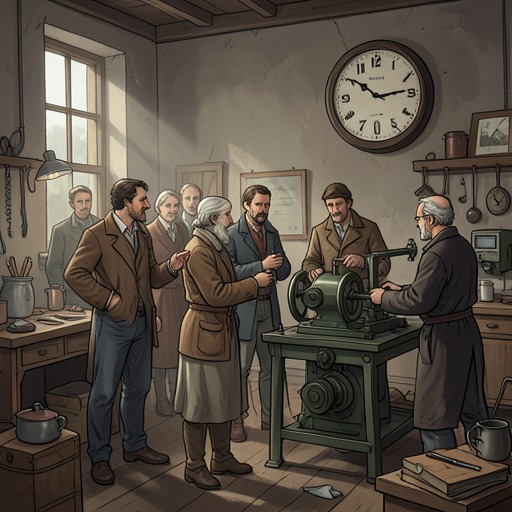
Gente que viene y ¡Bah!San Esteban Sawmill is a timber yard on the outskirts of San Esteban whose growth makes the village’s contested development visible in wood, machinery, and expanding industrial buildings. For Bea, it is both a place of fascination and the source of inexpensive lumber for her treehouse; later, the sawmill becomes the point of confrontation over the removal of her family’s chestnut trees. Its ordinary commercial role is inseparable from the larger dispute over who owns the forest and who has the right to decide its use.
Setting and Physical Character
Bea sees how dramatically the outskirts have changed when Débora drives her to the sawmill. The sawmill stands within a wide, open yard, but it is dwarfed by the enormous biomass factory nearby. An even larger facility is under construction beside it, making the scale of the industrial expansion seem startling in a village setting. The three structures share an immense clearing where logs are piled and a huge crusher spits out heaps of chipped wood. Bea imagines climbing and sinking into the mounds of chips; the smell of wood, sawdust, and even the vapor from the biomass factory draws her attention as strongly as the buildings do.
That sensory response reflects a long-standing familiarity rather than a passing curiosity. Bea has taught herself to distinguish kinds of wood encountered in architecture and interiors, and she thinks of different species as suited to particular spaces and even moods. American beech, red pine, untreated oak, and yew are among the varieties she admires. A visit to a sawmill feels to her like an amusement park visit might feel to someone else. The crowded yard, with hundreds of stacked logs and plentiful pine and eucalyptus, also revives a childhood memory: when her father came there to get materials for a shed in the vegetable garden, Bea, then no older than nine, insisted on coming along.
Timber, Work, and Bea’s Visit
Bea returns as an adult because she needs red-pine planks for her treehouse and has little money to spend. She persuades Débora to accompany her, partly by appealing to her sister’s bargaining skills. At the customer-service area, a heavily made-up woman receives them, and Bea takes out a paper covered with her measurements and notes. The visit brings her specialist interest into the practical world of prices, orders, and available stock.
The yard also introduces Bea to Diego Ariza, whom she recognizes as the man from the pink Mercedes. He explains that the fir logs they have been discussing were brought from Álava for a customer’s order. When the receptionist identifies the wood as fir, Bea confirms the identification, to Débora’s evident pride. Diego teases Bea about her earlier, drunken enthusiasm for wood, recalling her talk of climbing onto a pallet or rolling on the ground. Her embarrassment makes the encounter personal, but it also establishes the sawmill as a place where Bea’s architectural knowledge and Diego’s timber business meet.
The Biomass Dispute
The industrial complex provokes sharply different reactions. Débora curses the biomass factory, arguing that its supply depends on stripping the forests. Bea answers that it uses mainly leftover wood, brush, and other organic matter, and presents forest clearance as a way of giving neglected woodland a new use. She also anticipates the conversion to an electricity-generating plant. Débora rejects this defense, points to solar and wind power and the reservoirs traditionally used to produce electricity in the area, and accuses Bea of having adopted Irene’s arguments. Their exchange makes clear that the factory is not a neutral backdrop to Bea’s timber purchase: it is already a source of local disagreement.
The sawmill’s role becomes more contentious when workers begin removing trees from land Bea regards as her family’s chestnut grove. A man produces a forest map and locates the group about two hundred metres north of forest track seven. He says the surrounding timber belongs to the sawmill because it has been bought from the owners, and that it will be divided between the biomass factory and lumber production. Bea insists that the land is her family’s and rejects the claim that the timber may simply be taken. The dispute is thus not only about the purpose of the wood but about the difference between family attachment to the grove and the purchasers’ asserted rights to harvest timber.
Confrontation and Local Stakes
Bea threatens to bring the conflict into public view. She tells Débora to contact the environmental association whose members chain themselves to trees and to bring the press. Débora hesitates, but Bea leaves for the sawmill in a fury, blaming Diego for ordering the destruction of her treehouse and trees after she would not build his daughter’s first. At reception she demands to see him. When he appears, she accuses him of sending workers to clear her chestnuts; Diego says he has no idea what she is talking about. Her accusation and his denial leave the conflict unresolved at the point shown, while making the sawmill’s commercial authority central to the confrontation.
The sawmill’s offices also connect timber purchases to the choices offered to landowners. Irene argues to Arturo and two other men that they would all benefit: the sawmill is paying well for their timber and offering to buy their parcel for short-rotation forest crops. She suggests that the municipality could instead expropriate the land and make it public, but warns that the council would not pay as much as the Andrada family. The alternatives place private sale, municipal control, and industrial forestry in direct competition. Through these linked scenes, San Esteban Sawmill becomes more than a supplier of planks: it is the material and political centre of a struggle over forest use, ownership, and the village’s changing landscape.