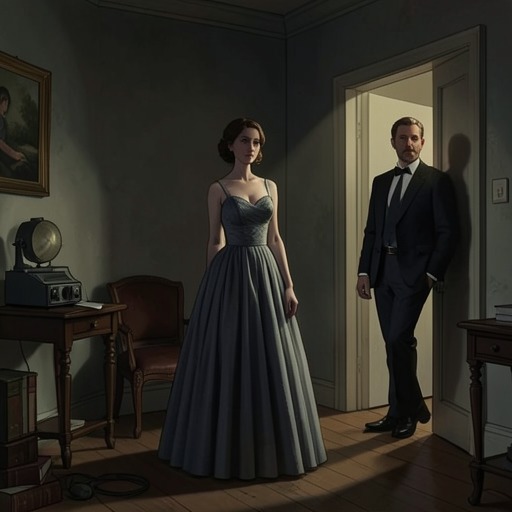
Teodoro Visits Débora to Claim His Place as the Father
Gente que viene y ¡Bah!Teodoro Visits Débora to Claim His Place as the Father is a doorstep confrontation in which Teodoro García tries to turn a past paid encounter with Débora into a claim of possible fatherhood. He arrives carrying yellow roses and says he is willing to accept responsibility for her son; Débora denies that the child is his, refuses to let him see the boy, and threatens to seek a restraining order. The scene makes his wish to take responsibility collide with her insistence that he has no place in her family, without resolving whether his paternity claim is true.
The Unexpected Visitor
The visit begins with a knock at the main door. Bea’s father, nearest the entrance, goes to answer it, accompanied by Gollum, the family’s three-legged dog. The contrast is immediate: the dog greets the visitor with frantic barking and tail-wagging, while the household is otherwise described as having little reason for cheer. Bea’s father returns puzzled, reporting that a dwarf with flowers is asking for Débora. The unexpected appearance turns private family tension into a spectacle at the threshold.
Débora’s face changes color as the news sinks in. She insists that the visitor must have made a mistake, then looks accusingly toward Bea before checking their mother’s reaction. Bea denies responsibility with a gesture; their mother gets up to look outside, and Bea and León follow. The rapid, silent exchange shows that the visitor’s arrival is connected to knowledge shared within the family, even as Débora is unwilling to acknowledge it in front of them. Her father, by contrast, does not understand the looks passing among the others.
The visitor is dressed in jeans and a blazer, carrying a large bunch of yellow roses. Bea observes that clothing changes how she recognizes him: dressed, and without the thong associated with their earlier encounter, he looks markedly different from the man she would have failed to recognize on the street. The detail connects the formal, flower-bearing caller at the door to the past sexual encounter at the center of the dispute. Gollum sniffs and tries to reach the roses, forcing Teodoro to raise them out of the dog’s reach. León comments that the flowers are a nice gesture, but their courtesy cannot undo the awkwardness of the visit.
From Denial to a Claim of Paternity
Débora eventually goes outside to speak to Teodoro, warning their mother that they will discuss the matter later and blaming her for arranging it. Bea watches from an upstairs window after the pair have moved only a short distance away. That vantage point shapes the scene: the family’s initial reaction is visible collectively, but the central exchange is overheard from a remove, as though the private confrontation has become an involuntary performance for the people inside.
Débora begins by saying that whatever her mother told him, the visit is based on a misunderstanding. Teodoro counters that, if the boy is his, he is prepared to accept his share of responsibility. His phrasing leaves paternity conditional rather than proven, but Débora rejects the possibility outright and challenges him to explain how the child could be his when she does not even know his name. He identifies himself as Teodoro García. The name gives the visitor an identity, but does not settle the question he has come to raise.
The argument reaches back to their earlier encounter. Débora says she should not have to pay three hundred euros to sleep with a dwarf, but Teodoro points out that she did pay him and claims that she now has a child carrying his genes. He has come to recast an encounter she regards as something that harmed her life as the beginning of a parental obligation. Débora, in turn, invokes the possibility of reporting him for not using a condom and for prostitution, and asks how he can bring this trouble to her home. The exchange establishes the circumstances behind his claim while preserving the sharp difference in how each of them describes what happened.
Responsibility Refused
Teodoro asks what the boy is called. Débora does not answer with a name; instead, she repeats that he is not Teodoro’s son and tells him to forget the matter and leave. Teodoro says he can request a paternity test, arguing that women are not the only ones entitled to ask for one. Débora responds that her son belongs to her alone and insists that Teodoro will get nothing by coming to the house. His stated aim is not to obtain something from her but to take responsibility. The disagreement is therefore not simply over whether he wants access or advantage: it is over whether his assertion gives him any standing in the child’s life.
When Débora turns to go back inside, she discovers that the door is shut and she has no keys, leaving her to ring the bell. Teodoro asks if he may at least see the child; she refuses. He then says that the roses are for her. Their gift remains an offered gesture, not an accepted reconciliation: Débora keeps both the child and the house beyond his reach.
The confrontation ends without a test, an introduction, or any agreement about future contact. Teodoro says he will not give up, and Débora threatens to seek a restraining order and orders him to leave. Bea’s father eventually opens the door from inside, prompting Débora to protest about how long he took. The closing movement returns the scene to the household and its uneasy spectators. Teodoro’s effort to establish himself as a responsible father has been made explicit, but Débora’s refusal is equally explicit, and the question of paternity remains unresolved.