The Family Reads Ángela’s Notes Together
Gente que viene y ¡Bah!The Family Reads Ángela’s Notes Together is the family’s first shared encounter with the private instructions Ángela wrote before her death. In a red Hello Kitty notebook, she had left messages for her loved ones, transforming an object Bea initially believed was meant for her alone into a guide for the whole family. As the notes reveal what Ángela knew and what she understood about each of them, grief becomes a setting for disclosure, reconciliation, and decisions about the future.
The Notebook and the Gathering
Ángela had been writing when she died. León and Bea’s father found her unconscious on the kitchen table and called an ambulance, but there was nothing more to be done. Bea was relieved not to have been there, unable to imagine herself coping with finding her mother already dead. After the funeral, cremation, condolences, and embraces, she withdrew to her old bedroom with the notebook. She had returned home during the spring, when Ángela had been closely concerned with her troubles; in the shock of bereavement, those former troubles seemed small beside the loss. Bea also recognized the painful irony that her breakup with Víctor and his public relationship with the girl on the news had brought her home and given her those months with her mother.
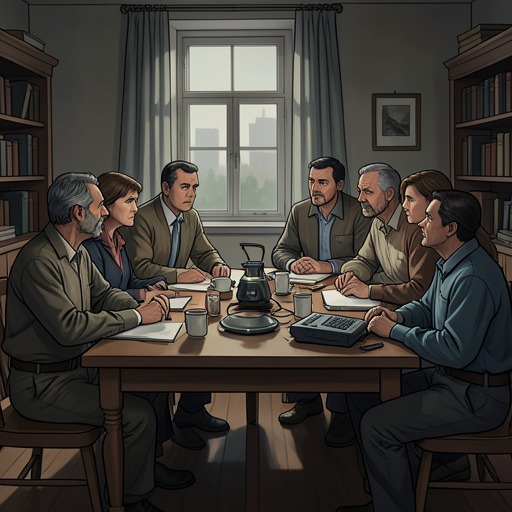
Before opening the notebook, Bea hugged it. The red cover and its Hello Kitty design made it an intimate keepsake, but its contents altered its meaning: Ángela had written Bea’s name on the cover, yet the notes were for the family. Bea spent about half an hour alone with it, then called everyone into the living room. Bea’s father, Débora, Irene, León, Fin, Jacobo, and Teo, holding a child, settled on the sofa and chairs. Bea explained that Ángela had regarded the pages as a kind of instruction book for the time when she would no longer be there. The act of reading aloud made the notebook communal: each message was addressed to one person, but its meaning was received by the gathered family.
What Ángela Had Known
The first major revelation was that Ángela had known she was dying. Her family had not understood the extent of her condition. Bea’s father had sometimes noticed that Ángela seemed more tired or worried that she was losing her empathy, but none of them knew she had undergone tests. The notebook disclosed that, months earlier, she had learned her heart would not hold out much longer. She had not told them because she hoped that keeping the knowledge unspoken might keep it from coming true; she also did not know how much time remained.
Bea’s father described Ángela as someone who absorbed everyone else’s worry and pain while keeping her own hidden. He framed her heart’s failure in terms of that lifelong burden. The family had to sit with the force of his account, not because they rejected it, but because grief had stripped away the usual reserve and made such open speech possible. The notes thus reveal both a concealed fact about Ángela’s final months and a pattern her family recognizes in the way she cared for them.
Notes for Débora, Fin, and Irene
Ángela’s message to Débora confirmed that she had inherited her mother’s empathic gift. Ángela did not demand that Débora continue her consultation or take up the same work. She accepted that Débora might have found her vocation in photography, praising a photograph of Teo and the child as beautiful and presenting art as another way of empathizing with others and channeling pain. The consultation would be available to Débora if she ever wanted it, but the choice of how to live remained hers. When Irene asked whether the gift was real, Débora eventually acknowledged that it was.
Fin’s note, in contrast, offered a deliberately brisk instruction to stop dwelling on death and live. In the room, the words initially felt almost impossible to accept: Ángela’s death had left the family feeling emptied and bereft. Teo helped them understand the note by explaining the concrete fear beneath Fin’s abstract anxiety about dying. Fin wanted to keep racing, improve, and compete at the highest level. Doing so required training in Bélgica, where the best team was based, and he would need to move abroad with a parent while still a minor. His father had never supported his racing, while Irene’s commitment to the mayoralty had previously made such a move impossible. Unable to blame anyone for the obstacle, Fin had withdrawn and recast his fear of losing the life he wanted as a more general fear of death.
Irene then announced that she and Fin would try their luck in Bélgica in a month. She had already begun studying Dutch and expected to use English while seeking work as a lawyer. Ángela’s note to Irene made the decision legible as more than a change of country: it urged her to listen to her son, describing him as a champion on his motorcycle and a thoughtful, intelligent adolescent who still needed her more than she realized. The family’s understanding of Fin’s distress therefore leads directly to a change in Irene’s plans.
Bea’s Note and the Family’s Response
The note for Bea addressed the sisters’ relationship. Ángela believed that Bea and her sisters would make peace with one another without being instructed to do so, and suggested that her death might already have brought about that reconciliation. She compared death to the deus ex machina of Golden Age theatre, the sudden arrival that resolves the action. León supplied the theatrical term; Ángela’s note then turned the idea into a reflection on bereavement, arguing that death can make other problems seem ridiculous. The three sisters looked at one another and needed no words to acknowledge the truth they found in it.
Their response did not erase the loss. Jacobo wept openly, while Bea’s father tried to tease León about crying and could not finish without tears of his own. That exchange prompted the first laugh of the day. The shift from shared crying to laughter was small but decisive: Ángela’s absence remained, yet the family could still recognize one another, tease, and respond together. The notebook does not replace its writer; it allows her understanding of the family to keep shaping the way they meet one another.
The Ashes and the Continuing Bond
Ángela’s notebook also specified where she wanted her ashes scattered: at the cliff where Irene had arranged for the Romanesque Chapel to be moved. It was one of Ángela’s favorite places, although she had joked that Irene’s chapel project had turned it into a place of pilgrimage. She imagined that her choir friends, the priest, and her patients might interpret the scattering as evidence that she had finally entered the fold and would pray for her; she was willing to let them believe it, reasoning that a mass or two would do her no harm.
The family went to the cliff two days later. They had intended to keep the ceremony private, but many people heard about it and wanted to accompany them. They did not turn anyone away: Ángela would have liked the company, and in those days the family also needed the warmth of other people. In October the sky was clear and the sea calm. Bea had feared that a northerly wind might blow the ashes back over them, but the wind did not interfere. The ashes fell into the sea and disappeared among the waves. The final act carries the notebook’s movement from private writing to shared life into a public farewell: the family follows Ángela’s instructions, gathers around her chosen place, and continues to hold her through memory and ritual.