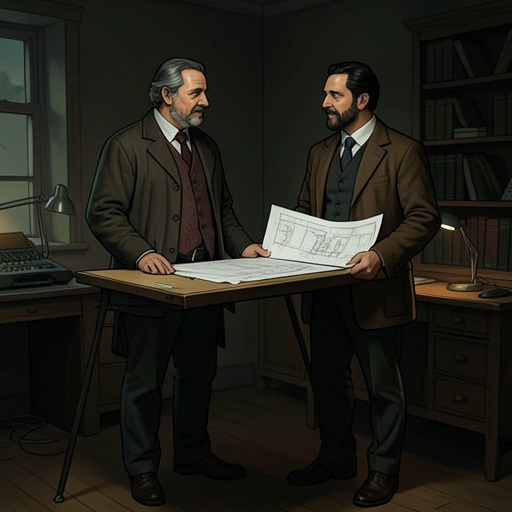
Víctor Returns to Win Bea Back, and They Reunite for a Night
Gente que viene y ¡Bah!Víctor Returns to Win Bea Back, and They Reunite for a Night marks a sharp division between physical reunion and emotional reconciliation. Víctor arrives at Bea’s family home seeking forgiveness and another chance; later, Bea goes to his hotel room and kisses him. Their night together briefly revives their former intimacy, but it does not repair the breach between them: by morning, Bea questions why he came, admits she may no longer love him, and leaves.
The Unexpected Return
At eight in the evening, the doorbell rings at Bea’s family home. Her father, Jonás, answers and is so surprised by the visitor that he nearly freezes. It is Víctor, who greets him as an old acquaintance. Bea is in the sitting room eating her favorite low-fat yogurt with pieces of peach. Hearing Víctor’s name, she nearly spills it, sets it aside, and rushes to check herself in the mirror. She is in pajamas she does not consider her best; Ángela and Débora, sitting on the sofa, watch her hurry toward the entrance without knowing what to say.
The familiar man at the door is carefully put together: Víctor wears his best jeans and the black leather motorcycle jacket Bea gave him for their second anniversary. Bea notices how well it suits him and how handsome he looks, even as she asks what he is doing there. The jacket makes the encounter more than an unexpected visit. It is a gift from their shared past, now worn as he asks to be admitted back into her life.
An Apology and a Request
As they speak, Bea drinks orujo. She jokes that she needs to numb herself so she will not get up and hit him, then accepts the glass when Víctor passes it to her. She understands his visit as an attempt to tell her that he misses her and to ask for forgiveness. But she refuses to treat those declarations as sufficient. The drink, she explains, is mild beside what she felt watching him appear on television beside another woman and publicly call her the woman of his life. His polished clothes, familiar jacket, smile, and explanations cannot erase the hurt caused by those broadcasts.
Víctor says that coming in person was the only way he could think of to speak honestly and accept her anger. Asked what he feels, he tells Bea that he loves her. She experiences the declaration with repulsion rather than relief. He says he had to make a mess of things, lose her, and expose his narcissism publicly before recognizing that she is what matters most to him and that he is at his best when he is with her. His confession frames the visit as a belated recognition, but it cannot dictate how Bea receives it.
When his phone rings again, Víctor looks at the screen and turns it off. He describes the call as work and says it can wait: Bea matters more. He does not claim she should forgive him that evening or return with him to Madrid the next day. Instead, he asks her not to close the door forever and to consider giving him another chance when the hurt has eased, whether in a week, a month, or two. Bea answers no, though without the force she thinks the refusal deserves. He asks her not to say no, leaving the conversation suspended between her resistance and his insistence.
The Night at Room 414
Later, Bea reaches the hotel room where Víctor is staying. The journey has left her breathless, and she has only one shoe: she has climbed the remaining two flights carrying the other, after calling at room 414 until Víctor finally opens the door. He is in his underwear, as he usually sleeps, and looks drowsy. He asks why she is there, why she is sweating, and where her other shoe is. Bea says it is a long story and that getting there took a great deal of effort. Rather than explain, she throws herself into his arms and kisses him.
That action reverses the direction of the earlier encounter. At home, Víctor came to Bea and asked for a chance; at the hotel, Bea crosses the distance herself, despite the anger and refusal she had voiced. The kiss produces a night together, but the scene does not establish that she has accepted his proposal to resume their relationship. In the morning, their intimacy is real, while its meaning remains contested.
The Morning After
When Bea wakes, sunlight and unfamiliar, elaborately patterned curtains disorient her. She recognizes the room and the person sleeping beside her. Víctor speaks warmly of the previous night and of the two of them as a strong team, listing how well they fit together in drinking, sex, living together, and working. He even points out that their wedding is only a week away and suggests they could still keep the date. Bea’s startled response makes clear that the wedding he imagines is not a decision she has made.
Bea says she had come the previous day intending to talk. Víctor counters that, amid bottles of whisky and gin, they talked about their future and their compatibility. The difference is consequential: he treats the night as evidence of a continuing partnership, whereas she is still trying to understand what his return meant. She connects his talk of teamwork to his new architecture studio. Because he had asked for her advice on a problem involving pipes, she suspects he wants her beside him as an architect and partner, perhaps more for professional usefulness than for love. She even raises the possibility that he might keep a girlfriend while making Bea his lover. These are Bea’s suspicions, not confirmed facts; Víctor rejects her reading and says she has always been distrustful.
The encounter therefore ends not with a renewed engagement but with a boundary. Bea studies Víctor with detached, almost scientific interest and tells him she no longer knows whether she loves him. She says she is leaving. Víctor gets up, embraces her, and says he will wait for her, but Bea does not answer. She opens the hotel-room door and goes, limping because she has only one shoe. Her awkward exit leaves the reunion’s physical closeness intact as an event, but denies it the status of a settled return to their former life.
Significance and Outcome
The sequence turns on the gap between a declaration and the proof Bea would need to trust it. Víctor’s apology, his decision to silence his phone, and his request that she take time all suggest that he wants to repair the relationship. Yet Bea measures those gestures against the public humiliation of seeing him celebrate another woman on television, and against the uncertainty of why he is now invoking their professional and personal compatibility. Her suspicion is not resolved by the night together; intimacy instead brings the question of motive into sharper focus.
The event’s central reversal is that the kiss does not deliver the reconciliation either character might have hoped for. Víctor reads their shared night as confirmation that their partnership still works, even imagining the wedding going ahead. Bea leaves without agreeing, uncertain of her own love and unconvinced that his reasons are purely romantic. The lost shoe gives the departure a concrete, unsettled finish: she has crossed the distance to him, but she still walks away.