Ángela
Gente que viene y ¡Bah!Ángela is Bea, Irene, and Débora’s mother, a village fixture whose unusual capacity to feel other people’s pain gives her both a public role as an informal diagnostician and a complicated place within her own family. Her gift is not presented as healing or magic in the conventional sense: she identifies suffering and directs people toward medical specialists, while the emotional and physical cost of feeling what others feel limits what she can give at home. That tension—between care for the village and care for her daughters—runs through her characterization, as do the private fears and old choices she gradually brings into view.
Identity and Everyday Presence
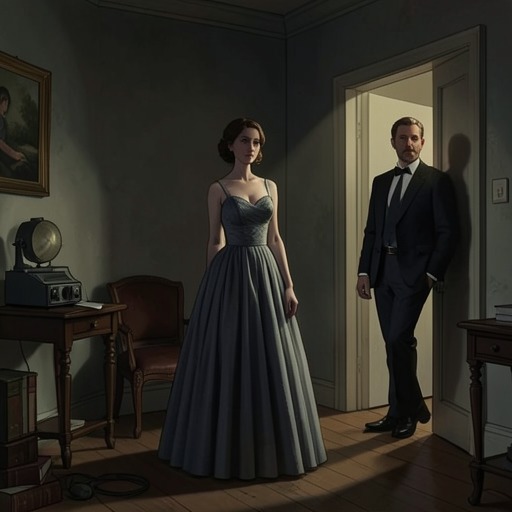
Ángela appears in the family’s domestic scenes as a familiar, practical presence. When Bea is preparing to go away for a weekend, Ángela comes out of the bathroom in curlers and a sky-blue dressing gown so old that Bea says it has been around longer than she has. She points out the size of Bea’s suitcase, and Bea’s claim that it is not especially large is immediately dismissed by Irene as a lie. The small exchange places Ángela within the household’s affectionate teasing: her concern is ordinary, and the children’s familiarity with her is expressed as readily through jokes as through serious disclosures.
That domestic image sits beside her considerable standing beyond the home. People come to the house in large numbers for her help, and she has become widely known across Cantabria. Her informal consultations do not bring her money. She accepts food instead, a practical arrangement that also compensates for her poor cooking. The resulting pots circulate through family life: she marks each one with its owner’s name and address in permanent marker, and Bea spent much of her childhood and adolescence cycling around the village to return them. The task made Bea known to people throughout the community, while also showing how Ángela’s public service became an everyday responsibility shared by her family.
The Gift and Its Costs
Ángela’s ability is described as an unusually precise empathy. By touching someone’s hands, or another part of the body, she can feel the pain that person is experiencing and identify symptoms accurately. Over time she has developed the ability through study; her diagnoses range from a stomach tumor and chronic depression to an anxiety crisis, tuberculosis obscured by respiratory-allergy symptoms, and kidney stones. Yet she does not claim to cure anyone. She tells people what symptoms she detects and which kind of specialist they should consult, keeping her work within that limited, practical role.
The same bodily closeness that makes the gift useful also depletes her. Feeling another person’s pain leaves her exhausted, and she gives so much attention to patients and other people that little time remains for herself or for the demands of parenting. Irene often fills the space Ángela’s attention to the village leaves open. The gift therefore has consequences beyond the consultations: it rearranges family labor, and the daughters grow up with a mother who is compassionate but not always available in the conventional, attentive way.
Her judgment is also less reliable when the person suffering is one of her children. Ángela does not lose the gift with them, but she exaggerates their symptoms, turning a minor cold in her imagination into the beginning of pneumonia. Bea resists Ángela placing a hand on her back because she fears that her own pain and anger will be magnified into something more alarming. When Ángela does assess her, she tells Bea that she is in a bad way; Bea insists that the problem is only a strain from carrying the heavy suitcase. The contrast between Ángela’s broad diagnostic accuracy and her tendency to overstate her daughters’ ailments makes her gift intimate as well as burdensome.
That tendency has, however, had a consequential result. One of Ángela’s exaggerated warnings led to Irene’s ovarian tumor being detected in time. The episode complicates the family’s frustration: Ángela’s alarm can make ordinary problems feel catastrophic, but in Irene’s case it also helped bring a serious condition to attention before it was too late.
Family, Secrets, and Fear
Ángela’s role in the family includes more than day-to-day care. When her daughters react with alarm to a confession, she explains that their father had to break with his entire family because of her. She accepts that responsibility was shared but says she was more to blame, then reaches into a cupboard for a bottle of herbal orujo before continuing. The gesture gives the disclosure a tangible pause: she recognizes that what she is about to tell them is difficult, and the daughters’ response makes clear that the revelation unsettles their understanding of their family history. The evidence here establishes the rupture and Ángela’s own account of shared blame, without resolving every detail of what happened.
The family also experiences her as physically vulnerable, despite the authority of her gift. When Ángela does not answer from the bathroom, Irene calls for her in a panic. The door opens and Ángela forces a smile, defusing the moment with a joke about being left alone to use the bathroom. The brief scene turns her absence into a source of immediate fear for her daughters, then restores the household’s familiar humor without erasing how quickly their concern rises.
A different uncertainty appears after Ángela wakes from a dream discussed as possibly prophetic. Bea notices that her mother seems affected in a way that makes the possibility feel less remote than before. Because Ángela already has capacities that Bea regards as extraordinary, Bea wonders whether premonition might belong among them. Her rational skepticism wins out: she decides the idea is too implausible and tries to forget it. The scene does not establish that Ángela can foresee events; instead, it shows how the family’s experience of her gift makes the boundary between the remarkable and the unbelievable feel less settled to Bea.
Work, Memory, and Change
Ángela’s account of the Romanesque chapel’s return to its home reveals a private motive beneath a public cause. She tells Irene that the effort to recover the chapel took place around the time her tumor was detected. Though she had justified the work by saying the chapel belonged to the village and that its residents wanted it back, she admits that she had never told anyone about a more personal fear: she felt, somehow, that nothing bad could happen to her until the chapel had been returned and every stone set in place. She imagined that God would not let her die before the transfer was finished. The restoration thus carried the weight of a promise against mortality, even while Ángela presented it publicly as an obligation to the community.
Her account connects a concrete public undertaking—the return and reconstruction of the chapel—to the uncertainty of living with a tumor. Rather than treating the project as proof that her fear was justified or that her belief could control what happened, the narrative presents it as a private bargain Ángela formed with herself and with God. Her confession gives Irene access to a vulnerability that had remained hidden behind the language of public duty.
Relationships and Narrative Role
Ángela’s care extends readily to people around her, including those whose presence surprises her daughters. When a man known in the village for a repeated verbal catchphrase arrives with an orchid wrapped as a gift, Ángela welcomes him warmly and asks him inside. Bea is left wondering about the familiarity between them, while León greets the visitor with a nod. The scene shows how little Bea necessarily knows about the web of relationships in which her mother moves, even in the family home; Ángela’s open welcome is visible, but its history is not explained.
Her warmth is just as immediate when Víctor arrives. Ángela greets him with evident pleasure and asks whether he wants food, how he travelled, and whether the journey has tired him. Bea has to remind her that she and Víctor are no longer a couple. Ángela’s instinctive hospitality does not settle the relationship or override Bea’s boundary, but it places her at the meeting point between an old attachment and her daughter’s present decision. Later, when Bea goes to the kitchen for another glass of orujo, Ángela warns her that the drink is treacherous. The exchange is brief and familiar, a small return to maternal care amid Bea’s strong, contradictory feelings about Víctor.
Ángela is therefore neither simply a village healer nor simply a self-sacrificing mother. Her touch brings other people’s suffering into her own body; her service feeds the household through food that others have brought; and the same attentiveness that reaches strangers can overwhelm her daughters or leave them needing Irene to step in. In private, she has also carried guilt over a family rupture and fear that her life might end before the chapel’s stones were all in place. These strands make her gift a way of inhabiting relationships, not a power detached from them: it earns trust, drains her, and shapes the family’s understanding of care, uncertainty, and responsibility.