A National Newspaper Publishes a Scandalous Report on Bea’s Family
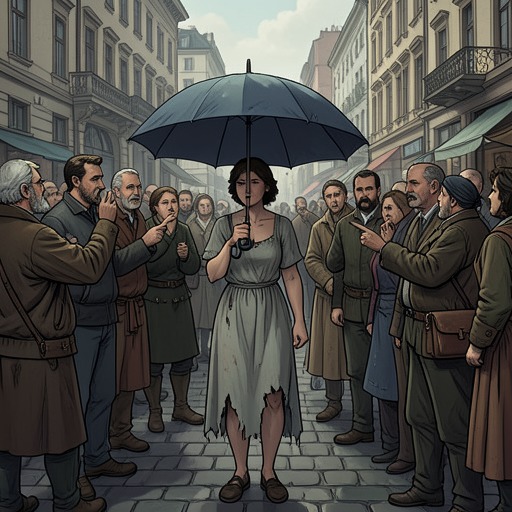
Gente que viene y ¡Bah!A national newspaper’s scandalous report transforms Bea’s private history and her family’s tangled affairs into a public spectacle, binding them to the controversy over the biomass plant. By placing a photograph of Bea entering the Andrada home beneath the headline Una cántabra es la tercera en discordia, the paper recasts a local political dispute as celebrity gossip—and makes the family, rather than the plant’s merits alone, part of the story.
Background and Publication
The report appears after a hidden-camera recording from Hotel Cantábrico has made Bea’s drunken visit to Víctor’s room a subject of television gossip. The hotel receptionist’s account identifies her as Víctor’s ex-fiancée, describes her entering the room and throwing a shoe, and says that the pair did not leave during his shift. The recording offers viewers a partial, compromising account; the newspaper expands that moment into a profile meant to explain who Bea is and why she has come to the coastal town.
The publication lands amid an existing political conflict. The town is divided over a biomass plant supported by Irene’s municipal government. Irene argues that it can provide clean energy, employment, and electricity for 50,000 people while making use of otherwise unusable forest wood. Opponents accuse her of siding with capital against local trees. Pacheco has already shown Bea a newspaper story alleging that Irene threatened two landowners with expropriation if they would not agree to sell their trees to the plant. The new report folds that controversy into its account of Bea’s family, while Bea recognizes Pacheco as the person who has found a national platform for a grievance he has against her.
The Family in the Newspaper’s Frame
The article recounts Bea’s architecture studies in Madrid, her meeting and near-marriage to Víctor, and the end of their relationship when the television presenter entered the picture. It describes Bea’s return to her family home as an effort to recover from the breakup, then presents her relatives as an explanation for the woman portrayed in the hotel recording. The result is not a neutral family profile: personal events are selected and arranged to make Bea appear unstable and to turn her background into a punchline.
Irene is described as a controversial United Left mayor presiding over a town divided by the biomass plant. The article contrasts her public reputation for integrity with the allegation that she used her position to secure Bea a job with the businessman she had openly favored through the municipality. The report therefore ties Bea’s employment and family connection to a charge of political favoritism, presenting an inference about influence as part of its scandal narrative.
The account also exposes Débora’s separation from Juan and her pregnancy after an encounter with a dwarf stripper. It brings Jacobo into the same portrait, describing his unofficial work for Irene as the cleanup of her political and family troubles and emphasizing his close friendship with her younger brother, Fin. Finally, it reports that Víctor has fought with Diego, the biomass businessman—an incident the article presents as a blow many townspeople would have liked to land themselves. By collecting these separate relationships and disputes into one account, the paper makes the family seem less like a group of people caught in distinct difficulties than a single scandalous unit.
Bea and Irene Read the Story
Irene receives a call warning her that a television crew is on its way, then goes with Bea to a nearby newsstand. The kiosk seller greets them as celebrities and points out that the coverage is unflattering. Bea and Irene each take a newspaper and search the society pages. When Bea sees the photograph of herself entering the Andrada home and reads the article, she has to sit on the curb; she cannot remain standing as she takes in how much of her life has been gathered and repackaged.
Bea is especially shaken by the report’s reach. It is not merely a local attack or gossip circulating in town: it has appeared in a national paper, in the society pages read by a broad audience. She objects to the exposure and wonders how the information was obtained and whether its publication is legal. Irene, meanwhile, identifies Pacheco as the likely source and sees the story as the megaphone he had been seeking. Bea’s private history has become a route into a much larger accusation against Irene and the plant project.
The sisters disagree over what to do next. Bea suggests that Irene cancel her scheduled interview, but Irene refuses: now, she says, she has more reason to speak and defend herself against what she regards as falsehoods. The report has also exposed Débora’s private circumstances at precisely the moment she was beginning to move closer to Juan, making the article’s damage extend beyond Bea and Irene. Irene tries to recover her confidence and meet the presenter on her own terms, but the interview that follows is not the reversal she hopes for.
From Scandal to Political Attack
In the television interview, the presenter questions the plant’s environmental and economic claims: the fossil fuel consumed in transporting forest material, the waste left after combustion, carbon emissions, the amount of woodland needed to supply the plant, the viability of comparable facilities, public subsidies, and the gap between promised and actual jobs. Irene has answers, but the presenter overwhelms her with figures and then shifts from the plant’s general merits to the political arrangements behind it.
The interview’s sharpest turn comes when the presenter shows Irene an iPad copy of a revised agreement changing pollution-control parameters. Irene says the change is false, but the document catches her unaware. The presenter frames it as evidence that the plant is pursuing its own benefit at the expense of neighbors’ health and that Irene’s government has made the project its political banner. Irene, caught without an explanation for the document, loses her composure and denies the charge angrily. The television segment thus carries the newspaper’s portrait of a compromised mayor into a direct confrontation over environmental safeguards and political trust.
Public Aftermath
The controversy reaches the streets during the demonstration against the plant. Bea sees cameras and mobile broadcast units around Irene’s interview and spots Pacheco, now wearing a floral shirt with a slogan, pointing her out to reporters. The press crowds around Bea with questions about whether Irene secured her a job at the biomass company. She tries to get through the crowd, but the cameras follow her; the former bride who expected a discreet wedding has become a recognizable figure in the news cycle.
Bea then calls out Rebeca Ramos, the reporter covering the demonstration, and confronts her in front of the cameras. The resulting outburst fills heart-program broadcasts and fuels a week of heated, often absurd studio debate. Bea succeeds in making herself a prominent story, but she cannot displace the demonstration’s central message: the crowd is too large to ignore, and the protest remains news even beyond the entertainment programs. Emerge ultimately breaks its contract with the Andrada family and chooses another power plant. That decision threatens Diego with financial ruin, leaving Bea unsure whether he deserves the consequences after having risked Irene’s position. The newspaper report is one stage in a widening media conflict: it makes the family’s private life public, while the coverage that follows helps bring the biomass dispute—and its material costs—before a national audience.