Bea's Engagement Ring
Gente que viene y ¡Bah!Bea’s Engagement Ring moves through three sharply different roles: a sign of a marriage Bea finds herself wanting, a prized object she displays with comic excess, and a prop in the humiliating rupture of her engagement to Víctor. Its changing use links the excitement of the proposal to Bea’s practical calculations and, finally, to her anger when she finds Víctor kissing the TV News Presenter.
The Proposal and Its Promise
Víctor proposes to Bea during the period of celebration surrounding her firm’s success and the arrival of visitors from Stockholm. He presents a ring, making the proposal tangible, and Bea is caught off guard by how happy it makes her. Marriage had not been one of her priorities: she had neither imagined a wedding ceremony nor planned the traditional details associated with one. Her initial attempt at cynicism gives way almost immediately to excitement. The ring therefore marks not the fulfilment of a long-held wedding fantasy, but Bea’s surprise at discovering that Víctor’s proposal matters deeply to her.
That emotional turn gives the ring an importance beyond its place in the wedding plans. Bea’s response is immediate and physical: she finds herself overcome with happiness and unable to maintain the detached attitude she first attempts. The ring makes the engagement visible, but the feeling it represents is new even to Bea herself. Its promise is consequently personal as well as social: it records a decision she did not expect to make with such enthusiasm.
Display and Bridal Excitement
After accepting the proposal, Bea insists to herself that she will not become someone who flaunts her ring, her fiancé, or her wedding. Her behaviour contradicts that resolution. She repeatedly extends her arm to show the ring while trying to make the gesture seem casual and subtle, to the point that she describes injuring her arm through the effort. The joke depends on the gap between her declared restraint and the conspicuousness of her display. The ring becomes the most visible shorthand for an engagement that Bea is eager to announce.
Her excitement also takes material form in the wedding preparations. She and Víctor decide on a supposedly discreet wedding of no more than a hundred guests, then invite 215. Bea sets an imaginary upper limit of 800 euros for her dress but spends 2,853 euros instead. These figures do not establish the ring’s price, which is never specified, but they place its display within a broader burst of extravagant bridal enthusiasm. At the firm, Bea believes that her colleagues—especially the women—resent her more after the wedding announcement. The ring is thus not merely a private keepsake: as she wears and shows it, it also becomes a marker of her newly public status and a focus for other people’s reactions.
The Sink and the Ring’s Practical Value
At the celebration in the Casino de la calle Alcalá, Bea overhears women disparaging her for rubbing the ring in their faces. She responds by opening the door, adjusting her dress, and dramatically taking it off in front of them. The gesture turns the object she had displayed as a happy announcement into a pointed answer to their accusation. But the performance lasts only a moment: Bea throws the ring into a sink, then rushes after it when it is about to be drawn down the drain.
Her recovery is both comic and revealing. Hairs caught in the drain keep the ring from disappearing, giving Bea just enough time to retrieve it. Although she is disgusted, she cleans it carefully and puts it in her handbag. Her anger does not outweigh the object’s practical value. She recognizes that it might be worth enough to support her for several months if she has to begin a new life, especially if Víctor does not persuade her that the situation is a misunderstanding. The ring therefore carries two possibilities at once: it belongs to the engagement Bea has just publicly repudiated, and it may have material value if that engagement is over. Its meaning is no longer only romantic.
A Final Use in the Breakup
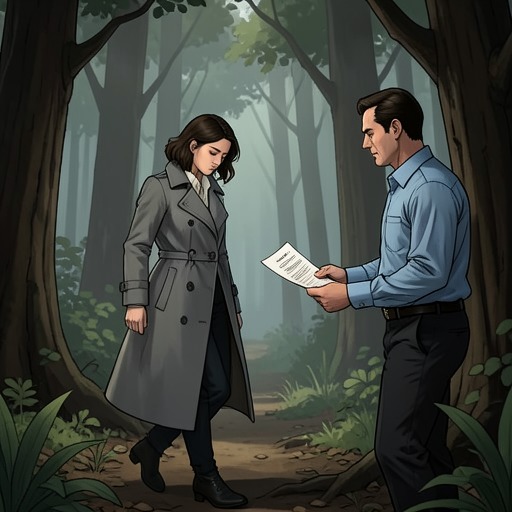
Later, Bea finds Víctor just after he has separated his lips from those of the TV News Presenter. She opens her handbag, takes out the same ring, and puts it into Víctor’s mouth. The gesture converts an object once offered as a promise into an instrument of accusation and contempt. Bea leaves firmly, without looking back, despite the difficulty of walking in high heels after drinking Moët Chandon. She hears Víctor speak as she goes, but the noise makes her uncertain of what he said; the scene does not settle the disagreement by supplying a clear explanation from him.
The ring’s route through the story gives the breakup a sharply physical conclusion. It has been presented, proudly displayed, dramatically removed, nearly lost, recovered, cleaned, and carried away in Bea’s handbag. At the final confrontation, Bea does not discard it into a drain or keep it safely as a possible asset: she uses it to answer Víctor’s betrayal directly. Its significance rests in that change of function. The same object that once embodied Bea’s unexpected happiness becomes something she can turn against the man who gave it to her.