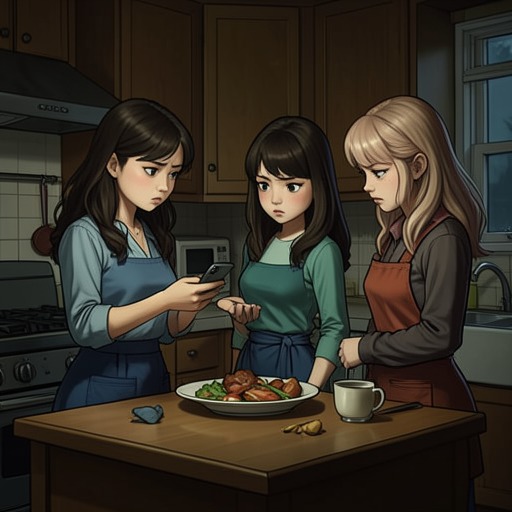
Débora Confesses Her Affair with a Dwarf Stripper to Her Family
Gente que viene y ¡Bah!Débora Confesses Her Affair with a Dwarf Stripper to Her Family is a family confrontation in which news of Óscar’s achondroplasia draws out a secret from Débora’s bachelorette party. The confession changes the argument from Juan’s hurt at learning the diagnosis late to his suspicion that he may not be Óscar’s father. Débora admits that a dwarf stripper was hired for the party and that she cannot remember what happened; Juan leaves convinced that the stripper fathered the child, but the scene does not confirm that conclusion as fact.
Diagnosis and suspicion
The scene begins after Bea and her sister return home to find Juan in the kitchen with reddened eyes and Ángela looking stricken. Juan can barely begin to explain what has happened. The news is that a pediatrician diagnosed Óscar with achondroplasia, a form of dwarfism, at birth, and expects him to reach no more than about 1.10 to 1.20 metres in height. Juan says he has only just learned of the diagnosis, despite the pediatrician’s having identified it when Óscar was born.
Bea initially misunderstands the word dwarf as a strange description of a baby and responds with an attempt at humour. When the diagnosis is made clear, she tries to soften the shock by calling Óscar the family’s first little person and comparing his condition with illnesses she considers worse. Juan tells her that such reassurance does not help. His distress is not only about the child’s future: he is also wounded that Débora kept the diagnosis from him for months, including while he was away in Turkey. He explains that he had been there because of the earthquakes and his work with the Red Cross, and objects that he was absent when the baby arrived early.
Juan’s anger at being excluded becomes suspicion. He reasons that Débora might have withheld the diagnosis because its cause was genetic, and asks whether Óscar is his son. Bea tries to offer a less accusatory explanation: Débora may simply have struggled to find a way to tell him and let the matter go unspoken. Débora remains silent, however, and Juan interprets that silence as further evidence that she is hiding something. When he asks directly whether Óscar is his, Débora finally answers with anger. She insists that the child is as much Juan’s as hers. That reassurance briefly relieves Bea and Ángela, but it does not resolve Juan’s question about why he was kept uninformed.
The confrontation in the chestnut tree
Bea moves away after Juan agrees that she should go and help Fin. Ten minutes later, Juan and Débora are arguing loudly from separate branches of a chestnut tree. The setting gives the confrontation an exposed, precarious quality: their private marital dispute is taking place above the family’s work, while others are nearby. Juan says that he knows Débora and believes she is concealing a further truth. He asks her to tell him, suggesting that honesty might let them get past what has happened.
Débora answers by naming the suspicion she thinks he wants confirmed: that she became pregnant by someone else and slept with a dwarf. Juan says he hopes she has not slept with anyone, dwarf or not, because she is married to him. He also declares his love and says that he cannot imagine being with anyone else, asking her to tell him the truth. Bea envies the declaration, comparing it with the kind of declaration of love she will not hear from Víctor. This reaction momentarily places the sisters’ marital situations side by side, even as Débora breaks down under the immediate pressure of Juan’s questions.
Débora begins to explain by recalling her bachelorette party. She says that her friends hired a dwarf stripper for the occasion. Juan immediately asks whether she had sex with him. Débora cannot give a clear answer: she says that she does not know and does not remember. The uncertainty is central to the confession. She discloses the encounter and the possibility of sex, but her account does not establish what occurred, and Juan’s certainty exceeds what she can recall.
The men working nearby—León, Fin, and Jacobo—stop hammering and fall silent when the revelation reaches them. Juan responds with a personal attack, contrasting Débora’s concern about avoiding toxins with the possibility that she had sex with the stripper. Débora is left unable to answer him. The exchange turns a confession made in distress into a spectacle witnessed by family and companions, while the language of the argument reduces the stripper and his stature to the terms of Juan’s accusation.
Departure and the fallout
Juan climbs down from the tree without looking at Débora. He says that their son is the child of a dwarf stripper and that she kept this from him. Then he leaves without saying goodbye to anyone. His departure is the immediate consequence of the disclosure: the couple’s argument does not end in understanding or reconciliation, but in Juan walking away believing both that he has been deceived and that Óscar’s paternity is in doubt. The scene supplies no independent confirmation of that belief.
After Juan leaves, the family does not know whether to continue working or end the day. Bea looks at Débora and sees hatred directed at her. Débora asks whether Bea is satisfied and blames her for having come home and stirred everything up. She specifically resents Bea’s involvement with Juan and her comments about Óscar’s appearance, including the child’s large head and slight build. The accusation shows how the argument’s consequences spread beyond the marriage: Débora treats Bea’s presence and interventions as the cause of a secret becoming a crisis, even though the underlying concealment and Juan’s suspicions predate the final disclosure.
Débora remains on the tree and refuses to come down. She says she does not want to do anything or live. Fin warns her not to lose her balance, while Jacobo looks among León, Bea, and Fin, registering the extremity of the family scene. Later they all sit on different branches. Bea characterizes the gathering by the most conspicuous circumstance each person carries: a gay civil guard and his not-quite-boyfriend, an abandoned architect, a motocross champion in existential distress, and an unfaithful sister with a child described as a dwarf. She recognizes that these labels make the group sound grotesque, but explains that reducing people to a single trait can make a crisis seem more manageable and absurd. Humour is her way of finding perspective, not a comfort she believes Débora could accept while crying.
The secret and what remains unresolved
Débora’s fear turns from Juan’s departure to Óscar’s future. She imagines the child growing up without a father and being unhappy because of her actions, and worries that she will one day have to explain that his condition followed her intoxicated encounter with a stranger at the party. Bea pushes back on Débora’s description of herself as an addict, distinguishing a night involving alcohol, ecstasy, and M from a settled identity. León adds a deliberately provocative counter-suggestion about Juan’s own bachelor party, undercutting the assumption that suspicion should run in only one direction. Neither remark establishes any further fact about what happened at either party.
The confession therefore yields a disclosure, not a resolution. It reveals why Débora might fear telling Juan about the bachelorette party and why the diagnosis has become entangled with questions of trust and parenthood. It also leaves the decisive factual question open: Débora cannot remember whether she had sex with the stripper, and no evidence in the scene establishes that he is Óscar’s biological father. The abrupt separation, Débora’s despair, and her anger at Bea carry the consequences forward without settling either the marriage or the child’s paternity.