Diana's Treehouse
Gente que viene y ¡Bah!Diana's Treehouse is an unfinished project whose fortunes follow the upheavals in Diego’s family and finances. First halted when Diego is ruined, it returns as a personal request from his daughter after the family has moved away from the estate. Bea’s promise to finish it turns a stalled commission into the first step toward a new shared project with Diego.
An Interrupted Commission
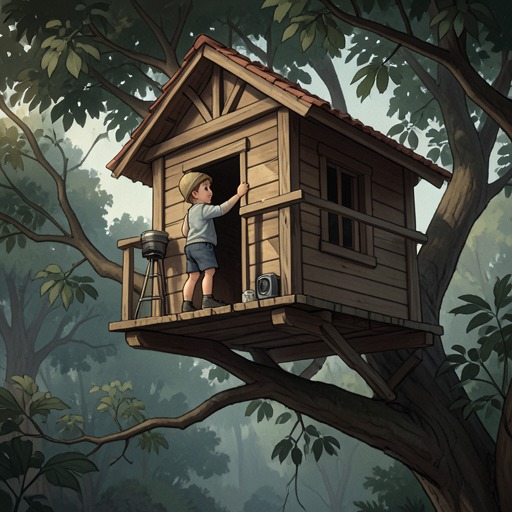
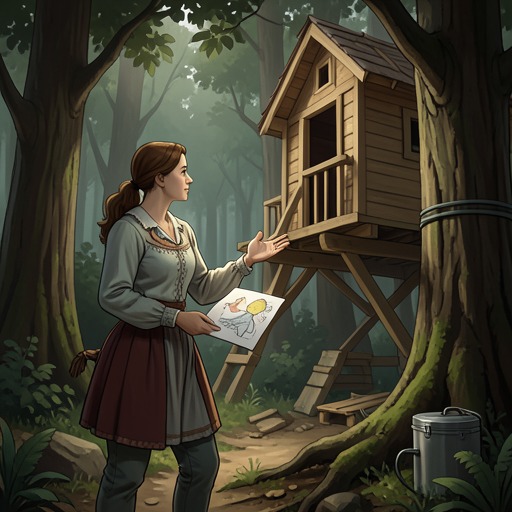
The treehouse is already underway at the home of Diana’s grandparents when its future becomes uncertain. Bea learns that Diego is ruined and has been unable to reach him by phone. When she asks what will happen to the treehouse, the answer is that the work will stop. For Bea, this news is part of a larger pattern: she feels that every attempt she makes to build a treehouse is destined to fail. Rather than give up, Bea goes to the sawmill because she urgently needs to speak with Diego and believes he will have to receive her there. The project is therefore more than an isolated construction job. Its interruption brings her face to face with the consequences of Diego’s financial crisis, while her determination to find him keeps open the possibility that the work might continue. At this point, however, the treehouse has no assured future; the work is stopped, and Bea’s conviction that it may fail is grounded in the immediate circumstances.
The Estate and a Changed Home
When Bea later speaks with Diego, he explains that he has managed to save the estate and its house. That recovery does not restore the family’s former arrangement: Diego and Diana no longer live there and have moved to Santander. The treehouse’s setting has consequently changed in meaning. It is still to be built at the grandparents’ home, but that place is now somewhere Diana will visit rather than her everyday residence. Diego’s account gives the unfinished structure a definite purpose within this altered family geography. Diana wants a special place of her own for visits to her grandparents. The treehouse is not presented simply as another feature of the saved property; it is meant to make those visits hers, with a distinct place she can claim. Bea’s earlier work at the house thus remains relevant even after Diego’s financial collapse and the family’s move: the project can connect Diana to a home she no longer shares with her father.
Diana’s Request and Bea’s Promise
Diego tells Bea that Diana has made completion of her treehouse a condition: Bea must finish the one she began at the grandparents’ home before turning to the next project. He then plays Bea a voice recording in which Diana asks for her treehouse. The request arrives with particular force because Diana has only recently begun speaking in full words. Diego’s eyes fill with tears, which he quickly wipes away; he admits that he is still not used to hearing her speak. The recording gives the project a direct voice from the person it is for. Until then, the treehouse has appeared through financial news, Bea’s fear of failure, and Diego’s account of family circumstances. Diana’s recorded request makes its purpose immediate without changing the practical condition Diego has set: her treehouse must come first. Bea accepts, tells Diego to tell his daughter she will build it, and promises to hurry. The treehouse is no longer merely a work suspended by Diego’s ruin; it has become a commitment Bea makes in response to Diana herself.
From the Treehouse to the Hotel
Bea’s agreement also establishes the order of the work ahead. She says she will move quickly because a much more ambitious project is waiting: building a hotel in the trees with Diego. The intimate scale of Diana’s special place and the scale of the hotel are linked, but not treated as interchangeable. Bea accepts the daughter’s request first, making the smaller, already-started structure the necessary beginning rather than allowing the new venture to displace it. That sequence gives Diana’s Treehouse significance beyond its construction. It had seemed to embody Bea’s repeated disappointment, and it was stopped when Diego’s finances collapsed. By the time Bea agrees to finish it, Diego has saved the estate, his household has moved to Santander, and his daughter’s recorded words have made the purpose of the work unmistakable. The object’s meaning shifts from a threatened commission to a promise with a specific recipient and place. Its completion is not confirmed in this passage, but Bea’s decision to proceed—and to do so before the treehouse hotel—marks a concrete return to the work and a renewed professional connection with Diego.