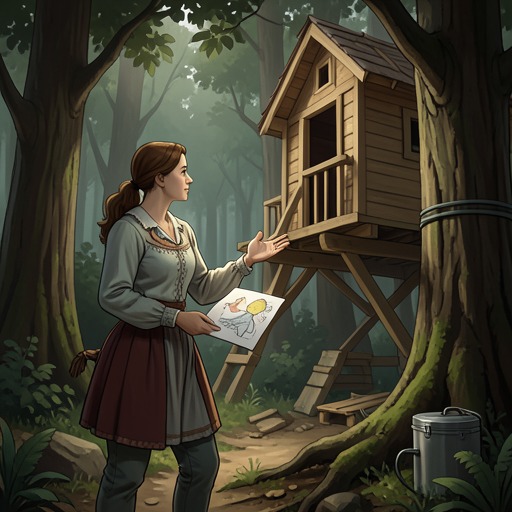
Diana's silence after her mother's death
Gente que viene y ¡Bah!Diana’s silence after her mother’s death ends in a brief recorded request: at four years old, she speaks to Bea and asks for the treehouse that was begun for her. The moment is both a milestone for Diego’s daughter and the condition that links a new treehouse project to the family home she will visit. Heard by Bea as evidence of what Diego has helped his child overcome, Diana’s voice also meets Bea at a point of grief of her own.
The silence and its context
Diana’s silence is explicitly connected to her mother’s death. The evidence does not describe when the silence began, its duration, or any treatment or particular steps taken to address it; instead, the change becomes known at the point when Diego tells Bea that his daughter now speaks. He emphasizes that she has said it in words, and supports the news by playing a voice recording. The account therefore defines the change through a specific act of speech rather than through an explanation of its causes or a clinical label.
The circumstances around the announcement matter. Diego tells Bea that he and Diana no longer live at the estate, having moved to Santander, and that he managed to save the property and house. The family’s circumstances have changed, but the earlier treehouse still has a place in Diana’s life: Diego says she wants it completed so that she will have a special place when she visits her grandparents. Her return to speech is thus introduced alongside a concrete wish about where she will belong during those visits.
The recorded request
When Bea asks how Diego knows what his daughter wants, he answers that Diana has told him herself. He takes out his phone and plays the recording. In it, Diana addresses Bea and asks for her treehouse. The recording gives the revelation a direct, material form: Bea does not merely receive Diego’s report of a change but hears the child’s voice and the request in her own words. The scene’s evidence remains deliberately precise. Diana speaks, names what she wants, and directs that request to Bea; the account does not supply a longer conversation or describe speech beyond this moment.
Diego’s reaction makes the recording more than a practical confirmation of the project’s condition. Tears appear in his eyes, and he quickly wipes them away with the back of his hand. He apologizes for becoming emotional and calls himself foolish. Bea rejects that judgment in her thoughts, understanding his tears as a response to his four-year-old daughter finally speaking after her mother’s death. His emotion marks the importance of the change without turning it into a public declaration: the scene holds on the recorded voice and his small, immediate gesture of wiping his eyes.
The treehouse and family connection
Diana’s request makes the treehouse a place associated with her grandparents and her visits to them. The first version had been started at their home; Diego’s condition is that Bea finish that one before taking on the new project, so Diana can have her special place there. The request therefore preserves a connection to the earlier home even after Diego and Diana have moved to Santander. Her wish is not presented as an abstract symbol supplied by others: in the recording, it is the concrete thing she asks Bea to make.
The condition also changes the meaning of Bea’s work. The treehouse is not simply a commission at a new site; finishing the earlier structure is tied to a four-year-old’s stated desire and to the family’s continuing visits. Diana’s words give the project an intimate purpose, while Diego’s account supplies its circumstances: the home has been saved, but he and his daughter no longer live there. The scene brings those facts together without suggesting that the move or the treehouse alone caused Diana to speak.
Grief and narrative significance
Bea interprets Diana’s speech through the effort she believes Diego has made on his own to help his daughter move beyond her mother’s death. The passage does not recount that effort in detail, so its emphasis falls instead on the result Bea can witness: a voice on a phone, a clear request, and a father who cannot listen without tears. Her response turns the moment toward her own bereavement. She wonders whether Diego might also help her get through the death of her mother, but this remains a question in her thoughts, not a resolution established by the scene.
The timing makes Diana’s return to speech resonate with Bea’s decision about her own mistakes and grief. As the exchange closes, Bea recalls her mother’s belief that mistakes must be accepted and that they can lead people somewhere unexpected. She thinks that her own errors have brought her to this point and that there is only one answer to Diego’s proposal. The passage therefore places Diana’s newly audible wish beside Bea’s possible next step, while leaving the decisive reply unstated in the supplied scene. Diana’s brief request is not merely a condition on construction: it is the moment through which the story lets Bea hear a child’s recovery, a father’s grief, and the possibility of moving forward without claiming that one loss cancels another.