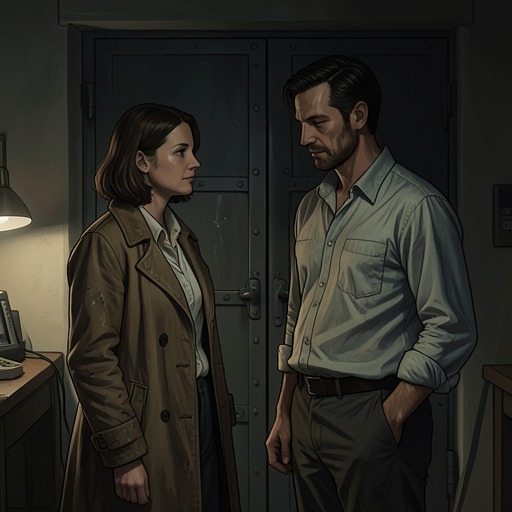
Irene Champions the Biomass Energy Project
Gente que viene y ¡Bah!Irene Champions the Biomass Energy Project follows the mayor’s determined effort to transform a biomass operation near the Andrada Family Sawmill into a major electricity-generating project. What Irene presents as a path to jobs, cleaner energy, and local independence becomes a divisive struggle over forest use, environmental risk, and the credibility of the people promoting it. As Bea recounts the campaign, enthusiasm and doubt repeatedly shift places: a promise of progress becomes a dispute over who bears its costs, and political support becomes vulnerable to revelations about how the project is being managed.
The plan and its promises
When Bea asks how things are going at the town hall, Irene reduces the subject to one word: biomass. The town is already divided between supporters and opponents of the factory beside the Andrada Family Sawmill. The existing facility produces pellets for boilers; the larger ambition is a power plant on an adjacent site. Irene describes the project as requiring the involvement of the whole community, including the consolidation of privately owned forests, use of public woods, and short-rotation plantations harvested every three years.
For Irene, the plan answers several local needs at once. She argues that it will put otherwise unusable wood to work, create employment, and produce electricity for 50,000 people. She imagines the project reducing reliance on fossil fuels and making the area energy self-sufficient, while establishing it as a Spanish pioneer. In her telling, forest conservation and energy production need not be opposites: with sensible management, trees and energy can coexist. She also points to the Andrada family’s expansion of its timber business, in which Diego, the family’s son-in-law, has played an important part.
Irene backs the project through the municipal government and works closely with Diego to make the power plant a reality. The scheme still needs outside investors, but she insists that it will succeed, even if she has to take every available shortcut. Bea warns her that, as mayor, she could face accusations of corruption or misuse of public funds. Irene rejects the suggestion that her support involves personal favors or financial wrongdoing. She says she backs Diego because she believes in the project, not because of sympathy or friendship. Her confidence is inseparable from her political purpose: she wants the town to move beyond its familiar reliance on anchovies and tourism.
A divided town and contested forests
Irene’s certainty has a public cost. She says that slogans around town insult her as a traitor to Cantabria because, as a left-wing woman, she is expected to defend every tree. She does not deny wanting trees protected; instead, she insists that environmental concern must also allow for green energy, employment, and economic change. Opponents, in her view, mistake resistance to the project for protection of the forest, while she believes that managed use of wood and forest residues can serve both development and environmental aims.
The disagreement becomes concrete when Bea visits the industrial site with Débora to seek affordable timber for a treehouse. The scale of the operation surprises her: the biomass factory dwarfs the sawmill, and the power plant under construction is larger still. Around the buildings, logs are stacked across an immense yard, where a huge chipper turns wood into heaps of fragments. Bea’s affection for wood—its varieties, texture, and uses—shapes her response to the site, but it does not settle the political question. Débora calls the factory a threat to the forests; Bea counters with the case Irene has made, that the operation can use residues and give neglected woodland a new use. Débora suspects the mayor has already persuaded her.
At a logging site, a worker points to a forest map and locates the group about 200 metres north of Forest Track Seven. Bea’s family says the chestnut trees belong to them. The worker replies that the timber in the surrounding hectares belongs to the sawmill because it has been bought from the owners, and that it will be divided between biomass production and usable lumber. When Bea objects, he says the timber purchase includes the right to extract it. Bea calls for Débora to bring the tree-protection association and the press, hoping to make a public confrontation of the dispute; Débora hesitates. The scene exposes the project’s reliance not only on persuasive environmental claims but also on contested questions of ownership, consent, and the terms under which forests are made available.
From development campaign to political vulnerability
The project’s opponents also challenge Irene’s conduct as mayor. Pacheco shows Bea a newspaper article alleging that two landowners were threatened with expropriation if they did not agree to sell their trees to the biomass factory. The article further suggests that Irene’s former husband is supplying information against her. These are allegations reported in the newspaper, not facts independently established in Bea’s account, but their political force is immediate: support for the plant is now entangled with claims that municipal authority may have been used to secure timber.
The challenge intensifies when a television presenter interviews Irene. The program questions the premise that biomass power is clean, raising concerns about combustion, the fossil fuels consumed in transporting forest material by truck, what remains after burning, carbon dioxide emissions, and the quantity of forest needed to supply a plant of this scale. The presenter also invokes examples of other plants that, she says, closed, depended heavily on subsidies, or delivered far fewer jobs than promised. Irene has answers to many of the questions, but the rapid succession of statistics leaves her struggling to make her case convincingly. The interview changes the frame: the project is no longer presented simply as a local opportunity but examined as an industry whose environmental and economic costs may undermine its advertised benefits.
The most damaging moment comes when the presenter cites a four-percent reduction from the original offer and connects it to a change in pollution controls. A copy of the revised agreement, displayed on the presenter’s iPad, specifies a cheaper boiler and filters that would increase pollutant emissions by 20 percent. Irene says the claim is false, then appears to realize that the agreement has been changed without her knowledge. The presenter accuses the plant of prioritizing profit over neighbors’ health and portrays Irene’s government as having made the project its banner despite those risks. Caught off guard, Irene angrily denies the charge rather than offering a persuasive explanation. The exposure reveals a gap between her confidence in the project’s environmental purpose and the decisions made in its name.
Public consequences and narrative significance
The project’s local division converges with Bea’s own entanglement in public attention during a demonstration. Followed by television and press cameras, Bea sees the presenter reporting on the protest and connects the political crisis to the upheavals in her family: Irene may lose the mayoralty, and Diego may lose his fortune. Bea’s immediate response is to call out to Rebeca Ramos, hoping to redirect the attention of the press that has been following her. The moment links the dispute over biomass to the novel’s wider concern with how public narratives are made and redirected, without resolving the project’s contested claims.
Irene’s campaign therefore carries two competing accounts of progress. Her case rests on jobs, energy independence, and the possibility of using forest material productively; the opposition points to the scale of extraction, disputed access to land, and the health consequences of weaker pollution controls. Neither account can be reduced to a simple clash between progress and backwardness: the evidence of the logging site and the revised agreement gives the conflict material and political stakes. The project’s significance lies in that widening gap between its green promise and the contested arrangements through which it is pursued. For Irene, the plant is a future the town should build together; for its critics, the means of building it may put both the forest and public trust at risk.