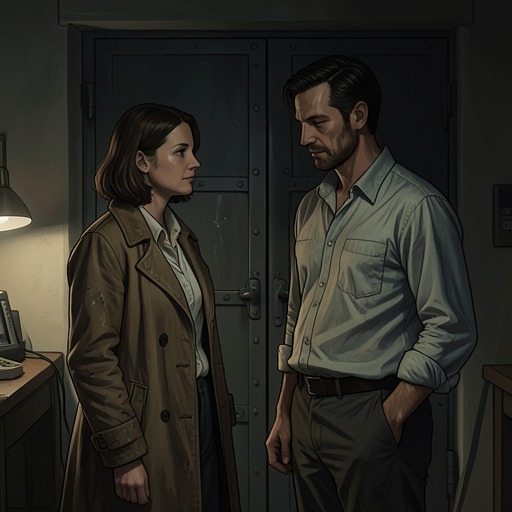
Irene–Fin mother–son relationship
Gente que viene y ¡Bah!The relationship between Irene and Fin is defined by a mother’s encouragement of her son’s passion and the sudden fear that this support may have exposed him to mortal danger. His motocross crash turns the question of how far to let him pursue that passion into a crisis: Irene blames herself, Bea reminds her that she has been a good mother, and Fin’s recovery becomes a responsibility shared across the family.
A Mother Who Supports Fin’s Passion
Irene has supported Fin in living out his passion for motocross. In the aftermath of his crash, Bea points to that support as evidence against Irene’s harsh judgment of herself: not every mother would have encouraged him in the same way. The exchange makes clear that Irene’s care is not expressed by keeping Fin away from risk; she has allowed him to pursue what matters to him, even when that choice leaves her vulnerable to fear about what might happen.
Irene’s responsibilities beyond the family also shape the circumstances of her care. At the hospital, she says that the town hall has consumed her and reproaches herself for not having been there and for not listening to Fin. Her distress links public service to maternal guilt: she fears that her attention to her work has made her unavailable when her son needed her. Bea counters that self-accusation directly, insisting that Fin would have fallen regardless and that Irene’s support for his passion is part of what makes her a good mother.
The Crash and Its Emotional Cost
At a motocross race, mud causes Fin to lose control and hit the motorcycle ahead, which has also fallen. A motorcycle coming behind cannot stop in time and lands on him, trapping his chest and head beneath the machines. He does not move. From Bea’s perspective, the scene becomes an immediate possibility of death, and her thoughts turn to Fin’s longstanding anguish about dying and to her own part in encouraging him to keep racing when he had doubts.
Irene’s fear takes a different form once she is with him: she clings to Bea and says she should have been there. When Román, Irene’s ex, enters the hospital room and asks how Fin is, the crisis is also shown drawing the wider family into the same anxious vigil. Bea tries to steady Irene rather than let her guilt dictate what the accident means. Her reassurance does not erase the danger; it gives Irene a way to face it without treating the crash as proof that she has failed her son.
Waiting for an Answer
The initial emergency does not end the family’s uncertainty. Doctors keep Fin in the hospital for additional days because something in his tests does not satisfy them. They do not appear to believe the problem is serious, but they have no clear answer yet, and that lack of certainty is difficult for Irene to bear. The uncertainty makes the hospital stay a test of endurance as well as a period of medical observation.
The comparison with Irene’s own experience of cancer sharpens the contrast. She had met her cancer with extraordinary strength, yet the possibility that something might happen to Fin overwhelms her. The passage presents maternal fear not as a measure of her courage but as a different, more personal vulnerability: facing her own illness had not prepared her to tolerate uncertainty about her child. The family tries to encourage her while the tests continue.
Recovery and Shared Care
Irene’s connection to the Romanesque Chapel provides the setting for one of the family’s attempts to manage that waiting. She takes Bea for a walk to the chapel near the cliffs. Recovering it had been Irene’s first major success as mayor: after the chapel was removed during plans for a reservoir that was never built, she persisted in securing its return to the region. Later, when she fears for Fin, she threatens to knock the chapel down stone by stone if he does not recover. The threat turns one of her most important public achievements into an expression of private desperation; she does not have to carry it out.
Three days later, doctors rule out possible complications and discharge Fin, to the family’s relief. His leg is in a cast, and he can barely move even with crutches, so the family decides that he should stay at Bea’s parents’ house. Irene cannot be at his side all day, and the family home offers care from several relatives. This arrangement does not diminish Irene’s role: it shows the family taking on practical support at a moment when her worry and responsibilities cannot be managed alone.
The Relationship Under Pressure
Fin’s crash exposes the tension between giving a child room to follow a passion and wanting to protect him from every danger. Irene’s response is first self-reproach, but Bea’s intervention recalls the history beneath it: Irene has backed Fin’s ambitions, and that support is not recast as neglect simply because an accident occurred. His discharge and the family’s shared care provide a concrete, if cautious, resolution to the immediate crisis.
The relationship is therefore presented through both Irene’s fear and her continuing commitment to Fin’s life beyond the hospital. Her earlier support for motocross remains part of her motherhood even as the crash makes it frightening; the family’s presence helps her care for him through the limits imposed by the cast and her own obligations. The episode does not make danger disappear. It shows Irene moving from the unbearable prospect of losing her son toward the ordinary, collective work of helping him recover.