La arquitectura es una cosa seria. No es para niñas
Gente que viene y ¡Bah!La arquitectura es una cosa seria. No es para niñas is the dismissive judgment Ingrid makes when Bea presents her treehouse model, turning a brief professional encounter into a challenge over whose ideas count as architecture. Bea’s response gives the phrase its force: rather than accept that small, playful-looking work is unserious, she resolves to build the house and defend a different architectural vision.
The Phrase in Context
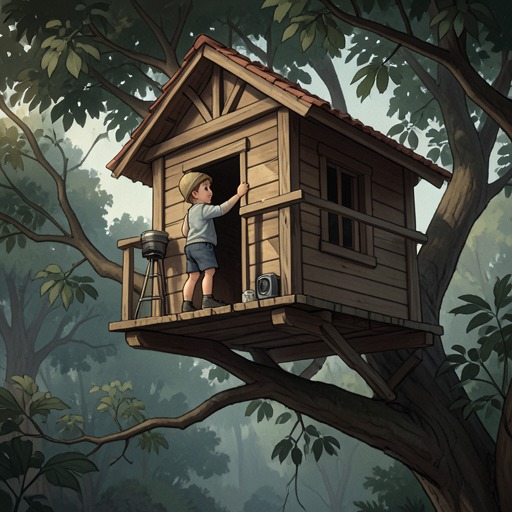
Bea brings Ingrid a model of a treehouse and tries to explain its connection to microtopia: the creation of small, human-scale spaces rather than oversized construction that wastes space. Ingrid interrupts her with the assertion named by the expression, then asks whether Bea has anything else to show her. The interruption cuts off Bea’s explanation before she can make the case for the model on its own terms.
The dismissal lands during an encounter that is already painfully brief. Ingrid thanks Bea for visiting and tells her to pass on to Ángela that she was right: Ingrid had consulted a specialist, and the problem was allergic dermatitis. Bea leaves in a hurry without even putting the model back in its bag. Ingrid has needed only two minutes, Bea reflects, to dismiss her work.
Bea’s Rebuttal
On the roughly two-kilometre walk from the plaza to her home, Bea is angry with Ingrid, with Ángela, and with herself for failing to defend either her work or her understanding of architecture. Her private argument rejects the assumption that worthwhile architecture must be monumental: she asks why every project should be a hundred-storey building or a grand museum, and associates that model of practice with bankruptcy. Ingrid’s own buildings and projects can be admirable, Bea acknowledges, but that does not make other approaches illegitimate.
The phrase’s gendered force becomes explicit in Bea’s response. She questions whether being a woman means having to prove that her architecture can be as robust, solid, and phallic as a man’s. Her treehouse, she insists, is solid; it is neither feminine nor childish. Even if it were either, she sees no reason that should disqualify it. The passage thus makes the insult more than a verdict on one model: it exposes the gendered standard Bea believes is being used to decide what counts as serious work.
From Humiliation to Resolve
Bea’s anger turns into a plan. She tells her family that she will build her treehouse, based on the model but improved, and declares that she will show Ingrid and anyone else who doubts her that there is another valid way to do architecture. She does not expect the project to win every architectural prize; what matters to her is proving that architecture need not have only one correct scale or form.
The expression therefore marks a reversal in Bea’s trajectory. Ingrid’s words initially leave her humiliated and unable to answer, but the walk home gives her space to formulate a defense of her work. The small model that Ingrid treats as childish becomes the starting point for Bea’s commitment to a human-scale project and to an architectural identity of her own.