Planta termoeléctrica de biomasa
Gente que viene y ¡Bah!Planta termoeléctrica de biomasa is the ambitious power-generation project at the center of San Esteban’s conflict over forests, employment, and local authority. Its promise of renewable electricity and economic development is tested against the scale of the timber operation it requires, contested rights to harvest woodland, and evidence that the plant’s pollution controls were weakened in a revised agreement. The project becomes more than an industrial development: it is a struggle over who defines progress and who bears its costs.
Design and Promised Benefits
The power plant is planned beside an existing biomass factory that produces pellets for heating boilers and next to the Andrada sawmill. The much larger electrical facility is described as a major expansion, requiring the involvement of the town and a coordinated supply of wood. The plan includes bringing private forests together, using public woodland, and establishing short-rotation forest plantations harvested on a three-year cycle.
Irene, speaking as mayor and project supporter, argues that the plant could turn otherwise unusable forest material into inexpensive, clean energy while creating jobs. She says it could generate electricity for 50,000 people, reduce dependence on fossil fuels such as gas and oil, and make the region a pioneer in Spain. Her defense is not that trees should simply be sacrificed: she insists that forests and energy production can coexist, and treats the Andrada timber business’s expansion as evidence that even established wood-industry interests recognize the direction of the future.
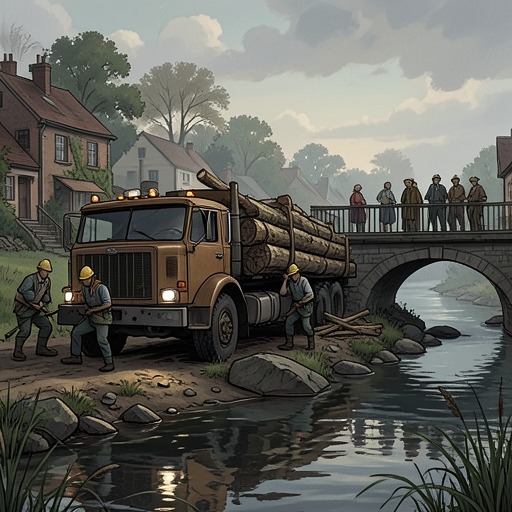
The physical site gives that promise an imposing form. When Bea visits the sawmill with Débora to negotiate cheap timber for her treehouse, she sees the pellet factory dwarfing the sawmill and the electric plant under construction looming larger still. Logs cover a broad open yard, where a huge grinder reduces wood to chips; pine and eucalyptus are especially abundant. Bea’s fascination with timber—its types, texture, smell, and warmth—contrasts with Débora’s immediate description of the factory as a threat to the forests. Their exchange makes the project’s central dispute concrete: the same wood can appear as a useful material with a new purpose or as evidence of woodland being depleted.
Forests, Ownership, and Local Division
The project divides San Esteban between supporters and opponents. Irene regards opposition as resistance to change and says the municipality backs the development. She is personally insulted in graffiti and denounced as a traitor to Cantabria for supporting the project rather than defending every tree. Her political case rests on the possibility of combining woodland and energy, but the required supply of timber makes forest management and ownership unavoidable questions rather than distant technical details.
That conflict enters Bea’s family’s land. In the woods, a representative points to a map and identifies their location as 200 metres north of forest track seven. He tells them that the timber in the surrounding hectares belongs to the sawmill: some will go to the biomass factory and suitable wood will be made into planks. Bea’s family objects, but the representative says the wood was purchased from its owners and that the purchase included the right to extract it. The disagreement therefore concerns not only whether harvesting is desirable, but who holds the relevant rights and what a sale permits.
Irene also presses landowners to accept the project’s terms. In a meeting with two older men and a map, she argues that the sawmill is paying well for their timber and offering to buy their plot for short-rotation forest cultivation. She adds that the municipality could instead expropriate the land and make it public woodland, in which case it would not pay as much as the Andrada interests. The proposal frames the transaction as a choice with economic advantages, but also places public authority and the possibility of expropriation inside what might otherwise look like a private sale.
Political Pressure and Public Scrutiny
The treehouse dispute and the project’s broader political controversy become entangled in the press. Pacheco shows Bea a newspaper report alleging that two landowners were threatened by the mayor with expropriation unless they agreed to sell their trees to the biomass factory. Irene’s former husband is said to be supplying information. Later, Débora tells Bea that the confrontation with the Guardia Civil has added to the damaging publicity and worries that Emerge, the corporation involved in the project, may withdraw because of the negative attention. The dispute around Bea’s family land thus supplies a route for criticism of Irene’s handling of the development, even as Débora says Bea was not the one who threatened the owners.
A television interview intensifies the scrutiny. The presenter first questions whether biomass power is as environmentally beneficial as claimed, raising the plant’s combustion, the supply and transport of material, the fossil fuels used by trucks, the disposal of residues, carbon dioxide emissions, and the amount of forest needed to provide biomass each year. Irene has answers, but the presenter overwhelms her with figures and examples of other plants that have closed, heavily subsidized generation, and job creation that fell short of promises. The exchange puts the project’s claims under pressure not only as environmental arguments but also as economic assurances.
The sharpest revelation concerns the plant’s pollution controls. The presenter says the final choice followed a four-percent reduction from the initial offer and that this saving was linked to a cheaper boiler and filters. According to the revised agreement she displays on an iPad, the change would increase pollutant emissions by 20 percent. Irene says the claim is false, then sees a copy of the agreement and realizes that she had not known about the altered parameters. The presenter characterizes the plant as pursuing profit at the expense of neighbors’ health and condemns the left-wing government for supporting and promoting it. Caught off guard, Irene denies the accusation angrily rather than restoring confidence in her earlier assurances.
Narrative Significance
The plant’s meaning shifts as it moves between different accounts of the same development. For Irene, it signifies clean energy, jobs, independence from fossil fuels, and a future in which forests remain useful. For opponents such as Débora, its demand for wood makes that green promise difficult to separate from the prospect of forest loss. The report on landowner pressure adds a question of political legitimacy, while the revised pollution agreement raises the possibility that the plant’s environmental performance has been traded away for a lower price.
These competing claims prevent the project from functioning as a simple contest between progress and resistance. Its benefits are presented as collective, but they depend on decisions about private and public woodland, land purchases, harvesting rights, and local consent. Its risks are also unevenly made visible: forest extraction is visible in the heaps of logs and wood chips, while the revised emissions figures emerge only when a journalist produces the agreement. By linking the plant to both a family’s contested trees and Irene’s political exposure, the novel makes the infrastructure itself a force in local relationships and public life. The power plant remains a promise of development, but one whose credibility—and whose terms—are increasingly in dispute.