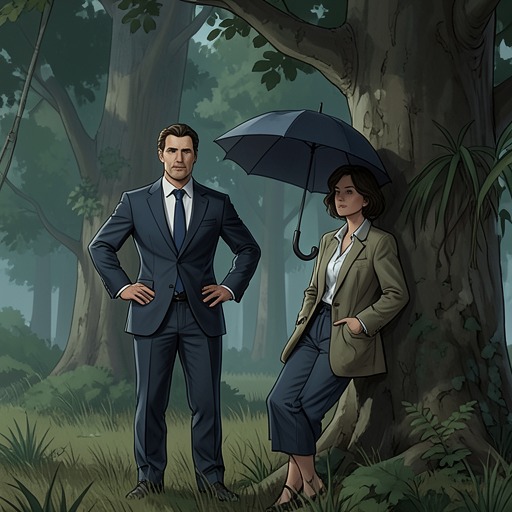
San Esteban
Gente que viene y ¡Bah!San Esteban is the setting in which the novel’s family dramas and local disputes become inseparable from the shape of the town itself. Its stone-built center and expanding industrial edge hold contrasting visions of home, work, and progress: Bea is drawn to the timber around the Andrada Family Sawmill, while the San Esteban Biomass Plant divides residents over what the forests should provide and what development should cost.
Townscape and everyday life
The town’s civic heart is the Plaza Mayor, described as a source of local pride and a tourist destination. Stone houses with broad white galleries surround it, looking toward a Gothic church with two bell towers. Bars occupy the ground floors; after Ley antitabaco, they added covered terraces with large heaters, preserving a place for smokers to gather outside. The details give the square a practical as well as ceremonial character: it is both a recognized landmark and a setting for ordinary social life.
The Ayuntamiento de San Esteban stands on the plaza. When Bea wants to confront Irene over the chestnut trees, she goes there to find her sister, the mayor. Her suspicion is that Irene knew their father had sold the trees, may even have helped bring about the sale, and said nothing despite knowing Bea’s plans for a treehouse. The town’s civic center thus becomes the point where a family grievance meets the authority of local government.
Another social landmark is Bar Caribe, where Bea and her companions spent their adolescence playing pool and discovering drinks such as Licor 43, Malibu with pineapple, and blackberry kalimotxo. In the present, its walls carry posters opposing the biomass plant. The bar’s history as a place of youthful memories sits alongside its new role as a venue marked by political division, bringing the town’s past and its current conflict into the same room.
Industry, forests, and competing futures
At the outskirts, the Andrada Family Sawmill is part of a much larger industrial landscape than Bea remembers. She sees the San Esteban Biomass Plant beside the sawmill and a still more imposing structure under construction nearby. The buildings dwarf the sawmill, while a broad open yard is crowded with logs and heaps of timber. A huge shredder spits out wood chips, and steam rises from the plant. The scale of the development makes the prospect of needing foreign investors seem plausible to Bea, even as she registers its ambition with a mixture of awe and unease.
The site also meets Bea through her particular affection for wood. She takes pleasure in its smell, touch, grain, warmth, and color, and imagines climbing into the mountains of chips. Over the years she has learned to distinguish woods such as American beech, red pine, untreated oak, and yew, and thinks different kinds suit different spaces and even different moods. For her, visiting the sawmill is less like inspecting an ordinary workplace than entering a place of fascination. That response gives the trees and timber an importance beyond their economic use: the same material is both the substance of her architectural ambitions and the resource at the center of a town-wide argument.
Irene makes the case for the project as a form of progress. She argues that the plant could produce clean, inexpensive electricity for fifty thousand people, create employment, use otherwise unusable forest wood, and help Spain become more self-sufficient and less reliant on fossil fuels, gas, and oil. In her account, protecting trees and generating green energy need not be mutually exclusive; she also points to the Andrada business’s expansion as evidence that the timber industry can adapt to the future. Her confidence contrasts with the opposition’s suspicion that development threatens a shared local inheritance.
A town divided in public
The conflict is visible in Bar Caribe’s posters, which oppose the plant and frame the forests as a common source of wealth. Bea challenges Pacheco, the bar’s owner, over his sudden concern for the woods, referring sarcastically to his former interest in marijuana plants. Pacheco answers that the sawmill owners should not be allowed to get their way and insists that the forests belong to everyone. Bea, by contrast, argues that timber should be put to use, including for energy, rather than left to become fuel for arsonists. Their exchange makes the dispute more than an abstract argument over technology: it is also a contest over who speaks for the land and what counts as responsible care for it.
The town’s division culminates in a demonstration whose size Bea has never seen in San Esteban, not even during the patron-saint festivities. An hour before it is due to begin, she cannot get close to the starting street; the crowd blocks her roughly six hundred meters away. She estimates that it includes half the town and half of Cantabria. Among the demonstrators she sees Juan and his fellow firefighters wearing their uniforms, a visible sign that they oppose the plant. Their stance surprises and hurts Bea, who had not known of it and suspects her brother-in-law persuaded them.
Television cameras and mobile broadcast units have also arrived, drawn by Irene’s interview. Near them, Pacheco identifies Bea to the press, and journalists, camera operators, and photographers converge on her. As she tries to make her way through the crowd, reporters begin asking whether Irene secured her a job with the biomass company. The question brings the conflict back to the family: in San Esteban, political allegiance, employment, and kinship are entangled, and public scrutiny turns those private connections into part of the demonstration’s story.