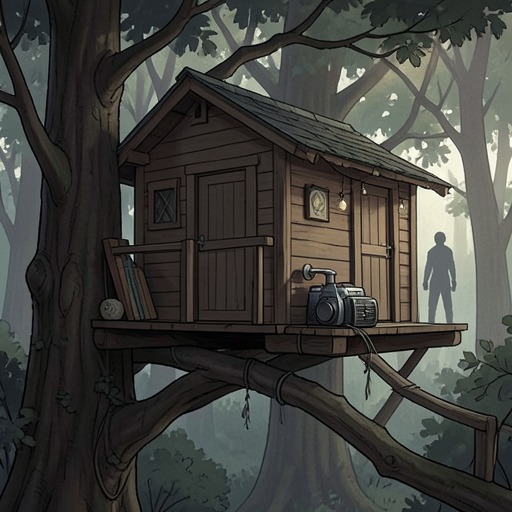
The Treehouse as a Symbol
Gente que viene y ¡Bah!The treehouse is both a practical architectural commission and a recurring measure of whether Bea and Diego can imagine a future together. When Diego’s financial ruin seems to end the project, Bea expects another failure; when he later offers her work on a hotel among the chestnut trees, the image expands from one child’s house to a shared undertaking. Her acceptance of both projects makes the treehouse a concrete sign of possibility after loss and disappointment.
The Project Under Threat
The treehouse first appears here as a plan endangered by Diego’s financial collapse. Bea learns that he is ruined and, having been unable to reach him by phone, asks what will happen to the project. The answer is that it will stop. The exchange reduces a design Bea has invested in to an apparent casualty of circumstances, and leaves her with no assurance that the work can continue.
Bea’s response is not to accept that ending. She thinks that any attempt she makes to build a treehouse seems destined to fail, but refuses to give up. Her determination is bound up with a pressing need to speak with Diego, so she goes to the sawmill, where she believes he will have to receive her. The journey turns the threatened commission into a reason to seek him out: the project matters as work, but it also brings her back into direct contact with the person whose absence and silence have left its future uncertain.
From One House to a Hotel
The eventual proposal changes the scale of the treehouse idea. Diego describes a hotel in the trees, with a small house in each tree. The plan is for fifteen houses and accommodation for thirty-eight or forty people; he wants it to become the first treehouse hotel in Cantabria. What had seemed to be a single commission now belongs to a larger architectural venture, rooted in the chestnut trees and presented as something distinctive for the area.
The hotel is not offered as a vague dream without practical footing. Diego says the necessary matters are already in order and identifies the missing element: the best architect. He asks Bea to take that role. The distinction matters to the symbol: the treehouse is not only an image of escape or wishful thinking but a project that requires professional skill, a defined scale, and a person willing to make it real. Bea’s response is startled, then affirmative. The proposal gives the treehouse a future precisely where she had expected another failure.
A Child’s House and an Adult Partnership
The larger hotel plan does not displace the original, more intimate undertaking. Bea agrees to build a treehouse for Diego’s daughter and says she will hurry, because the hotel project will follow. The sequence holds the two projects together without making them interchangeable: one is a house for a child; the other is a substantial development among the trees. Bea commits to both, and the smaller commission becomes the immediate work that precedes the larger one.
The child’s circumstances give that first house particular human weight. Diego has, on his own, helped his four-year-old daughter overcome the death of her mother and begin speaking. The passage does not claim that the treehouse cures grief or causes the child’s change. Instead, its placement beside this account associates the planned house with a family continuing after bereavement. Bea’s promise is therefore more than an architectural response to a client: it is a willingness to contribute to a future being made for Diego and his daughter.
Errors, Renewal, and the Treehouse Image
Bea understands her decision through her mother’s teaching about mistakes: they must be accepted and owned, and can sometimes lead somewhere unexpected. She sees her own errors and entanglements as having brought her to Diego. This reflection gives the treehouse image its clearest meaning in the ending. The project that had seemed condemned to fail becomes part of an unforeseen destination, reached not by erasing past mistakes but by accepting where they have led.
Diego, too, is described as beginning to let himself be carried forward, leaving his other life behind and offering to share what comes next with Bea. The proposed hotel gives that change an outward form: a new undertaking, designed among the chestnuts and entrusted to her. Bea’s final acceptance joins the intimate and ambitious scales of the motif. She will build the daughter’s house, then work with Diego on what she calls their most unlikely project, a hotel in the trees. Thus the treehouse stands at once for practical work, care for a bereaved child, and the possibility of a future Bea and Diego choose to build together.