Covenant House New York Shelter
Gone for GoodCovenant House New York Shelter is both a refuge and an outreach base for young runaways in New York City. Its significance lies in the contrast between a welcoming interior, designed to offer young people comfort and care, and the difficult work of reaching those still exposed to the streets. The shelter’s method is grounded in sustained attention rather than promises of easy rescue: its staff offer safety and belonging while recognizing that many young people cannot be reached for good.
Identity and Setting
The shelter is described as a charitable foundation that helps young runaways survive the streets. It is located on 41st Street in New York City. Rather than presenting itself as a bleak institution, it is arranged according to a practical test: whether staff would want their own children to stay there in trouble. That standard makes comfort part of the shelter’s purpose, not an extra reserved for donors or visitors.
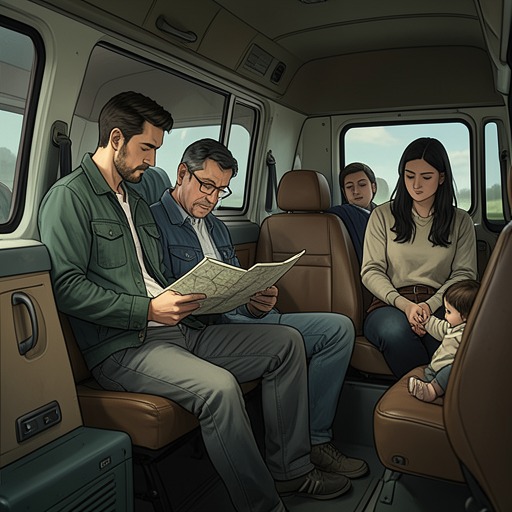
The work also extends beyond the building. The shelter’s van travels into the city to connect with and rescue young people who do not come to its doors. Outreach reaches into the city’s less visible and more dangerous environments, where the young people staff seek are often treated as disposable. The van is therefore a moving link between the shelter and those who may otherwise remain beyond its walls.
Daily Practice and Care
Inside the shelter, Will Klein and Squares direct their attention toward the young people in their care. Staff greet each child personally, listen without hurrying, meet their eyes, and offer a handshake or a hug. Their manner is meant to communicate that a young person is not an interruption or a problem to be processed, but the person who matters in that moment. The account emphasizes that this attention cannot be convincingly performed: the young people are quick to recognize false concern.
Care is offered without conditions. The shelter’s commitment is not limited to those whose recovery is likely or whose behavior is easy to manage; while a young person is there, staff seek to make the place safe, comfortable, and loving. This daily practice is presented as a standard the staff must either meet or abandon, rather than as a claim that compassion guarantees success.
Outreach and Its Limits
The shelter’s work confronts the difficulty of intervening before street life becomes harder to escape. Staff compare prolonged exposure to the streets to a worsening illness: early contact and preventive help matter because the longer a young person remains outside, the more difficult it may be to draw them back into safety. The comparison is explicitly qualified; the young people themselves are not the problem to be removed. The danger lies in the conditions surrounding them.
The limits are stark. The shelter loses more young people than it saves, and some are drawn back to the streets after receiving help. This does not cancel the value of a safe stay; it defines the work as an ongoing effort rather than a clean sequence of rescues and happy endings. Its promise is narrower and more immediate: while young people are inside, they will be treated with care and allowed to stay in comfort.
Staff, Trust, and the Wider Story
Will Klein is the shelter’s senior director, but his role is deliberately kept out of public view. His name does not appear on the letterhead, and he does not attend fundraising functions; his work remains behind the scenes. The account connects this caution to the public notoriety surrounding his family and his defense of his brother, Ken Klein. The shelter’s work thus depends in part on a leader whose public identity is constrained, even as his daily attention is directed toward making young people feel fully seen.
Sheila Rogers enters the shelter’s story first as a volunteer, having met Will Klein through work about a year earlier. She came from a small town in Idaho and told him that she had once been a runaway, while offering little more about her past. Her history gives a personal dimension to the population the shelter serves: someone who had experienced runaway life could later return to that world in a helping role. The shelter is consequently more than a setting for charitable work; it is where personal histories of vulnerability and care briefly meet.