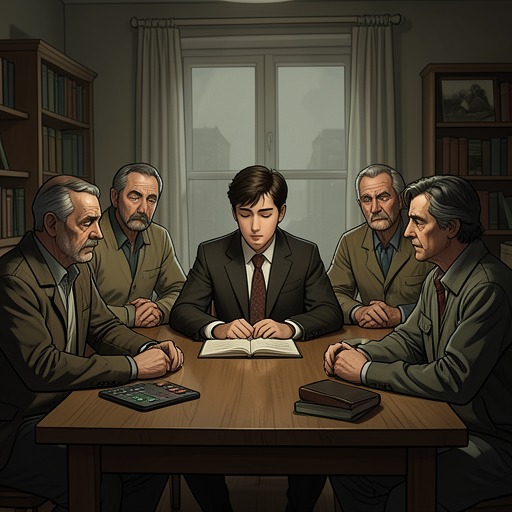
Irreversible Harm Caused by Street Life
Gone for GoodIrreversible Harm Caused by Street Life is the narrator’s recognition that rescue can come too late to reverse what street life has done. The idea shapes both the work of outreach and the limits the narrator comes to acknowledge: intervention matters urgently, but survival and removal from the streets do not necessarily restore what was lost. A discarded weed first seems to offer a way to describe the task; the narrator rejects that comparison because it treats young people as something undesirable to be removed. The replacement image, cancer, makes the argument more severe: delay allows harm to deepen, while early intervention may improve the chance of survival without guaranteeing recovery.
Outreach and the urgency of intervention
The Covenant House van moves into the city’s dangerous margins to meet runaway young people and others living on the street. Some come directly to Covenant House; others are reached through the van. Outreach therefore means entering the same environment that exposes young people to danger, rather than waiting for them to find a safe door themselves. The narrator describes this as connecting with the community’s “seedy underbelly,” where young people called “throwaways” are encountered as people in need of help, not as refuse.
The narrator initially compares a young person living on the street to a weed: the longer the person remains there, the harder it becomes to pull them out by the root. But the comparison is rejected almost as soon as it appears. It implies that something bad is being removed and something good preserved, reversing the moral reality of the work. The young people are not the unwanted growth; the conditions consuming them are the danger. Replacing the weed with cancer changes the emphasis from removal to prevention. The narrator’s formulation, “The street is more like a cancer,” presents exposure as a destructive process that can spread and become harder to treat over time. Early screening and preventive treatment become the analogy for reaching young people before that process advances.
Accumulation, not a clean break
The damage is described as cumulative rather than as a single injury that ends when a young person leaves the street. Looking out at the gray night, the narrator holds together two truths: outreach succeeds in turning some lives around, yet what happens in the street’s “vibrant cesspool of night” remains with those who endure it. A person may work around the consequences and go on with life, but the narrator insists that the damage is permanent. Rescue can alter what happens next without restoring an untouched past.
That distinction gives urgency to the narrator’s work while also limiting its promise. The account does not say that outreach is useless: the narrator knows that it can save lives and change their direction. Nor does it treat rescue as a complete cure. The contrast between successful intervention and lasting harm prevents an easy story in which leaving the street erases the experience. The central concern is the narrowing opportunity to reach someone before the consequences become irreversible, not a claim that every young person follows the same course.
The veterans’ knowledge and its competing explanations
The narrator connects this urgency to the way experienced street workers sometimes identify newer young people to outreach workers. One explanation is cynical: veterans may want newcomers removed from circulation because the newcomers compete for business. The narrator acknowledges this possibility rather than pretending that every helpful act has a pure motive. New girls, though made to wait in doorways until they earn turf, are conspicuous; the circumstances described make them visible to people who might notice and intervene.
The narrator nevertheless considers the more generous explanation more important. Veterans recognize themselves in the newcomers and understand the fork in the road because they believe they have already taken the wrong path. They may not readily admit that judgment, but the narrator sees their attempts to help as recognition that the newcomers still have a chance they no longer possess. This understanding corrects the narrator’s former insistence that it is never too late. The account does not turn the veterans into uncomplicated rescuers; instead, their knowledge of the street can produce both competition and an impulse to protect others from a fate they regard as settled.
Irreversibility and disappearance
The narrator describes prolonged street life as visible in rapid aging and in a gradual loss of individual presence. Candi’s appearance becomes part of that description: the narrator says street life ages people faster than a black hole. The image is forceful but belongs to the narrator’s bleak account of what the environment does, not to a claim that any one physical appearance explains a person’s worth. The larger movement is from recognizable individuals toward obscurity: those exposed to the street “fade away” and become, in the narrator’s image, one dark entity.
That disappearance has a practical consequence as well as a figurative one. The young people are lost to the outreach workers, and the narrator projects that many will die on the street, go to jail, or become mentally ill. These outcomes are presented as the narrator’s grim expectation, not as a record that every person will meet one of them. Together with the cancer analogy, the ending makes the concept’s stakes plain: delay is dangerous because the street can absorb people until they are difficult to reach, while timely contact may still change the outcome. The text’s point is not that help has no value, but that help must come before damage becomes irreversible.