Katy Miller's Encounter with Ken at Julie's Grave
Gone for GoodKaty Miller’s encounter with Ken Klein at Julie Miller’s grave overturns the certainty that had shaped her grief: the brother she believed had killed her sister is alive, denies the murder, and promises to find the person responsible. Because Katy has kept the meeting secret and is not entirely sure how to interpret it, the encounter does not settle Julie’s case. Instead, it gives Will Klein a new lead and draws Katy into the search.
Background: Grief Preserved in Place
Julie’s murder remains present in the Miller family’s home and routines. The basement has been left as it was: the old couch, television, worn carpet, and trunk where Katy used to hide are still there, though no one uses them. The family must pass through the laundry room in that basement, making the preserved room part of ordinary life rather than a space they can simply avoid. Katy describes the household as moving carefully around the memory, afraid that disturbing it will bring the loss crashing down again.
The Miller family’s attachment to the house echoes the Kleins’ refusal to leave their own home after Julie’s body was found. Will Klein remembers that his father stayed despite his mother’s wish to move, treating departure as a surrender and as an admission of Will’s guilt. After the murder, the mother who had once been volatile became quiet and emotionally flat. These different family responses give Katy’s visit to the grave a wider context: grief has fixed both families to places and objects associated with the past, even as they continue living around what happened.
Katy Returns to the Grave
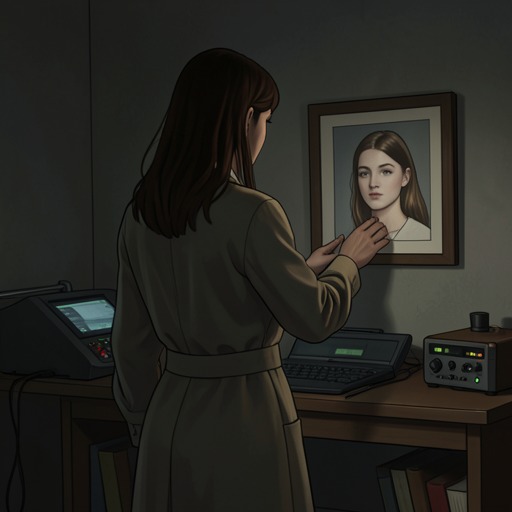
After Will visited the Miller house, Katy went to the graveyard. She had not been there for years, and she did not enter through the front gate; she climbed over a fence and approached from the back. At a diner later, she tells Will about the visit while avoiding his eyes. Her hesitation makes the disclosure feel difficult to bring into speech: she has returned to a place she had kept away from, and what she saw there challenges a long-held belief.
Katy says she saw a man near Julie’s grave, standing beneath a willow tree roughly a hundred feet away. She initially presents the identification cautiously. Ken looked different, she explains, and she remembered him only a little from the past, supplemented by photographs. But when Will asks whether she is certain, she moves from uncertainty toward conviction: she says that the man told her he had not killed Julie. The meeting is therefore not based on recognition alone. Ken’s words, and the fact that he addressed Julie’s death directly, persuade Katy that the stranger really was Will’s missing brother.
The Denial and the Promise
Katy reports that Ken first told her he had not killed her sister. She had hated him for a long time, but hearing him speak unsettled that fixed response. She was still about to scream when Ken came toward her, took her face in his hands, looked her in the eye, and promised to find the killer. He then let go and ran away. The encounter is brief: it offers no explanation of Julie’s death, no account of Ken’s disappearance, and no proof that his denial is true. Its force lies in the abrupt change from accusation to a promise that points toward future action.
The moment of direct eye contact matters to the way Katy tells the story. Earlier in the diner she has avoided Will’s gaze, a habit he recognizes from his work with young people at the shelter and does not force her to break. When she recounts Ken’s promise, however, she recalls that Ken held her face and looked directly at her. That remembered gesture does not verify his innocence; it helps explain why his claim reached her despite the years of hatred. The encounter leaves her with an experience she cannot easily reconcile with her prior certainty.
Secrecy, Doubt, and a New Alliance
Katy has told no one about the meeting before speaking to Will. Even as she recounts it, she admits that sometimes she is not sure it happened. Her account preserves both the revelation and its limits: she believes she saw Ken, but the event remains private, uncorroborated, and emotionally difficult to trust. Ken’s denial changes what Katy thinks may be possible, not what has been established about Julie’s killer.
The disclosure becomes a turning point in Katy’s relationship with Will. She has returned to Julie’s grave after his visit, and now she brings him the information she has withheld from everyone else. When Will says that he is looking for Ken too, Katy asks to help. He agrees. Her request converts a solitary encounter into a shared investigation: Will gains Katy’s firsthand account, while Katy moves from carrying the memory alone to taking part in the search.
Narrative Significance
The scene links the physical places where grief is maintained—the unchanged basement, the family home, and Julie’s grave—to the possibility that the past may still yield new knowledge. Katy’s visit does not provide closure. Ken disappears again before she can question him, and his promise to find the killer remains only a promise. Yet the encounter breaks the settled pattern of blame: the person Katy had condemned denies the murder, and she is willing to help investigate rather than simply repeat her old judgment.
Because the meeting reaches the reader through Katy’s later account to Will, its uncertainty is part of the event’s meaning. The reader receives no independent confirmation of what happened beneath the willow tree. Instead, the account shows how a brief, concealed meeting can alter the relationships surrounding an unsolved murder: Katy entrusts Will with her secret, Will accepts her help, and the search for Ken becomes a search in which Julie’s sister has a voice and a stake.