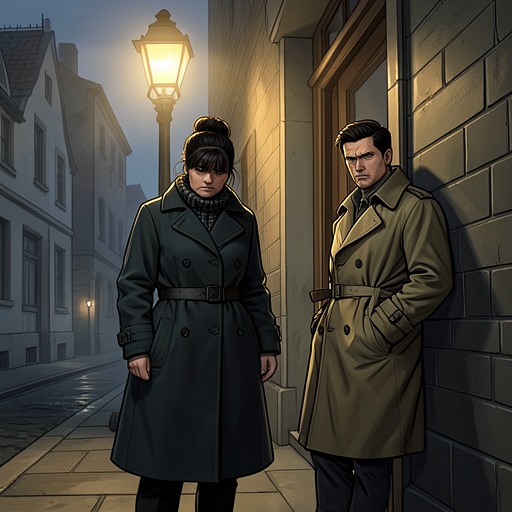
Philip McGuane
Gone for GoodPhilip McGuane is a New York organized-crime boss who has remade criminal power in the image of legitimate business: offices, payroll systems, tax payments, and carefully engineered security. Yet this polished surface does not make him safer or less ruthless. As his uneasy dealings with John Asselta and the federal investigation close in, McGuane’s own creed of never showing weakness gives way to a desire to disappear. His arrest marks both the collapse of his organization and the defeat of a man accustomed to making other people underestimate him.
Identity and Background
McGuane’s public manner belongs to a newer kind of criminal enterprise. He wears a hand-tailored Joseph Abboud suit, rents three floors on Manhattan’s lower west side, and operates through businesses that appear legitimate. He regards the old image of organized crime—backroom gatherings and conspicuous gangster posturing—as obsolete. Modern criminal power, in his view, works through offices, secretaries, computer-generated payroll, taxes, and lawful-looking commercial fronts. The change in presentation is not a change in moral substance: beneath the professional exterior, he remains ruthless.
Federal agent Joseph Pistillo describes McGuane as more dangerous than John Asselta because he is smarter, and identifies him as one of the East Coast’s leading organized-crime figures. McGuane adapted early to a changing criminal landscape, staying ahead of competitors that included Russian, Triad, Chinese, and Italian groups. According to Pistillo, McGuane was a boss by the age of twenty-three. His activities included drugs, prostitution, and loan-sharking, while graft and kickbacks were particular strengths; he also placed drug operations in less competitive areas away from the city. His power rests not simply on force but on the ability to adjust his methods and make criminal business look ordinary.
The Three Friends and the Threat of John Asselta
An old photograph in McGuane’s desk shows him at seventeen with Ken Klein and John Asselta. The three boys grew up in Livingston, New Jersey, though McGuane lived on the opposite side of town from the other two. They came together in high school. The picture records three apparently popular teenagers, not an obvious portrait of future criminals: Ken was known for tennis, John for wrestling, and McGuane for charm and student-council leadership. McGuane reflects on how little such outward circumstances reveal about the capacity for rage. In his view, comfort, parental love, and social acceptance do not necessarily prevent violence.
That history makes Ken’s disappearance more than a remote criminal matter to McGuane. When he is riding in his armored, stretch Mercedes near Wellington Cemetery, he thinks of his old friend Ken as someone who managed to disappear. McGuane is himself tempted to pack what he can and vanish, an impulse that cuts against the hard rule he has followed throughout his rise: showing weakness invites destruction, and retreat is not an option. The thought does not make him abandon his public composure, but it exposes the fear beneath it.
John Asselta, known as the Ghost, has particular power over that fear. McGuane understands that refusing Asselta’s request to meet would not keep him safe; it would merely mean that Asselta came to him instead. McGuane has capable people and strong security, but he believes Asselta has greater patience and can study a target until an opening appears. He therefore goes to meet him near the cemetery. When the two discuss the men McGuane sent to New Mexico, McGuane confirms that they failed, and Asselta responds that he will not. The exchange leaves McGuane dealing with a man whose threats cannot be dismissed as empty posturing.
Business, Security, and the Federal Investigation
McGuane’s office embodies the same mixture of respectable appearance and concealed danger as his larger enterprise. From a corner office overlooking the Hudson River near Manhattan’s southwestern tip, he monitors visitors through a security system built around eighty-three cameras. People entering his private elevator are recorded from several angles. The camera positions are designed so that footage can make an entrant appear to leave, while the corridor and elevator are painted spearmint green. That color allows an image to be extracted and composited against a different background, making the system useful not only for observation but for manipulating the apparent record of who came and went.
The arrangement depends on a calculated expectation: visitors may assume that no one would be attacked in McGuane’s own office, and investigators may share that assumption. McGuane has built his security to turn that apparent safety into a trap, with recordings that could suggest a victim left unharmed. The office is therefore more than a sign of wealth. It is an instrument for controlling what others can see and what authorities might be able to prove.
When Joseph Pistillo visits with a young colleague, McGuane recognizes him as a federal adversary and watches their approach on the cameras. He greets Pistillo with mockery, but the encounter is not simply an exchange of insults. Pistillo points to two dead men and two men killed in New Mexico, connecting the growing number of deaths to the pressure surrounding McGuane and Asselta. After the visitors leave, McGuane remains still for ten minutes. He understands that Pistillo’s visit was meant to unsettle him and considers whether using a secure telephone line to contact Asselta will reveal panic. He decides to risk the call. The pause, calculation, and eventual decision show a man who remains capable of strategic thought but is increasingly forced to react to threats he cannot fully control.
Arrest and Narrative Role
The investigation eventually reaches a decisive outcome: McGuane is arrested for the murders of Joshua Ford, a prominent attorney, and Raymond Cromwell, an undercover federal officer. Unlike an earlier moment of pressure, this arrest leaves him held without bail. Pistillo tells Will Klein that the case against McGuane is secured and that the organization is coming apart. For an agent who regards McGuane as a formidable opponent, the arrest is also the culmination of a personal struggle to bring him down.
McGuane’s arc is shaped by the contrast between his mastery of appearances and the limits of that mastery. He builds a legitimate-looking business world, engineers camera footage to create false impressions, and treats underestimation as an advantage. But he cannot make John Asselta’s threat disappear, and he cannot prevent the federal investigation from turning deaths into a case that reaches him. His fleeting wish to escape recalls Ken Klein’s disappearance, while his eventual arrest supplies the ending McGuane’s own rules seemed designed to avoid. The character joins two forms of criminal power in the same story: the established organization that adapts through money, business, and concealment, and the more personal danger embodied by Asselta. McGuane’s intelligence keeps him influential, but it does not make him invulnerable.