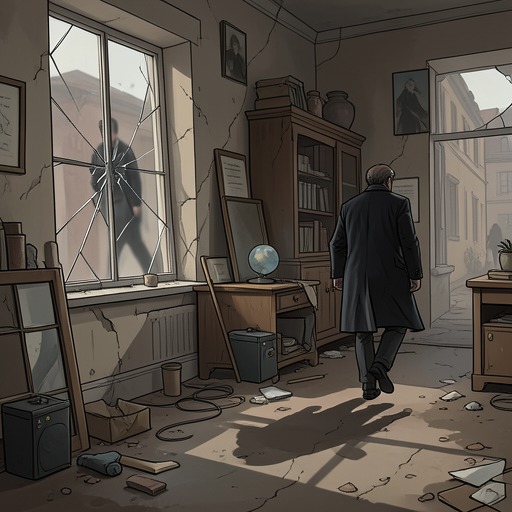
The Past Cannot Easily Be Escaped
Gone for GoodThe Past Cannot Easily Be Escaped names a tension at the heart of the novel: earlier lives do not simply disappear when people stop speaking about them, yet the fact of having a past does not settle a person’s worth or future. The idea takes form in withheld histories, visible reminders, and the lasting effects of violence. Its force lies in the difference between acknowledging what happened and allowing that history to become the whole meaning of a life.
Silence and the imagined beginning
Sheila Rogers’s reluctance to explain herself first appears as a small, repeated boundary. She tells Will Klein that years of farm work made her an early riser, but when he presses for details she quickly closes the subject. Will understands that the past is a line not to be crossed casually, though at the time he is more puzzled than concerned. In retrospect, the silence looks less like an incidental quirk than a warning that their intimacy has not given him access to every part of her life.
That silence also shapes their romance. Will recalls the ease of holding hands, walking together, and exchanging looks across a party; the relationship feels intimate and self-contained. They talk about nearly everything except the past. Later, he recognizes the fantasy that grew around this omission: it was almost as if neither of them had lived before they met, as if there had been no earlier loves, partners, or histories. The imagined fresh beginning is tender, but it is also fragile. Sheila’s past has not vanished; Will simply does not yet know what his picture of their life together leaves out.
A past made visible
Squares offers a striking contrast to Sheila’s reserve. In a conversation about his tattoo and the possibility of having it removed or covered, he explains that he has chosen to keep it because it reminds him of potential. The exchange links a visible mark to a past associated with racist extremism, while refusing to make the mark’s meaning simple. For Will, retaining it is difficult to understand. For Squares, the reminder appears to hold open the possibility of what a person might become, rather than serving only as a badge of what he once was.
The contrast matters: Sheila protects herself by declining to narrate her history, while Squares keeps a physical reminder in view. Neither gesture erases what came before. But the tattoo’s stated association with potential resists the idea that a past action must define a person forever. The novel leaves the precise meaning of that potential partly unexplained, making the object itself a compact expression of unresolved history: memory can be painful or incriminating and still be retained as a reason to change.
The violence behind the silence
When Will and Squares investigate Sheila’s history, the facts make the cost of her silence more concrete. Sheila had arrived from the Midwest as a runaway and was arrested for prostitution at sixteen. Her early arrests were connected to Louis Castman, who had exploited vulnerable young arrivals at the Port Authority. He describes approaching Sheila under a respectable appearance, taking photographs under false pretenses, then threatening and restraining her, drugging her, and filming her while she was impaired. He also says that he kept her drugged for about a week. The account makes clear that the life Sheila later kept private began not as a free choice but amid coercion and abuse.
Castman insists that such a history does not leave a person. His words are meant to wound, and Will leaves carrying their force; they expose how an abuser can try to make past victimization sound like permanent contamination. The novel does not endorse that verdict. Will reminds himself that Sheila was the victim, that what Castman did was not her fault, and that her history should not make him see her differently. Yet this clear moral understanding does not settle his response. He recognizes that the reasoning will not simply stick, and hates himself for that failure. The past persists here not only through Sheila’s memories, but through the difficulty of those who love her in separating what was done to her from who she is.
Lasting harm, without a final sentence
The novel widens the concept beyond one person’s concealed past. During outreach in the Covenant House van, Will describes the work of reaching runaway young people in the city’s most dangerous spaces. He first compares a child living on the street to a weed that grows harder to pull out over time, then rejects the analogy because it wrongly suggests that some lives are unwanted growth. He replaces it with a harsher image: street life is like cancer, and early intervention matters to survival. The change in metaphor is significant. The difficulty of recovery is real, but the young people are not the problem to be removed; the damaging conditions are.
That distinction echoes the novel’s treatment of Sheila. Her years on the street, the exploitation she suffered, and the resulting secrecy are not presented as proof that she is ruined. They are evidence of what has happened to her and of how difficult it can be to escape its effects. Will’s thoughts also turn to Tanya, whose face and experience of rejection remain with him after Castman is shot and left behind. These reflections show harm continuing beyond the original act, through abandonment, shame, and the memories of those who witness it.
The idea finally becomes a rule of compassion rather than a claim that history can be undone. At the end of the encounter, Will tells Squares that whatever either of them has done may never leave them, but it does not condemn them either. The sentence gathers the novel’s competing insights: memory and consequence endure; concealment cannot make the past disappear; and endurance is not the same as moral destiny. The past remains part of a person’s life, but it need not be the only account of that life.