1992 Pal Maciver statement cassette
Good Morning, Midnight (Reginald Hill Edition)The 1992 Pal Maciver statement cassette is an unlabelled interview-room recording whose recovery turns an old accusation into an immediate problem for the investigators. It preserves Palinurus Maciver Junior’s formal suspicion that Kay Kafka was involved in his father’s alleged suicide, but its first revelation is procedural: the recording begins with Andrew Dalziel making casual remarks that, as Peter Pascoe recognizes, break several clearly stated rules. The cassette therefore matters both for what the dead man says and for the compromised conditions in which his statement was taken.
Identity and Physical Form
The object is identified simply as a cassette, the kind used in the interview room but without a label. That plain appearance offers no name, date, or explanation on its surface. Its significance is not apparent until someone recognizes what it contains: the voice of a dead man, preserved in a routine recording format and left among box files. The contrast between an ordinary, unmarked object and the serious allegations it carries gives its discovery force. It has been present as a thing among records, but not as usable evidence until someone notices it and decides to play it.
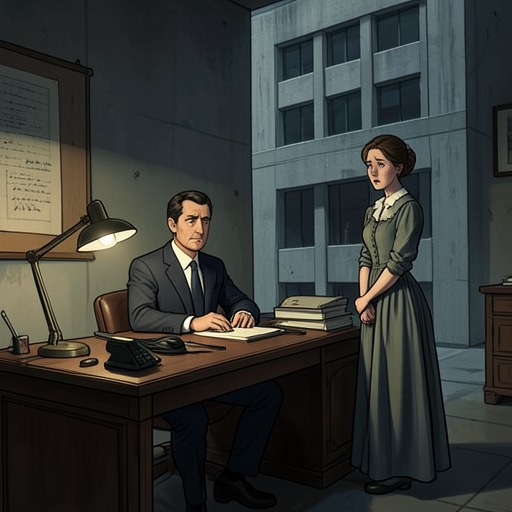
The cassette’s physical anonymity also shapes the scene of its recovery. Shirley Novello slides it across the desk to Dalziel without touching off an immediate examination of its contents. She says it was tucked away in one of the box files and allows that it might have ended up there by accident. The uncertainty is narrow but consequential: the recording’s presence is established, while the circumstances that put it there remain unexplained. Novello says she has not played it, concealing that she has already listened. Her account makes the cassette a test of trust as well as an evidentiary object.
Discovery and Playback
Novello has heard something on the recording that she does not want to admit hearing. She remains uncertain what to do until Dalziel’s patronizing use of “dear” prompts her to leave him to listen alone, intending to observe his reaction surreptitiously. Her choice turns the cassette into a private test: rather than immediately reveal what she knows, she lets the recording confront him directly. Once Dalziel agrees to listen, he takes it to the table with his computer and other electronic equipment and loads it into the cassette player.
The small pause before playback lets the object change the atmosphere of the room. Dalziel waits until Novello is seated and presses the start button. A familiar voice then announces that the recording is a voluntary statement by Palinurus Maciver Junior, made in Andrew Dalziel’s presence on March 27, 1992, at 1:37. The voice belongs to Dalziel himself. Its offhand complaint about missing lunch and its breezy invitation to Maciver to tell his story sit uneasily beside the formal announcement that a statement is being recorded. The cassette thus supplies its own initial evidence before Maciver’s account begins: the officer responsible for receiving the statement treated the occasion casually.
The Statement and Its Accusation
Maciver opens by insisting that he is making the statement of his own free will. He identifies its subject as the alleged suicide of his late father, Palinurus Maciver Senior, and says that he has already tried to communicate his suspicions without seeing evidence that Dalziel is acting on them. The recording gives that complaint a formal setting: Maciver is no longer merely voicing an opinion in conversation but making a statement addressed to the officer responsible for the inquiry.
His central allegation is that his father was deliberately driven to take his own life and that his stepmother, Kay Kafka, was involved. He expressly stops short of saying that she directly caused the death. He points to her absence in the United States when it happened, describing the distance as six thousand miles, but treats that apparent alibi as no answer to the possibility that she was implicated in some other way. He admits that he does not know the details and argues that finding them is the investigators’ responsibility. His certainty about suspected responsibility therefore coexists with acknowledged gaps in his knowledge.
Maciver’s language is openly hostile, and he frames what he suspects as premeditated murder: in his view, deliberately pushing someone to the point of suicide is culpable even if the accused person is not present at the final moment. He also speculates that Kay Kafka might have been physically present in the study despite her alibi, but presents this as a possibility rather than established fact. The recording preserves an accusation, not a demonstrated account of how Palinurus Maciver Senior died. That distinction is essential to reading the object: the statement makes the family’s suspicions audible but does not settle their truth.
Evidentiary and Narrative Significance
As the recording plays, Peter Pascoe looks at Novello and tries to keep his expression blank. He understands why she was concerned before hearing Maciver’s allegations: Dalziel’s own voice has already revealed that the interview began with a casualness incompatible with the gravity of a formal statement. Novello’s concealed prior listening and Pascoe’s restrained reaction create a second layer of meaning around the cassette. The recording is not simply information delivered to investigators; it alters what they know about the conduct of their own inquiry and about one another’s knowledge.
The wider context makes the old allegation significant without proving it. The narrative later establishes that Palinurus Maciver Senior, after losing control of the firm, raised accusations of illegal trading and sought hard evidence, while efforts were made to undermine his credibility. Those circumstances place the family’s suspicions within a broader environment of business conflict and concealed interests, but they do not establish that the cassette contains proof of his death or that Kay Kafka caused it. The recording’s force lies partly in that unresolved gap: it preserves Maciver Junior’s demand that his father’s death be investigated while exposing a flaw in the process through which his earlier account was taken.
The cassette also makes the novel’s past audible in the present. Its dated announcement fixes Maciver’s statement to a particular afternoon in 1992, while the investigators hear it after his death. The formal voice and recorded date promise an official record; the unlabelled tape, the casual opening, and the unresolved accusation complicate that promise. It is at once a surviving document, a challenge to Dalziel’s handling of the case, and a reminder that an allegation can be both consequential and unverified.