Arnold Gentry
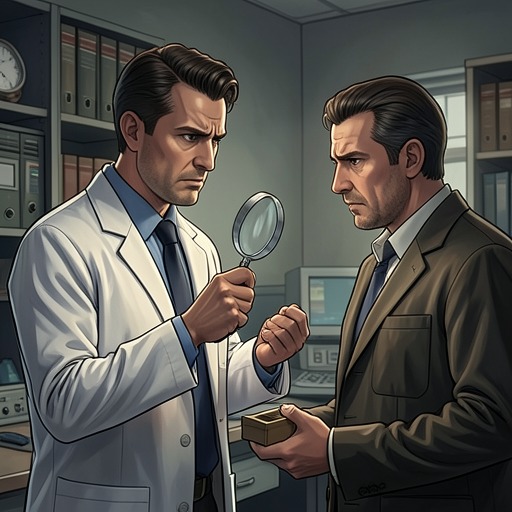
Good Morning, Midnight (Reginald Hill Edition)Arnold Gentry is the head of the Forensic Lab whose examination of material from Moscow House gives the Mid-Yorkshire CID its first concrete challenge to the apparent suicide scene. Nicknamed Dr Death for his cadaverous appearance, he combines mordant humour with forensic restraint: he can demonstrate how the study door might have been locked from outside, but refuses to turn a plausible mechanism into a conclusion. His findings make ordinary objects—ash, a lock, a gramophone, and a palm print—central to the question of whether the room was as it appeared.
Identity and Introduction
Gentry enters a conversation between Andrew Dalziel and Peter Pascoe with a deliberately alarming reputation already attached to him. His appearance has earned him the police-wit sobriquet Dr Death, reinforced by a story that he once fell asleep in a hospital waiting room and woke on a slab just in time to catch the pathologist’s wrist before an incision. The anecdote is presented as hearsay, but it captures the macabre humour through which his colleagues recognize him.
His first exchange with the detectives sustains that comic register. Gentry greets them by observing that there seems to be life in the CID, and attributes his ability to recognize it mainly to its rudeness. The banter sets him apart from the urgency of the inquiry without making him indifferent to it. He has come in person because, while passing on his way to an appointment, he wanted to respond to Peter’s urgent request by conveying the laboratory’s findings himself. He brings a plastic file from his briefcase and lays it before Andrew Dalziel.
Forensic Findings at Moscow House
Gentry’s account begins by clearing away evidence that might otherwise invite a misleading connection. A coil of rope shows no sign of ever having been used to hang or whip anyone. An ice axe bears faint residual traces of blood beneath dust and rust, but the traces are far too old to relate to the current investigation. The axe is thus evidence of an earlier, unspecified accident, not an instrument that explains the death under inquiry.
The lock provides a more consequential result. It had recently been liberally treated with high-grade lubricant, reducing the resistance encountered when turning a key. Traces of ash adhered to the lubricant and appeared on the key. At first, the ash might have been explained by the fire the dead man had lit in the waste bin. Gentry points out, however, that ash on a key would hardly have penetrated the lock while the key was inserted. Analysis identifies the ash inside the lock, and some on the key, as coming from a different source from the waste-bin fire. The distinction turns residue that might seem incidental into evidence that the scene’s physical details require a different explanation.
The gramophone supplies a possible link between that unexplained ash and the lock. Its exterior ash is consistent with the waste-bin fire, but dismantling the machine reveals a length of thin, strong, high-quality thread twisted around the turntable spindle. One loose end appears to have been severed by flame. Gentry does not claim that this proves how the door was secured. Instead, he describes a laboratory hypothesis: thread could have run from the spindle through the power-cable aperture, around the head of a key, and through the keyhole. With the key already in the inside of the lock and turned almost far enough to engage the bolt, a record playing on the gramophone could take up the slack and exert enough pressure to turn the key. The machine could be switched on from outside at the mains switch. In this reconstruction, the gramophone is not merely furniture but a mechanism that could make a locked door appear to have been secured from within.
Evidence, Hypothesis, and the Detectives’ Judgment
Gentry carefully marks the boundary between what the laboratory has observed and what the detectives may infer. He says the team is conducting experiments and that the proposed thread arrangement seems possible; he does not say it happened. He leaves conclusions to the CID and directs Andrew Dalziel to the file for the remaining results, including further analysis of the waste-bin ash. This qualification matters: Gentry advances the inquiry by showing how the apparent locked-room condition might be produced, while preserving the difference between a reproducible possibility and proof of a particular act.
His final finding shifts attention from objects to people. The SOCO team sends a palm print for comparison with the print found on the study door, and Gentry reports that the two appear to match. The second print was found in the lounge, where a childbirth took place on the same night as the suicide. His inference is spatial and specific: someone who had been in that lounge had also been on the landing, crouching outside the study door. The print links two locations within the house, although it does not identify the person or establish when the print was left.
Andrew Dalziel immediately offers alternatives: the print might belong to one of the police officers, or it might be old, since the house is for sale and prospective buyers may have been shown around. Gentry does not resolve the objection. Instead, he smiles, and Dalziel reads the expression as a sign that the most important—or most troubling—piece of information has yet to come. The scene therefore ends not with a solution but with a held-back disclosure, preserving uncertainty even as the accumulating physical evidence makes the suicide scene look less secure.
Character and Narrative Role
Gentry’s importance in this episode rests on how he presents knowledge. His macabre reputation and dry exchanges make the forensic visit entertaining, but his professional method is exact: he separates old traces from relevant ones, distinguishes the waste-bin ash from residue inside the lock, and labels the gramophone mechanism a hypothesis. He neither dramatizes the evidence into certainty nor suppresses its implications. That discipline leaves Andrew Dalziel and Peter Pascoe responsible for weighing competing explanations.
The objects he describes also change their status as the investigation proceeds. The lubricated lock, thread, spindle, and key are not initially announced as parts of a proven device; examined together, they form a possible means of simulating an internally locked door. Likewise, the palm print is not an identification, but its appearance in both the lounge and near the study gives the house’s movements a new significance. Gentry’s contribution is to make these details legible without closing the case. His findings turn the apparent simplicity of a suicide into a set of testable questions—and his final smile leaves the detectives, and the reader, waiting for the next fact.