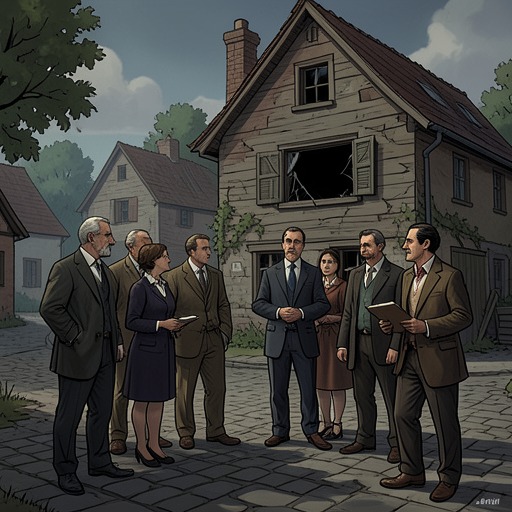
Constable Jennison
Good Morning, Midnight (Reginald Hill Edition)Constable Jennison is a uniformed officer posted at Moscow House during the investigation of Palinurus Maciver Junior’s death. His duties place him at the threshold of the house and at the edge of the inquiry: he guards the scene, reports the movements and questions of a visitor, and is later asked to help trace her. Known as Joker Jennison, he is also a source of friction and humour among his colleagues.
Identity and Introduction
Jennison is introduced on guard at the front door of Moscow House in daylight, where Peter Pascoe is surprised to find him still there. His appearance establishes a practical role in maintaining the scene while the investigation continues inside. The narrative also associates him with the nickname Joker, marking him as a familiar comic presence within the police team rather than presenting him only through his duties.
Guard Duty at Moscow House
Jennison explains that he had been relieved at about one o’clock, then returned roughly an hour before Pascoe saw him. He had been taken off car duty and sent back to Moscow House. Jennison suspects the reassignment reflects blame for allowing members of the family up the drive the previous night. Pascoe counters that even a check would not have prevented their entry, since they were family; the exchange distinguishes Jennison’s sense of responsibility from Pascoe’s assessment of what the situation required.
On the current shift, Jennison reports that no one has visited since he came on duty, and that the officer he replaced had found it quiet as well. The detail gives Pascoe a limited account of activity at the house, bounded by the hours of the officers’ respective watches rather than a claim that the site had been undisturbed throughout the day.
Information About Dolores
Jennison’s most consequential contribution is his report of a woman who repeatedly asked for details about the death, including a description of the deceased and whether any of the women were involved. Shirley Novello dismisses the incident as little, but Pascoe presses for more information, asking whether Jennison obtained the woman’s details. Jennison looks uncomfortable at that question; the exchange records his unease but does not establish why he is uncomfortable or what information he had collected.
Later, Pascoe identifies the visitor as Dolores, the name she used, and includes her in a set of investigative tasks. He directs the team to speak with women working on the Avenue and specifically orders them to find Dolores, check what Jennison has done to trace her, and follow up if that work is insufficient. Jennison’s observation therefore becomes a lead for the wider inquiry, though the evidence does not say whether he ultimately locates her.
Relationships and Narrative Role
Jennison’s comic manner is not universally welcome. Novello resents him for having once pretended to mistake her for part of a drag act booked at the Welfare Club, and reacts sourly to his attempt at humour when he is back on guard. Pascoe, by contrast, grins at Jennison’s joke and later chides Novello for approaching an interesting point indirectly. Their differing responses establish Jennison as a figure who can amuse one colleague and irritate another, without making his banter separate from the work around him.
Within the investigation, Jennison is neither its decision-maker nor a mere background guard. His shift gives him a specific vantage point on the house, and his report passes a visitor’s unusual interest to Pascoe, who turns it into a task for the team. The small exchange about whether the woman’s details were taken leaves a practical uncertainty in view: information gathered at the scene matters only if it can be followed up.