Cothersley
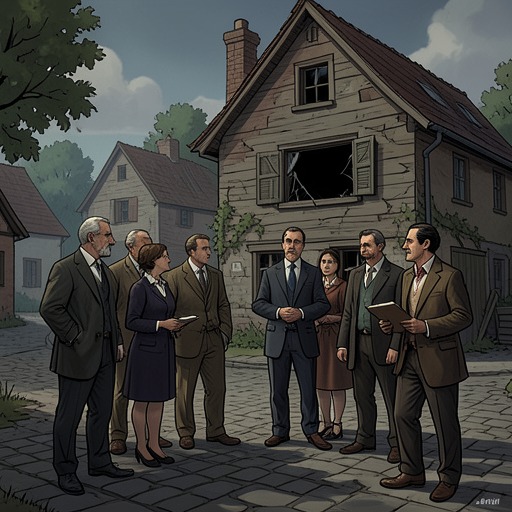
Good Morning, Midnight (Reginald Hill Edition)Cothersley is a prosperous village near Cothersley Hall, where a polished, exclusive present meets the older rhythms of parish life. The village’s church, pub, and substantial houses bring together the Maciver family, the Kafkas, local workers, and investigators; its neat surfaces conceal tensions over belonging, change, and family history.
Setting and Social Character
Cothersley is introduced in contrast with the more workaday villages of Yorkshire. Its manicured green and carefully maintained buildings distinguish it from places where rural life remains visibly practical. Peter Pascoe privately notices that even the speed bumps seem designed for robust vehicles, while a convoy of minibuses carries dust away from the village. The contrast is gently satirical: Cothersley presents itself as picturesque, but its polish is also a sign of wealth and the pressure of newcomers’ preferences.
The village is described as one of Mid-Yorkshire’s more exclusive dormer villages. Its social geography is marked by the contrast between Cothersley Hall, the Kafkas’ address, and Casa Alba, where the Macivers live. The Kafkas are treated as brash American incomers occupying the grand Hall; Palinurus Maciver Junior, with local connections and an antique-dealer’s background, lives instead in a solid, Spanish-style house. The difference between the properties complicates any simple picture of local status: the Hall is imposing, but the Macivers’ place is not a holiday villa, despite the impression its name might suggest.
Cothersley’s surroundings combine established country houses and newer substantial properties. On the road to Casa Alba, Pascoe passes through rolling countryside wooded with oak and elm, dotted with buildings of different ages. About two miles from the village, Casa Alba appears as a substantial two-storey home in burnt umber, with balconied bedrooms, practical shutters, and ochre roof tiles. Its style suggests a deliberate adaptation to winter and rough weather rather than a purely decorative imitation of southern Europe.
Church, Pub, and Village Life
At the village centre, the road divides around a manicured green. St Cuthbert’s Church faces the Dog and Duck across it, their contrasting façades giving the scene a pointedly local character: the church is severe, while the pub has whitewashed walls and a newly painted sign. The church is also part of the village’s civic life. David Upshott is its vicar, and his sister Dolly Upshott helps run parish affairs, including finances, timetables, and fêtes.
The church’s clock carries both practical value and local pride. Its chime was once a source of boastfulness for Cothersley residents: in mist or darkness, people working fields or tending sick animals could use it to know the time. That tradition was curtailed after light-sleeping incomers petitioned for the quarter chimes to be silenced between ten at night and seven in the morning. The native opposition lost the vote by five to one. David proposed a compromise during an early test of his ministry, preserving the hours while stopping the quarters overnight. The dispute makes the village’s broader divide audible: a customary sound valued by established residents becomes a nuisance to newcomers.
The Dog and Duck is likewise a marker of change. Andrew Dalziel recalls that it once served a decent pint in a jug, but complains that it has been modernized along with the rest of the village. His objections to its cold imported lagers and lack of traditional pub snacks are expressed as comic grumbling, yet they echo the clock dispute: old customs are being displaced by new tastes. Pascoe sees the pub’s updated menu, tartan upholstery, and horse brasses while looking in through a window, where Constable Jennison and another constable are taking their ease at the bar. Later, as village drinkers disperse, the pub remains a gathering place for local news and grief. Sue-Lynn Maciver speaks openly of her new widowhood to customers willing to buy her a drink, while Dolly sits alone with a vodka and tonic and her mobile phone.
Parish Networks and the Macivers
The Macivers’ relationship with Cothersley is expressed less through regular church attendance than through practical generosity. Dolly says they were supportive of church events and appeals. In the week before Palinurus Maciver Junior’s death, he brought a carload of goods for a parish sale. He declined to reserve the better antiques for the shop, saying that he wanted villagers to share the pleasure of finding bargains. His contribution was not merely financial: it placed his trade and enthusiasm at the service of the parish. Dolly’s voice falters as she recalls it, registering the closeness between ordinary village life and the recent loss.
Dolly’s own place in Cothersley is built through work. She came to stay with her brother David three years before the events of the investigation, after caring for their ill mother. What began as a rest became substantial unpaid parish work. She later met Palinurus through her collecting rounds and as a neighbour and parishioner. Their acquaintance led to a job in his antique business; she became involved in the shop’s accounts and took charge when he was away buying. Her path links the vicarage, parish finances, and local commerce, showing how a small community’s institutions overlap.
The village also sits within the Maciver family’s longer history. After Kay Kafka and Helen returned from America following a sudden death in the family, they initially stayed with Tony Kafka in Cothersley, then moved to the Golden Fleece Hotel, where the company kept a suite for important visitors. They remained there for several weeks before moving into town. Nearly a year later, Kay and Tony married and returned to Cothersley Hall. The Hall’s position in village life thus reflects not simply a fixed family home but a succession of arrivals, departures, and changes in household allegiance.
Investigation and Narrative Role
Cothersley becomes a working landscape for the inquiry into Palinurus Maciver Junior’s death. Peter Pascoe is sent to speak with the grieving widow, and Andrew Dalziel directs him toward Cothersley while warning him not to stir up trouble without considering the consequences. Pascoe, under pressure to make progress, sets out to question the people around the family. The village’s close arrangement of church, pub, Hall, and private homes makes it possible for family connections and local knowledge to intersect quickly.
The investigation repeatedly passes through the village’s public spaces. Pascoe drives through Cothersley while arranging to speak with Cressida Maciver, and later he and Dalziel again encounter activity on the green outside the pub. A police car is nearby, and the constables stand beside a mound resembling a model of Great Gable, speaking with an unhappy man. The moment is presented without immediate explanation, leaving the village’s familiar green as a stage where new developments can surface.
Cothersley’s narrative significance lies in this double character. It is both a setting of attractive façades and a place where practical loyalties remain visible: parish fundraising, a clock debate, a shopkeeper’s generosity, and a sister’s unpaid work all give the village a life beyond its scenery. At the same time, the divide between long-standing residents and affluent incomers makes change legible in small details. The chimes, the pub, the houses, and the congregation each reveal who feels at home in Cothersley—and whose preferences are reshaping it.