Cothersley Hall
Good Morning, Midnight (Reginald Hill Edition)Cothersley Hall is a country manor near Cothersley, home to Tony Kafka and Kay Kafka and a place where the novel’s historical setting and contemporary business and family conflicts meet. Its old brick exterior, extensive grounds, and modern glass-sided additions make the house a deliberate contrast of eras; its rooms also provide the setting for intimate domestic exchanges and tense encounters with investigators.
Setting and architecture
The Hall stands near the village of Cothersley. Its first appearance is framed by dawn mist and an ivy-covered western elevation that could suggest a seventeenth-century manor preserved in its original age. That impression is unsettled by the long, mainly glass-sided extension and the view through it of an indoor swimming pool and a table with a glowing computer screen. The building is not simply an old house with modern comforts: the contrast between its historic appearance and contemporary use is built into how the reader first sees it.
A later approach gives the estate a different emphasis. Peter Pascoe drives through a gateway and along a curving avenue of ancient beeches, with the gates closing behind him before the Hall comes into view. He sees a south-facing, brick-built seventeenth-century house, balanced in scale and softened by ivy. From this angle, the glass extension is on the western side; Pascoe notices the swimming pool beyond it and judges that the architect has tried to preserve the harmony of the older building. The narrative thus lets the house’s traditional appearance and its modern facilities remain in tension rather than resolving one into the other.
The entrance and grounds also shape other visitors’ impressions. Shirley Novello arrives through open gates and takes in the imposing entrance, tree-lined drive, extensive grounds, and house still surrounded by traces of morning mist. She contrasts this remote setting with Moscow House, where other buildings and nearby shops were within reach. To her, Cothersley Hall’s isolation raises the question of what it means to live there, whether alone or with a partner. Her response makes the estate’s distance from ordinary town life part of its character, rather than merely a measure of its grandeur.
A home made over time
The Hall becomes Kay and Tony’s home through a sequence of changes in residence. After returning from America, Helen Dunn and Kay first stay with Tony at Cothersley for a couple of days. They then move to the Golden Fleece Hotel, where Ash-Mac has a suite for important visitors, and later to a flat in town. Nearly a year after Kay and Tony marry, they move back to Cothersley Hall. The account presents the house as a destination reached after temporary arrangements, not as the family’s uninterrupted home from the outset.
For Kay, the Hall is also bound up with Tony’s decision to remain in Britain. She recognizes that he had wanted to return permanently to the United States, but he stayed while Helen was pregnant because he understood how she would feel about his leaving. Kay dislikes Joe Proffitt but feels unable to speak too forcefully against him; she believes Tony’s sense of obligation has kept him in place while Proffitt’s business certainties remain largely unchanged. Later, when Tony speaks of going home, Kay’s concern reveals a difference in what the word means to them: for her, Cothersley Hall has become home, especially after the previous night. The residence therefore represents both settled domestic life and a possible point of disagreement about where that life should be.
Domestic interiors and encounters
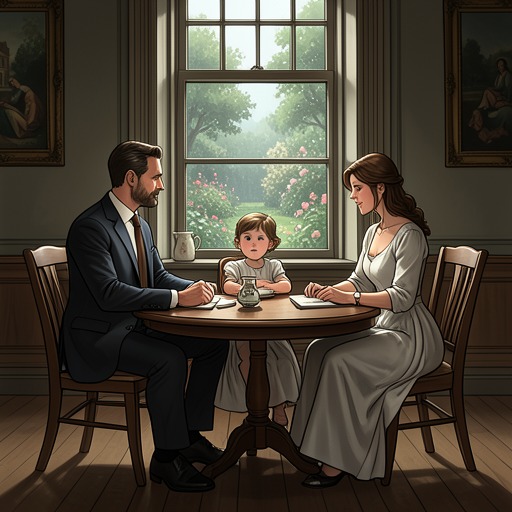
The Hall’s modern domestic life appears in small, concrete scenes. At dawn, Tony sits at a table beside a computer screen, dressed in a black silk robe. Kay enters in a white towelling robe carrying breakfast: croissants, butter, mugs, and coffee. Their exchange takes place between the older house and its contemporary extension, and Tony’s announcement that someone has returned quickly makes the room a setting for news as well as routine. The breakfast scene locates the Kafkas’ private life in a house that is at once stately and technologically current.
The interiors also become places where visitors test the atmosphere of the household. When Peter Pascoe comes to see the Kafkas, Tony leads him into a long, airy reception room, where Kay is sitting on a chaise longue. Tony jokes about the best position for an interrogation and asks whether Pascoe intends to question them together or separately. Once Tony has left the conversation, Pascoe asks Kay about her relationship with her stepson. She says it ended better than it began, while questioning the relevance of the inquiry. The reception room’s polished domestic setting thus accommodates an investigation into strained family history without ceasing to be a living space.
On another visit, Kay greets Andy Dalziel and Pascoe at the house in a bathrobe, explaining that she has been trying to contact her husband since waking. Pascoe considers whether her appearance might be intended to distract Dalziel, then dismisses the thought. The scene keeps the house’s private, informal character in view even as the police arrive on serious business. Later, after Dalziel’s attempt to close the gates as he leaves fails, he returns to the large living room, where Kay has remained. The open grounds, house, and interior rooms repeatedly shape the movement between arrival, questioning, and private conversation.
Family conflict and narrative significance
Cothersley Hall is not presented as a neutral refuge from the Maciver family’s conflicts. In a statement, Pal Maciver Junior alleges that Kay went there after she could no longer get back inside Moscow House, describing it as Tony’s pleasure residence. His accusation forms part of a broader hostile account in which he attributes his father’s death and the family’s divisions to Kay. These claims belong to Pal’s statement and are not established as objective facts by the location itself; they show how the Hall has become a target in his interpretation of her actions and attachments.
The contrast with Moscow House is central to that meaning. Helen recalls that, after returning from America, she and Kay could not initially enter Moscow House. She later learned that Pal had changed the locks. Cothersley Hall, by contrast, becomes the place where they stay with Tony, and eventually the home Kay shares with him. The movement between the two houses traces both practical displacement and family division: Moscow House is associated with the dispute over access and inheritance, while Cothersley Hall marks Kay’s new domestic life with Tony.
The estate’s double character gives it a role beyond a picturesque backdrop. Its architecture places historical appearance beside modern technology; its distance from town registers both privilege and isolation; and its rooms shift readily from breakfast setting to interview space. Through the changing views of Tony, Kay, Helen, Pal, Pascoe, and Novello, Cothersley Hall gathers conflicting ideas of home: a chosen residence, a place of refuge, a source of suspicion, and a setting in which the past remains present in current family and police business.