Dolores's voicemail
Good Morning, Midnight (Reginald Hill Edition)Dolores's voicemail first appears as a private greeting made public for investigative purposes. Its recorded voice identifies the speaker as Dolores and adopts the persona of Your Lady of Pain; later, Andrew Dalziel replays the greeting for Peter Pascoe. The message matters not only for what it says, but for the way its number helps the detectives reconsider who may have tried to contact the family that evening.
The recorded greeting
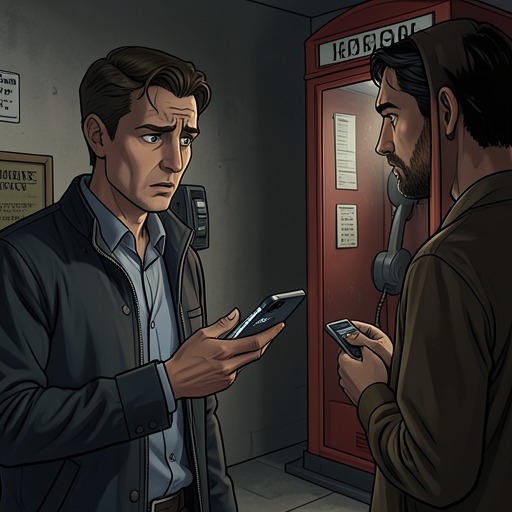
A character takes out a mobile phone, dials a number, and holds it so that two people can hear the recorded message. The voice is identified as a woman's, with a husky quality and a foreign manner of speech. Dolores introduces herself, explains that she cannot take a message immediately, invites the caller to leave one, and says she will respond when free. The greeting ends by presenting anticipation as part of pleasure. The message therefore establishes a deliberate, recognizable persona without disclosing the circumstances of any particular call.
That distinction is important: the recording is not a conversation between Dolores and the person who dialled. It is a prepared announcement heard by someone trying to reach her. Its playful performance may make the number memorable, but the greeting itself cannot establish who called or why. The object carries evidence in two forms: the words on the recording identify the voicemail's owner, while the call history associated with the number supplies a separate lead.
A number becomes a clue
In a later investigative exchange, Andrew Dalziel's manner shifts from threatening to sardonic. He picks up his phone, dials a number, and passes the handset to Peter Pascoe. Pascoe hears the opening of Dolores's greeting, which confirms that this is the same voicemail being used in the inquiry rather than an unrelated reference to her. The repetition turns a previously heard personal message into a piece of evidence that can be tested in front of another investigator.
Andrew Dalziel explains that this was the only number that had tried to contact the business, the home, and a mobile phone around seven o'clock. On that basis, he says the expected caller should have been Jason Dunn. The timing and the number's pattern of attempted contact thus make the voicemail relevant to the reconstruction of Jason's communications. The recording does not itself name Jason; the inference comes from the surrounding phone activity and the investigators' expectations about who would have been calling.
Discovery and evidentiary limits
Andrew Dalziel credits Hat Bowler with spotting the number. His remark presents the discovery as an instance of Bowler's sharpness and connects the clue to the work of the investigative team: a detail in the call records has been noticed, followed up, and made audible to Peter Pascoe. The voicemail's repeated appearance marks the progression from noticing a number to examining where it leads. First the greeting is played for two listeners; later Andrew Dalziel deliberately calls back and lets Peter Pascoe hear it for himself.
The conclusion remains suggestive rather than definitive. Andrew Dalziel says the number meant the caller should have been Jason Dunn, but the excerpt supplies no independent confirmation that Jason personally placed the call. Nor does hearing Dolores's recorded message establish that she spoke to the caller. The phone and its stored contact trail narrow the field of inquiry; they do not settle the identity of the person using the number. That gap keeps the voicemail useful as a clue without turning it into proof.
Narrative function
The greeting's function changes with its setting. In its first appearance, it is a recorded message played aloud, with the speaker's self-presentation taking the foreground. In the later scene, the same voice is reduced to a recognizable opening that helps verify the number under discussion. The return is economical: the reader recognizes the message as the investigation assigns it a new use, and what had sounded like a private flourish becomes part of a timeline.
As an object, Dolores's voicemail joins intimacy to procedure without resolving the mystery. Its distinctive greeting identifies the destination of a call, while the surrounding call pattern points toward Jason Dunn as the expected caller. Hat Bowler's recognition and Andrew Dalziel's demonstration bring that lead into the conversation with Peter Pascoe. The voicemail consequently serves as a small but consequential link between recorded identity and uncertain human action: it can tell the investigators whose message they are hearing, but not, by itself, who called.