HM Customs and Excise
Good Morning, Midnight (Reginald Hill Edition)HM Customs and Excise functions in the novel as both a credible public identity and a screen for covert inquiry. Laurence Waverley uses the appearance of a value-added-tax investigator to gain access to Ash-Mac’s after the takeover of Maciver’s business, while his actual instructions come from unnamed government masters concerned about allegations of illegal trading. The contrast exposes how an ordinary regulatory role can provide cover for intelligence work without making the two institutions identical.
A regulatory identity used as cover
Waverley says he used the VAT investigator role because it was a familiar cover that went deep: tax investigators naturally attract suspicion, so people are less likely to imagine they might be working for another kind of authority. A detailed CV for Laurence Waverley in HM Customs and Excise personnel records helps make that identity usable. His ostensible assignment is to investigate possible VAT irregularities at Ash-Mac’s, giving him a reason to approach Maciver and compare the firm’s current record-keeping systems with those used before the takeover.
The cover works partly because Waverley presents himself as dissatisfied with the new regime. Maciver, believing the visitor shares his misgivings, begins to confide concerns about the company. Waverley thereby gains information through an apparently routine professional conversation, rather than through an overt intelligence approach. The passage describes the tax role as a disguise Waverley chose; it does not establish that HM Customs and Excise itself directed the covert operation.
The investigation behind the disguise
The covert inquiry begins amid concern that Palinurus Maciver Senior, sidelined into an advisory directorship after the takeover, is accusing the firm of sanctions-busting and other illegal trading. The allegations could become a scandal if he produced hard evidence. Waverley’s masters, wary of the American management’s assurance that the matter was under control, send him to Yorkshire to assess the situation independently.
Using his cover, Waverley learns that Maciver has hired Jake Gallipot to obtain evidence. Waverley investigates Gallipot and describes using a combination of threat and bribery to bring him onto the government side. He also concludes that Maciver has been cut off from legitimate access to sensitive areas of Ash-Mac’s, leaving him able to make accusations but, as Waverley initially sees it, unlikely to substantiate them. Waverley recommends undermining Maciver’s credibility and allowing events to take their course. These actions belong to Waverley’s covert work, not to any clearly identified formal Customs and Excise procedure.
A vulnerable cover and its personal consequences
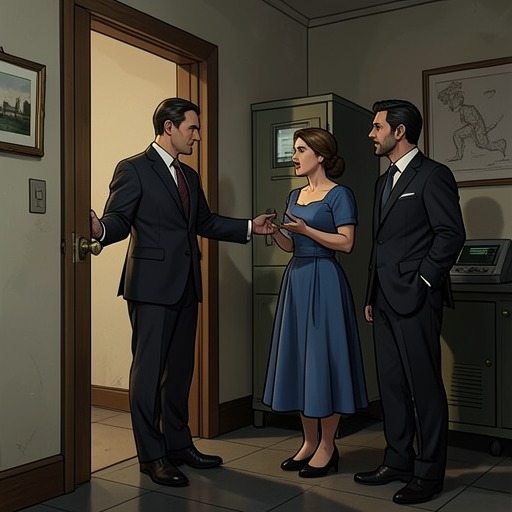
Waverley’s role as a VAT investigator also gives him a plausible reason to visit Lavinia Maciver. He introduces himself in that capacity and later returns under the pretext of retrieving gloves. When he offers her a ride home, he acknowledges that his motives are mixed: she is a possible loose end, but he is also personally intrigued by her. He says that bending the rules for a buttered scone was the only time he had done so, an admission that makes a small act of hospitality the point at which his professional self-description falters.
After Palinurus Maciver Senior’s death, Waverley goes to Blacklow Cottage so that Lavinia will hear the news from him rather than from a police officer. He recognizes that this choice risks drawing a coroner’s attention to the apparent VAT investigator’s contact with Maciver shortly before the death. His masters, he says, do not want their officers on the public stage, whatever the quality of their cover. The danger is therefore not simply that the disguise might fail: Waverley’s actions could expose the covert operation and complicate the official account of the dead man’s state of mind.
Institutional boundaries and concealment
The wider account places Waverley’s work within a landscape of public and covert government agencies, rumor, and corporate secrecy. Ash-Mac’s activities and security have become, in practice, a covert responsibility of people in Whitehall and Westminster, with others in Washington monitoring events. In that arrangement, the VAT-investigator persona provides a local point of entry, while the actual assessment is shaped by officials who remain outside public view.
HM Customs and Excise is significant less as an active organization in the investigation than as the credible administrative face Waverley borrows. Its records and the recognizable suspicions attached to tax investigations lend his disguise depth; the institution’s ordinary purpose makes an extraordinary intelligence role harder to detect. The resulting irony is that a supposedly routine inquiry into tax irregularities opens a channel into allegations involving sanctions, arms trading, and the suppression of corporate dissent.