Hat Bowler's bereavement and grief
Good Morning, Midnight (Reginald Hill Edition)Hat Bowler’s bereavement leaves him caught between a remembered life with the woman he loved and a present he can scarcely inhabit. Her death in a car accident drives his sleeplessness and recurring forest dream; when he returns to a place bound up with their intimacy, the boundary between dream and waking life blurs. The grief is not resolved by that encounter: it is interrupted by news of another death, which Hat witnesses as he emerges from his own inward world.
Loss and its immediate aftermath
The woman Hat loved more than life itself died in a car accident on a Saturday in late January. He went back to work on Monday, apparently without difficulty, but that outward return concealed a collapse in energy and purpose. When Peter Pascoe looked at him, he insisted that Hat see his GP. Hat regarded the recommendation of complete rest and psychotherapy with exasperation, and expected Pascoe to share his resistance. Instead, Pascoe warned that refusal could be made official and recorded for future promotion boards. Hat considered the threat empty because he believed he had no future, yet lacked the will to resist it.
His grief is marked by an absence he cannot readily name. When Dr Pottle asks what Hat hopes to find if he escapes the forest, Hat cannot bring himself to say the dead woman’s name; he knows that any hope of finding her is delusional. The silence does not mean she has ceased to matter. Rather, the scene makes the loss so present that even naming its object seems unbearable. Pottle answers as though Hat has spoken, observing, “It can be a terrible thing, hope.” Hat replies, “Thought that was what you tried to give people.” Pottle distinguishes his work from reassurance: “Oh no. Change is my game. But I never guarantee it will be for the better.”
The forest and the work of memory
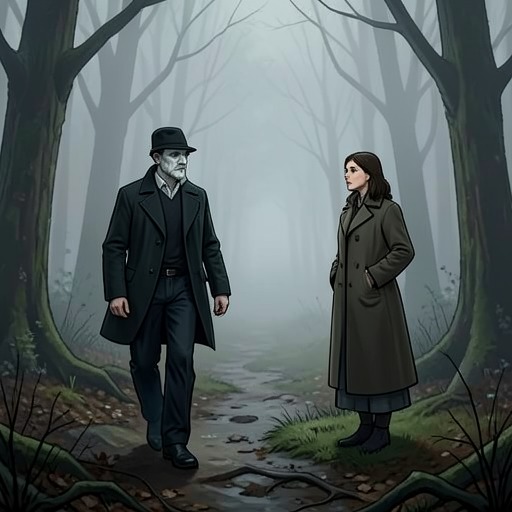
At the story’s opening, on the first day of spring, Hat is lost among trees in a recurring dream. The experience is familiar enough that he sleeps as little as possible, fearing that closed eyes will return him to a forest so crowded with trees that they admit only enough light to show there is no way out. Dr Pottle calls it “the primal forest.” The dream gives grief a setting and a repeated action: Hat is trapped, unable to see a path forward, and repeatedly made to wake into the same absence.
The narrative connects this dream to a real place and a particular memory. In autumn, Hat had driven through the Yorkshire countryside in his MG with the woman beside him. A deer leapt from a copse in Blacklow Wood, forcing him to stop. The two of them pushed through a hedge, sat beneath a beech tree, drank coffee and talked more freely and intimately than before. Hat understood the meeting as a milestone in their relationship, though the journey together proved far too short. The tree is therefore not simply scenery: it holds a moment of closeness that his present life can revisit but cannot recover.
The day before the spring dream, Hat returned to the same spot and sat beneath the same tree. Darkness fell and mist thickened, but he remained indifferent to both. When he eventually set off for his car, he realized he had lost his way. He wandered for an indeterminate time over rough grass and boggy fields, then, exhausted, lay down beneath another tree and slept. The actual disorientation echoes the dream’s entrapment, while the change of trees separates the cherished place of memory from the exposed conditions of his present grief.
A path opens, then breaks
In the dream, change comes gradually. The trees stand farther apart, a broad track winds between them, and Hat walks through hazy sunlight with birdsong around him. His ear identifies the birdsong as a sign of morning. At first he advances quickly, but slows as he understands what the opening path might mean: escape makes it possible to hope, and hope means confronting how terrible it would be not to find what he longs for. His response is consequently divided. He feels both disappointment and relief when the route leads him into a sunlit clearing rather than to the lost woman.
The shift from dream to waking is not presented as a clean escape. A vibration breaks through the “film of ice” separating dreams and reality, and Hat remembers the preceding day: the autumn meeting beneath the beech tree, his return there, and his night lost outdoors. The recollection gives his disorientation a history, but does not restore the life that made the place meaningful. Memory can bring him back to the scene of intimacy; it cannot undo the accident or make the past available again.
Witnessing another loss
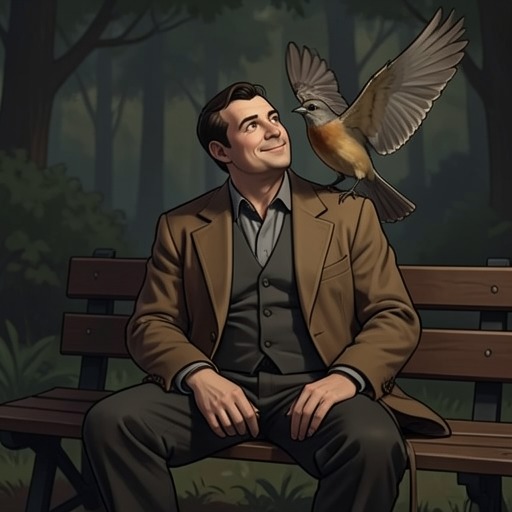
Hat wakes beneath branches as the fog clears and the sun rises, at first imagining that he is still asleep. He finds himself in Lavinia Maciver’s kitchen, where Laurence Waverley tells her that her nephew Pal has died by suicide at Moscow House, like her brother before him. Hat has emerged from introspection just in time to hear the news. The birds’ soft chirping, which had accompanied the scene, falls silent to him as the death is disclosed; Lavinia, in turn, sits speechless for almost a minute before asking whether she is needed and what she should do.
This encounter does not provide a cure or a neat conclusion to Hat’s bereavement. Instead, another person’s shock interrupts his private grief and makes him a witness to loss beyond his own. Lavinia’s request for advice, and Waverley’s suggestion that she come with him and find out what there is to learn, place them abruptly on first-name terms; Hat notices both their changed intimacy and his own obtrusive presence. His arc remains unresolved: the path through the forest has opened, but hope is still painful, and the morning brings news of death rather than reunion.