Junius
Good Morning, Midnight (Reginald Hill Edition)Junius is an unidentified digital intruder who returns to Ashur-Proffitt’s website under the new alias NewJunius. The breach brings a politically charged text to Kay Kafka and Tony Kafka, making Junius significant less as a physically present character than as the unseen source of a public challenge: the company’s business is placed beside a history of arms sales and arguments about whose interests it serves.
Identity and Introduction
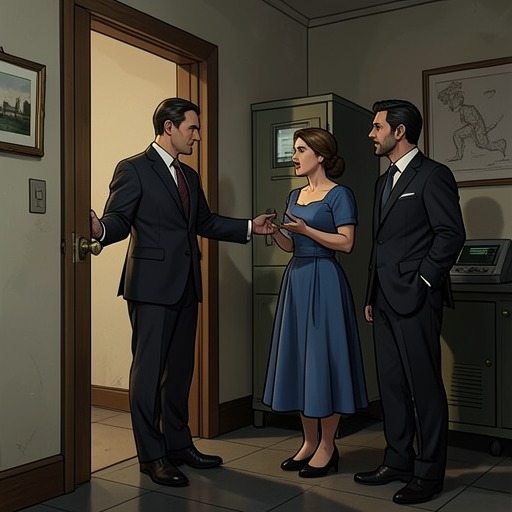
Junius first becomes present in this scene through Tony’s terse announcement to Kay: “He’s back.” The wording establishes recurrence without explaining what happened during the earlier intrusion. When Kay asks whether the intruder is Junius, Tony confirms that the latest material is much the same as before, but that he now calls himself NewJunius. The alias signals a fresh online presentation rather than a disclosed change in identity; the text supplies no real name, biography, or account of who is behind the screen.
Tony reports that Junius has broken in again, left messages, and supplied a hyperlink. His irritation is practical and dry: he says that the intruder’s style has not improved, even as the repeated breach demonstrates that the problem has not been resolved. Kay’s question about whether such access was supposed to be impossible points to a gap between assurances of security and what has happened in practice. The novel does not explain the technical means of entry, so Junius’s power remains defined by the visible result: messages and linked material appear where the company’s defenses were expected to keep them out.
The Linked Text and Its Argument
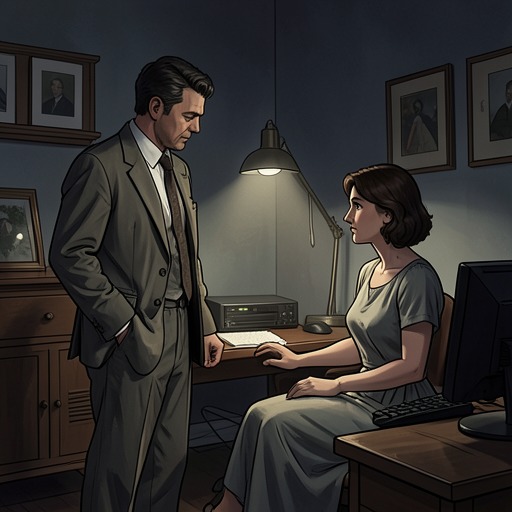
The screen presents a piece headed “ASHUR-PROFFITT & THE CLOAK OF INVISIBILITY,” with the subtitle “A Modern Fairy Tale.” Its opening recasts the Iran–Contra affair and British arms sales during the Iran–Iraq conflict as a story about officials who treat opposing sides as useful recipients of weapons. The deliberately casual fairy-tale voice turns serious political history into a tale of people who act against their own countries’ laws while remaining, in the piece’s central image, invisible to those in charge. The screen’s headline connects that image directly to Ashur-Proffitt, suggesting that the company too benefits from a failure of scrutiny.
The argument sharpens in the ending, which Kay identifies as the only part that holds her attention. It rejects the older justification that an enemy’s enemy can be treated as a friend and arms supplied accordingly. In its place, the text insists that American political divisions do not remove the need to decide which side weapons will serve; Ashur-Proffitt’s motive alone is no longer an adequate defense, and the company should be asked where its loyalties lie. The piece thus moves from a satirical account of government conduct to a direct question about corporate responsibility. It does not simply expose an intrusion: it uses the intrusion to circulate an accusation.
Style, Reception, and Uncertainty
Kay’s reading supplies the scene’s most sustained assessment of Junius’s writing. She regards the whimsical, convoluted style as dated and tedious, recalling a manner that might once have seemed fashionable but no longer does. That judgment matters because it distinguishes the text’s rhetorical success from its literary manner: the delivery may strike her as stale, yet the final paragraph still catches her attention. Junius’s intervention is therefore not presented as persuasive merely because it is rebellious or technically difficult. Its force lies in the specific political challenge that survives Kay’s impatience with the prose.
The scene also withholds any settled explanation of Junius’s purpose. The linked text attacks the political logic surrounding arms dealing and asks who benefits from it, but the evidence does not establish whether the intruder’s motives are patriotic, personal, commercial, or otherwise. Nor does it show the consequences of this particular breach beyond Tony and Kay’s discovery and reading of its contents. Junius remains an attributed presence on a computer screen: named by Tony, renamed online, and known through messages and a pointed essay rather than through direct encounter.
Narrative Role
Junius’s return brings the novel’s corporate and political concerns into the domestic conversation between Kay and Tony. Tony reports the security breach; Kay reads the linked text and considers its argument alongside Tony’s feeling of being foreign in Britain and the question of where their home lies. The juxtaposition does not prove that Junius intends to influence their private decision, but it places the public dispute over allegiance beside a personal discussion of belonging. The Stars and Stripes appearing on the screen after Kay finishes reading leaves the political symbol in view as the scene turns back to those intimate questions.
That screen-bound form defines the character’s narrative effect. Junius can interrupt the company’s apparent control of its own communications, but the novel withholds the person behind that interruption. What reaches the reader instead is a sequence of traces: an announced return, a new online name, messages, a hyperlink, and an argument whose sharpest question is whether the company’s interests can still excuse the consequences of its actions. The unresolved identity sustains the distinction between the intruder and the claims carried in the intruder’s text; the scene makes those claims legible without making their author fully knowable.