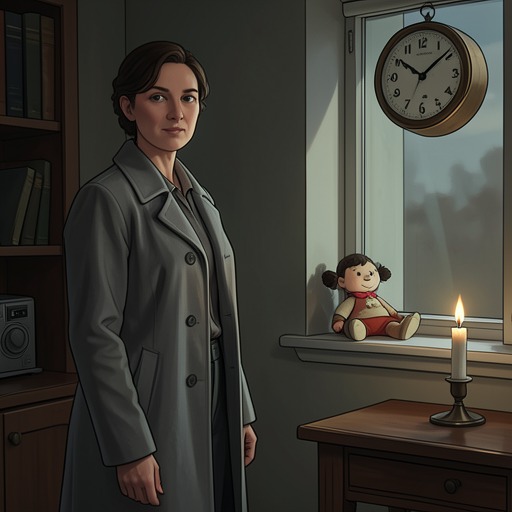
Kay Kafka’s prolonged grief after losing her daughter
Good Morning, Midnight (Reginald Hill Edition)Kay Kafka’s prolonged grief after losing Alba Dickenson shapes both a decisive hospital choice and the slow return to ordinary life that follows. The loss is not resolved by that return: it remains a measure of Kay’s love, guilt, and attention, even as work eventually gives her a renewed sense of where and who she is.
The loss and the decision
At the crèche, Kay finds alarm and confusion focused on Alba, who has suffered a seizure. An ambulance takes them to hospital. During the journey, lines from an Emily Dickinson poem keep recurring to Kay; the verses sound to her both valedictory and threatening. The poem gives the scene a frame of foreboding, but the medical crisis itself is starkly specific: the doctors name acute viral encephalitis, while Kay feels unable to see beyond what the illness has done to her child.
Kay remembers Alba as bright, beautiful, laughing, and loving, and cannot accept that the unresponsive child before her is beyond her reach. Her love remains, but she feels it cannot help and turns the failure into self-blame. The doctors eventually tell her that there is no hope of recovery and that machines alone are keeping Alba breathing. They need Kay’s permission to switch them off. She gives it. The decision is presented not as release from grief but as another burden within it: Kay experiences the required consent as having to participate in the loss of the child she has already lost.
Withdrawal and the slow return to daily life
After Alba’s death, Kay is enraged by people who describe it as a blessed relief. Her response is so fierce that their consoling phrases often remain unfinished. Tony Kafka is the person whose words reach her; his blunt advice is to endure, because life will not improve but she can grow stronger. Kay later recalls how often she needed him. His support takes practical as well as emotional form.
Kay leaves college, has no energy for it, and applies for full-time work in the company canteen. She describes choosing the easy route and recalls little of that period, though she suspects that her misery made her a poor waitress and may nearly have cost her the job. Tony intervenes again: personnel tells her that she is to start in his office the next day. She does not ask what the work entails or object. For what she remembers as eight, nine, or ten months, she follows the office supervisor’s instructions, word-processing, filing, and making coffee. The uncertain duration itself conveys how indistinct this stretch remains in her memory.
Kay says she emerges from her shell of grief only very slowly. Major upheavals and crisis meetings take place around her, but she registers them without developing interest or understanding. Her indifference may, she reflects, have been mistaken for loyalty and dependability. The result is a gradual change in her work: she becomes the personal assistant’s gofer, and after that capable assistant is head-hunted, Kay works alongside her for nine months. Kay expects the position to be advertised and only tentatively considers applying. Instead, she arrives one morning to find her own name being stencilled on the office door.
A moment of self-recognition
The new position produces a small but sharply defined break in the pattern of grief. Kay is so astonished by the change that she does not think of Alba for over an hour. When she does, she is, for the first time since Alba died, fully aware of who she is, where she is, and what she is doing. The passage does not present the hour as forgetting in any lasting sense, or as proof that the loss has passed. Its importance lies in the brief return of attention to the present: grief has occupied her so completely that ordinary self-awareness itself becomes a significant change.
Work supplies structure without being described as a cure. Kay’s duties move from basic office tasks to a position carrying greater responsibility, while her memory of the period remains partial. The contrast between that indistinct time and the exactness of the hour in which she recognizes herself makes the moment of awareness stand out. Alba remains central to Kay’s life, but the memory also records that Kay can again perceive her own surroundings and actions.
Grief, love, and the work of protecting Helen
Later, Kay speaks of another bereavement: the suicide of her husband, Palinurus Maciver Junior. Her reflections distinguish this loss from Alba’s death while showing grief returning in a changed family crisis. Kay cannot be certain why Palinurus died and considers whether he had been troubled by guilt, but she rejects the idea that she alone was responsible. She acknowledges a wider family failure to give him enough reason to remain alive, without accepting sole blame. Her account also recalls the Emily Dickinson volume she had given him as a token of love and wonders whether he had opened it to a poem that might have seemed to him like a message. These are possibilities Kay considers, not explanations she can establish.
Kay’s response to Palinurus’s death turns toward the living. She does not condemn his son, Palinurus Maciver Junior’s son and her stepson, for reacting badly after finding his father, but insists that he must stop harming himself and others through that reaction. Her immediate purpose is to protect Helen Dunn and help her through the pain. This later crisis does not erase Kay’s grief for Alba; it shows her directing the strength she says she has toward the care of a child who still needs her. Across both losses, the account holds together love, self-reproach, and responsibility without claiming that one cancels another.