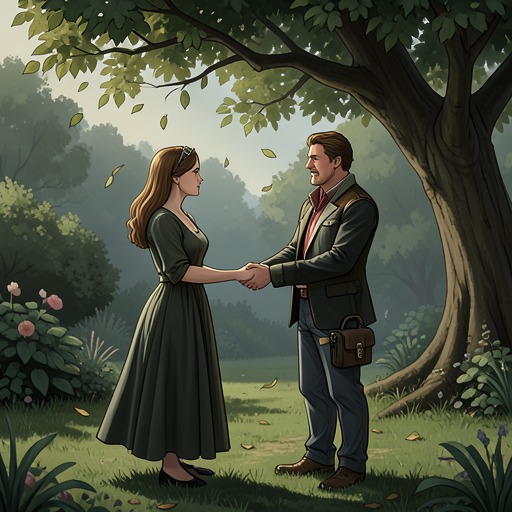
Palinurus Maciver Jr and his aunt Lavinia Maciver’s bond
Good Morning, Midnight (Reginald Hill Edition)Palinurus Maciver Junior and Lavinia Maciver are nephew and aunt, but the novel gives their bond definition through brief encounters, family conflict, and the aftermath of his death rather than through a continuous history of intimacy. Lavinia is the sister of Palinurus Maciver Senior, and the news that her nephew has died by suicide in Moscow House immediately echoes the earlier loss of her brother. Their last reported meeting, a visit that ended with Palinurus responding warmly to Lavinia’s care for birds, becomes the most personal surviving trace of their relationship.
Family Connection and the News of His Death
Lavinia’s place in the family is first made explicit when she arrives at Moscow House: she is Palinurus Maciver Senior’s sister and Palinurus Maciver Junior’s aunt. She has not learned of the death through the usual channels. Because she avoids telephone and broadcasting equipment, she knows nothing of the tragedy until Laurence Waverley comes to tell her. The news is therefore delivered as an act of personal friendship, but its content reaches beyond one death: Palinurus has killed himself, as his father did before him.
The comparison is not abstract for Lavinia. When Waverley tells her that her nephew is dead, she immediately understands the implication of his reference to her brother. Her response is a stunned silence followed by a request for guidance: she asks whether she is needed and what she should do. The scene shows the family tie becoming an urgent practical question. Lavinia does not claim to know what role she should take; she turns instead to Waverley, who advises her to come with him and find out what there is to learn. The shock also changes the formality between them, drawing them onto first-name terms as she confronts the news.
The Last Visit and Lavinia’s Recollection
The clearest account of Palinurus and Lavinia together comes later, during a confrontation with Sue-Lynn Maciver over the will. Sue-Lynn says that Palinurus visited Lavinia the previous week, reportedly for the first time in many years, and accuses her of having discussed his will with him. Her anger makes the visit sound like evidence in a dispute over inheritance. Lavinia answers that money was not mentioned. She does not deny that Palinurus came; instead, she offers a different account of what made the meeting memorable.
Lavinia recalls that the visit felt peculiarly like a farewell. Palinurus, who had not usually shown much interest in wildlife, took pleasure in watching the birds at her home. She remembers him telling her, “Maybe you got it right after all, Vinnie, opting for the birds.” In the middle of an argument that reduces the visit to a possible financial motive, this recollection preserves a smaller, more particular exchange: he noticed the life Lavinia had chosen and acknowledged its value. It does not establish that the two had become close, or explain why he came, but it gives the meeting an emotional significance distinct from Sue-Lynn’s accusation.
Kinship, the Will, and Conflicting Accounts
The disagreement over Palinurus’s altered will exposes how easily their family connection can be recast as a question of property. Sue-Lynn threatens to challenge the will on grounds of mental incompetence and invokes the similarity between the father’s and son’s suicides as evidence that the authorities should examine Lavinia and her birds. Lavinia responds that she has no interest in depriving Sue-Lynn of what belongs to her. Her account of the visit likewise rejects the claim that money was discussed, while leaving Palinurus’s purpose unresolved.
When Laurence Waverley later asks why Palinurus might have changed the will, Lavinia cannot offer a definite explanation. She recalls Sue-Lynn’s allegation that Palinurus had hired a private detective to follow her and speculates, with evident distaste, that Sue-Lynn may have been involved in some misconduct. This is conjecture, not a solution to the dispute. The novel preserves the difference between what Lavinia knows—that her nephew visited, and that he seemed to find pleasure in the birds—and what she cannot know about his intentions or his decisions. The visit therefore remains vulnerable to competing interpretations without being reduced to either one.
What the Bond Reveals
Lavinia’s recollection gives Palinurus a moment of responsiveness within a family story otherwise marked by death, accusation, and uncertainty. His remark suggests that, on this occasion, he recognized something worthwhile in the life she had made among the birds; her attention to the detail suggests that his response stayed with her. The evidence is suggestive rather than comprehensive: the narrative does not supply a long record of their contact or establish the depth of their affection. Indeed, Sue-Lynn’s claim that the visit followed years without contact sits beside Lavinia’s account without becoming a full history of the relationship.
That restraint matters. Lavinia’s role is neither to explain Palinurus’s suicide nor to resolve the will dispute. She is his aunt, the sister of the father whose death his suicide recalls, and the person who can remember a final visit that others interpret differently. Her initial question about whether she is needed expresses the uncertainty of that position; her later account gives it substance through one concrete memory. Their bond remains limited in what the narrative confirms, yet the bird-watching visit makes it more than a genealogical fact: it is a brief recognition between them, preserved after his death and left open to the questions that surround it.