Palinurus Maciver Junior
Good Morning, Midnight (Reginald Hill Edition)Palinurus Maciver Junior, also called Pal Maciver, is introduced through two linked absences: his death at Moscow House and the unresolved account he left of his father’s death ten years earlier. The novel presents his last night as a subjective passage toward death, then lets a recording made in 1992 disclose his accusation against his stepmother, Kay Kafka. Neither the accusation nor the circumstances of his own death are fully resolved by the evidence here; his importance lies in the way his death reopens an older family and police history.
Identity and Final Night
The narrative dates Palinurus Maciver Junior’s death to March 20, 2002, the last day of winter. In its opening account, the final minutes of his life are shaped by a woman’s arrival at the house. He watches her enter through the open front door and call his name, and the narration presents her presence as consequential to what he is trying to accomplish. It does not explain the plan in this passage, leaving the scene suspended between deliberate preparation and uncertain purpose.
His movement into the study becomes an encounter with his family history. The room is darkened by old oak panelling and shuttered windows; a portrait of a climber hangs above a Victorian desk, with a rope and an ice axe displayed beside it. Looking at the portrait, Palinurus Maciver Junior recognizes his own face in the painted man. The likeness makes the room more than a setting: it places him in direct visual relation to his father, Palinurus Maciver Senior, as he crosses the threshold.
The narration then describes a split in his awareness. One part of him summons the practical, controlled “Action Man” to continue the preparations; another registers fear and loss, while a third observes both from a distance. This is not presented as a settled explanation of his state but as the novel’s account of his consciousness at the edge of death. His final night is thus rendered not as a simple sequence of actions but as a division between the person carrying them out and the person watching himself do so.
The Family History and His Accusation
The study recalls an earlier death in the same house. Andrew Dalziel tells Peter Pascoe that ten years before, on that very date, Palinurus Maciver Senior locked himself in the study and died by suicide using his Purdy shotgun and a trigger cord. The anniversary gives the son’s death an immediate family echo. The father’s suicide is not merely background: it is the subject of the statement Palinurus Maciver Junior made on March 27, 1992, one week after his father’s death.
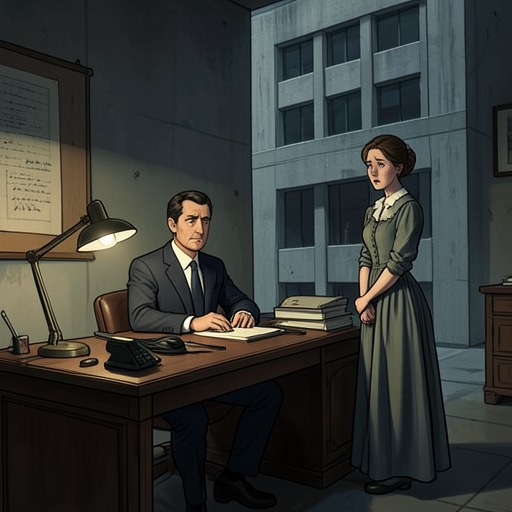
That statement begins as a recorded police interview with Andrew Dalziel. Its opening captures Dalziel’s casual manner, and Peter Pascoe and Shirley Novello recognize that the recording is unlabelled and that Dalziel’s conduct has breached clearly stated procedural rules. The irregularity matters because the tape is not simply a private recollection: it is a purportedly voluntary statement made in the presence of the superintendent, intended by its speaker to become part of the official record.
In the recording, Palinurus Maciver Junior says that he suspects his father was deliberately driven to suicide and that Kay Kafka was involved. He distinguishes his accusation from a claim that she directly caused the death: he says he does not know precisely what happened, and that she was in the United States when his father died. He nevertheless treats her absence as suspicious and argues that deliberately bringing someone to the point of suicide would amount, in his view, to murder. At moments he speculates about direct involvement, but he immediately acknowledges that he cannot explain how it could have happened despite her alibi. The tape therefore preserves an accusation and its limits together: conviction about wrongdoing, without a demonstrated mechanism or physical evidence.
The Statement as an Act
The recording shows that Palinurus Maciver Junior is not only accusing Kay Kafka; he is also trying to prevent his allegation from disappearing. He says he has already voiced his suspicions without seeing the police act on them, which is why he now wants to make a formal statement. He insists that it be typed and made official, and says he intends to repeat the allegation at the inquest. His warning that the coroner may ask why police records contain no preparation for this evidence makes the tape an attempt to hold the investigation accountable as well as a record of his belief.
His manner complicates that effort. He reproaches Andrew Dalziel for treating the interview casually and suspects that the superintendent is under Kay Kafka’s influence. Yet he also revises his own rhetoric during the recording, telling the listener to disregard his more extravagant speculation so that it will not be used to dismiss the accusation altogether. This self-correction reveals a practical awareness of how his credibility might be attacked. The statement closes with a precise date and time, March 27, 1992, at 1:53 p.m., reinforcing his demand that the allegation be documented rather than left as an unrecorded complaint.
Death, Evidence, and Narrative Role
In the 2002 investigation, Palinurus Maciver Junior’s death first appears as an unidentified body at a desk in the Moscow House study. Paddy Ireland has kept the scene undisturbed for forensic photographs, and Tom Lockridge, present as a police medical examiner, looks down at the deceased. Peter Pascoe cannot confirm the man’s identity from where he stands. Later, when Edgar Wield contacts Jake Gallipot, he describes Palinurus Maciver as having killed himself two nights earlier. The account of his death therefore reaches the reader through the police inquiry, while the opening pages have already brought the reader close to his final consciousness.
A snakeskin wallet found in the deceased man’s jacket supplies a small, concrete link to the investigation’s next steps. Its contents include eighty pounds, three credit cards, two Archimagus Antiques business cards, and a gold card bearing Jake Gallipot’s name and Harrogate telephone number. Forensics has examined and recorded the wallet without noting anything further; Peter Pascoe nevertheless notices Gallipot’s card, and Wield later calls him in an official capacity. The card does not explain Palinurus Maciver Junior’s death, but it turns an item carried by the dead man into a route by which the inquiry can continue.
As a character, Palinurus Maciver Junior is known here through a brief final-night perspective, a recording preserved for ten years, and the objects recovered after his death. The contrast between them is central: his private experience is fragmented and difficult to interpret, while his tape is exacting about dates, procedure, and the need for a formal record. His allegation gives the investigation a possible history behind the apparent suicide, but the evidence presented does not establish that allegation as fact. His narrative role is consequently both personal and investigative: his death renews the question of what happened to his father, and his recorded words make the failure to pursue that question part of the case itself.