Palinurus Maciver Senior
Good Morning, Midnight (Reginald Hill Edition)Palinurus Maciver Senior is the former owner of the Maciver family firm whose death at Moscow House, initially treated as suicide, becomes entangled with family accusations, corporate intrigue, and doubts about whether he was killed. His story joins private collapse to public change: the loss of his place in the business, the rupture within his family, and the uncertain circumstances of his final days all become part of the investigation into his son’s later death.
Identity and public position
Maciver Senior was the father of Palinurus Maciver Junior, Cressida Maciver, and Helen Dunn, and the head of an established family. He was married to Kay Kafka, a younger second wife who was away in America with Helen when he died. The family’s status and business history made his death more than a private tragedy: investigators recalled a tense household and a succession of disputes surrounding his marriage, his children, and his position in the company.
Before the takeover, Maciver’s was the source of his pride and an expanding fortune. When the company’s fortunes changed, he faced not only a loss of income and influence but the decline of an enterprise with which he closely identified. The eventual sale left him with a board position that appeared substantial in name but, in practice, offered little authority. His changed standing is repeatedly associated with the possibility that he felt betrayed, including a sense that he had failed the employees whose livelihoods had depended on the business.
Climbing, injury, and business decline
Maciver Senior had been a committed climber, known for attempting difficult ascents. After a serious fall on a later expedition, his left leg was left unable to bend normally, ending his ability to pursue the activity as before. The loss of climbing coincided with his deeper investment in the firm: he directed his energy toward the business, which became both a source of pride and the centre of his working life.
The company’s decline followed the economic upheaval of the late 1970s. As orders dried up and workers were laid off, Maciver Senior confronted the prospect that the firm would continue to contract. Ashur-Proffitt then offered to take over. The account presents his decision as having little real choice: accepting the offer was preferable to allowing further job losses. The business became Ashur-Proffitt-Maciver’s, also known as Ash-Mac’s, and Maciver Senior received money and a seat on the board as an executive director. The role was later understood as largely symbolic. His reduced authority was not merely a change of job title; it marked the separation of the former owner from the firm he had built and the growing distance between the old Maciver’s and the company’s new operations.
Family conflict and the final days
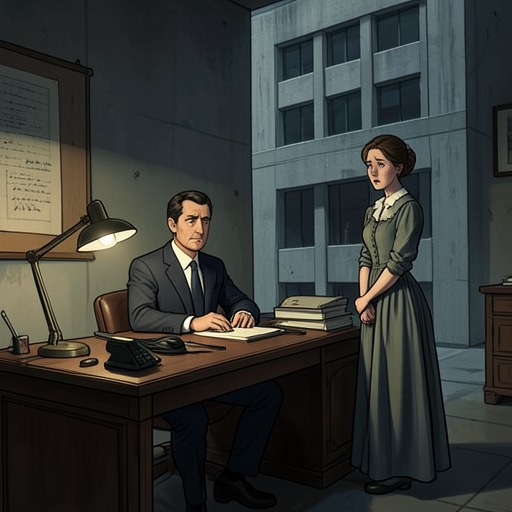
The circumstances around Maciver Senior’s death were strained. His son had accused Kay of making unwanted advances toward him, and Cressida’s later account supports the existence of serious tension between father and son over those allegations. She recalled that Maciver Senior had become distracted, angry, and worried during the period before his death. Palinurus Maciver Junior told her he intended to write to their father and wanted her prepared to confirm his account if asked. Cressida believed that Kay had left for America with Helen after anticipating that the son would tell his father; she also recognized that this was her interpretation, not certain knowledge of what was in her father’s mind.
The dates sharpen the sense of a family crisis. Maciver Senior went to London on March 15, 1992, and returned two days later. Kay and Helen flew to the United States on March 18. Maciver Senior died at Moscow House on March 20, and Palinurus Maciver Junior, returning from Cambridge, found him on March 23. Cressida was informed at school and came home the following day; Kay, travelling abroad, arrived later. When she reached the house, she could not enter because the locks had been changed on her husband’s instructions to his son. The sequence leaves the journey abroad, the letter, and the altered locks as part of the surrounding conflict, without establishing that any one of them explains the death.
Death and competing accounts
The death was first reconstructed as a suicide. Investigators believed Maciver Senior had started to write a note to his wife, then abandoned it; an addressed envelope remained, while the note itself had been burned. Instead, he had left a poetry book as a final communication. The account of the scene also described a twine arrangement attached to a shotgun. Those details later acquired added significance because his son’s apparent suicide echoed the father’s method, prompting investigators to revisit the earlier case rather than regard it as settled history.
A different possibility emerges through the later inquiry. Laurence Waverley recalled finding Maciver Senior in the study with a severe head wound and an ice axe nearby, as well as a letter from his son accusing Kay of attempting to seduce him. Wield subsequently reasoned that a blow from the axe might have left Maciver Senior unconscious rather than dead. On that hypothesis, Waverley could have staged a suicide and relied on Kay’s belief that she had caused the death to secure her continued cooperation. This is presented as a theory, not a confirmed reconstruction. It complicates the original suicide account but does not, by itself, settle who caused Maciver Senior’s death or when he died.
Corporate investigation and narrative significance
Maciver Senior had also begun investigating what he suspected was happening inside Ash-Mac’s. He hired Jake Gallipot, a former police officer, to work in the company’s security section and examine its activities. Gallipot supplied documents, including memos and bills of lading, that Maciver Senior regarded as circumstantial evidence that the firm might be involved in exporting military-related materials to countries under sanctions. He tried to draw Tony Kafka into an admission, received a warning instead, and eventually contacted newspapers. His last diary entry, written before the London trip, expressed hope that the inquiry was nearing a breakthrough. What happened in London, and why the diary contained no account of the return, remained unanswered in the discussion of the evidence.
The company’s former owner was therefore a potential source of a scandal with consequences beyond his family. A government account explains that Maciver Senior’s accusations could attract attention if backed by hard evidence, and that officials sent Waverley to Yorkshire to assess the situation. The takeover itself, though publicly associated with privatization, had also brought Ash-Mac’s activities and security under discreet government oversight, with observers in Washington. Maciver Senior’s attempt to expose suspected illegal trading placed him at the point where private grievance, corporate power, and state interest met.
His significance in the novel consequently depends on the gap between the apparent simplicity of the original account and the growing complexity of the evidence. At first, he is the father whose death provides a grim precedent for his son’s; then he emerges as a displaced business leader who may have been preparing to expose his former company. The family accusations, Gallipot’s investigation, the unexplained London visit, and the later doubts about the study scene do not resolve neatly into a single motive or verdict. They make Maciver Senior’s death the buried event around which both the family’s history and the investigation’s competing explanations continue to turn.