Sanctions on military and dual-use exports
Good Morning, Midnight (Reginald Hill Edition)Sanctions on military and dual-use exports are a recurring legal and political boundary in the novel: they restrict the transfer of arms and of material or machinery with military applications to prohibited destinations, yet the surrounding world of covert trade repeatedly turns that boundary into something to evade, conceal, or manage. Their significance lies in the contradiction between rules presented as public safeguards and a secret economy in which profit, political advantage, and avoiding detection can matter more than compliance.
The rule and its political setting
The novel places sanctions within a wider history of clandestine arms dealing. Its satirical account of the Iran–Contra affair and the parallel sale of arms to Iraq while Iraq was fighting Iran presents national policy as less coherent than its public justifications suggest: actors in both countries conduct business contrary to domestic law while appearing invisible to those meant to oversee them. The point is not that every sanctioned transaction is identical, but that the language of national allegiance can coexist with transactions that cross legal and political lines.
The later reflection on the end of the old argument that an enemy’s enemy could be treated as a useful ally makes the boundary more explicit. In a changed political climate, the question becomes whose side an arms seller serves and which way its weapons may ultimately be pointed. Sanctions therefore operate in the story not only as restrictions on particular exports but also as a test of the claims companies and governments make about loyalty and responsibility.
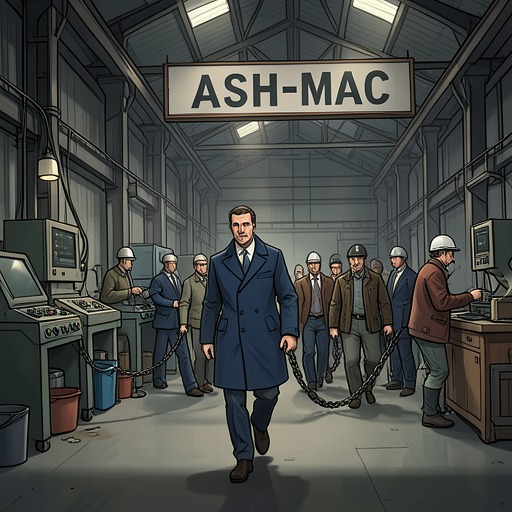
Ash-Mac’s and the suspected exports
Palinurus Maciver Senior suspected that Ash-Mac’s was being used, directly or as a staging post, to export material and machinery with military applications to countries on sanctions lists. He recruited Jake Gallipot, a former police officer he knew from a Masons’ meeting, to investigate from inside the company’s security section. Gallipot’s nighttime access produced memos and bills of lading that were circumstantial rather than conclusive. Maciver Senior believed the trail might lead to decisive proof, but became impatient as it failed to produce a smoking gun.
He tried to draw an admission from Tony Kafka by claiming to know more than he did. Kafka responded with a polite warning about how much harder modern business had become and the need for Maciver Senior to be careful. When the private investigation stalled, Maciver Senior contacted the press; his last diary entry, written on the eve of his trip to London, recorded hope. The account establishes suspicion and an attempted investigation, not a definitive finding that a particular shipment breached sanctions.
Corporate secrecy and official protection
The takeover of Maciver’s by Ashur-Proffitt initially appeared to be an ordinary consequence of globalization or the privatization of British industry. The account complicates that appearance: Ash-Mac’s activities and security had, covertly, become a concern of people in Whitehall and Westminster, with others in Washington, DC, watching. The takeover is consequently described as a kind of covert nationalization beneath the public appearance of private commercial change.
That arrangement raises the stakes of Maciver Senior’s allegations. If he could substantiate claims of sanctions-busting and other illegal trading, the matter could become a scandal, and officials within both public and covert agencies might use that scandal to advance their own interests. American management’s assurance that the situation was under control did not settle the matter; a government sent Laurence Waverley to Yorkshire to assess it independently. The rule exists within an environment where oversight itself is entangled with institutional interests.
Kafka’s proposed pause and the rule’s significance
On the first day of spring, Kafka met Victor Warlove as news of a disturbance at the plant was already known to Warlove. Kafka proposed cooling business for a while and, more concretely, putting a Gulf shipment scheduled to leave the plant that weekend on hold. He argued that another war in the region was likely and that Ash-Mac’s equipment would look compromising if it were found there. His intervention shows the sanctions issue operating prospectively: the shipment’s destination and military character could expose the company to political and reputational consequences even before the feared conflict erupted.
Kafka’s caution contrasts with the broader system described by Peter Pascoe, in which illegal arms deals and sanctions-breaking persist beneath changing treaties and shifting alliances. Pascoe links that covert economy to profit and evasion, and stresses that its costs are borne in human lives. The rule is thus more than a technical control on exports: it marks the point where commercial calculation, state secrecy, and the consequences of armed conflict collide.