Shirley Novello
Good Morning, Midnight (Reginald Hill Edition)Shirley Novello is a Mid-Yorkshire detective constable whose direct manner and practical intelligence make her one of Peter Pascoe’s most useful colleagues in the investigation of the Maciver deaths. Initially assigned discreet research, she follows evidence from a matching shotgun to a cassette, bank records and witnesses on the Avenue. Her contribution is not simply to retrieve information: she notices what matters, tests what a clue can establish and brings its implications back to the senior officers.
Identity and Working Style
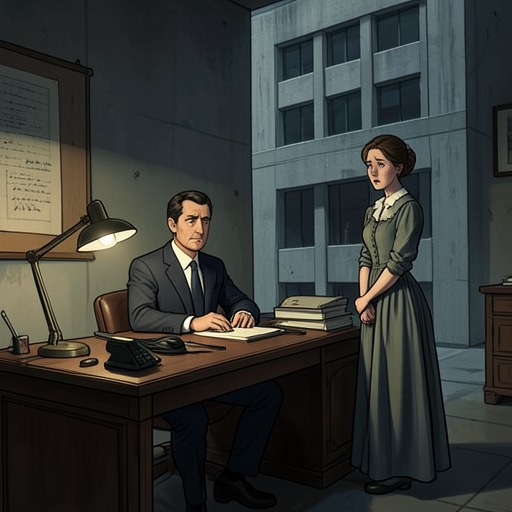
When Peter Pascoe first encounters Novello at the station, he smiles and she does not automatically return it. That reserve belongs to a wider independence. She is described as sharp and direct, quick to learn, able to take orders without surrendering her own judgment, and physically brave when tested. Her record does not capture her appearance: she is plainly dressed, usually in loose combat clothes, with short brown hair and no apparent interest in make-up. The contrast between official assessments of competence and the ordinary details omitted from a personnel file establishes her as a person whom institutional paperwork only partly describes.
Novello is also alert to the different kinds of performance around her. She has learned to ignore Peter Pascoe’s elaborate chatter and Andrew Dalziel’s provocations, and she is amused when Pascoe slips past the superintendent’s door only to find a summons impaled on his desk by a paper knife. Her composure is neither deference nor detachment: she watches colleagues closely, recognizes their habits, and remains ready to redirect her attention to the work.
Building the Evidence Trail
When Andrew Dalziel is absent and Edgar Wield has the morning off, Peter Pascoe brings Novello up to speed on the previous night and asks her to examine the evidence-store material relating to Palinurus Maciver Senior’s suicide. He stresses discretion, ostensibly because of the danger of publicity about a copycat. The narration makes clear that his more immediate concern is avoiding Dalziel’s attention. Novello receives the assignment as an investigative task and pursues the detail that distinguishes repetition from resemblance.
The gun used in the later death is not the original weapon. Novello finds that it is practically identical, the other half of a matching pair, and that the original permit covered two shotguns. No one appears to have followed up the second weapon at the time; its permit was never renewed, and it was presumed to have remained in its cabinet at Moscow House. This does not make the later death a simple copy of the earlier one, but it keeps the link between them materially close. Novello’s finding gives the investigation a specific, checkable connection while preserving the question of how the second gun entered the events.
Among the papers she brings back from the evidence store is an unlabelled interview-room cassette. She pushes it across Pascoe’s desk after he has begun to dismiss the returned material, making sure the recording is not lost in the pile. Pascoe asks what she makes of the tape and whether she was listening. The exchange places her not merely in the role of a records assistant but in the developing interpretation of a statement made by Palinurus Maciver Junior in 1992. Later, as Pascoe explains the recording and its implications, Novello listens with sustained concentration and asks the question that follows from its most troubling details: why the speaker did not come forward after hearing of the suicide.
Fieldwork and Witnesses
Novello’s inquiries extend beyond the station. When Constable Jennison reports that a woman called Dolores had spoken to him outside Moscow House, Novello has already set him searching phone boxes and other likely places for a message or calling card. None is found, and the other women he contacts either do not know the woman or will not say so. The absence of an easy lead does not end the search; it clarifies what the investigators have not yet established about Dolores’s identity and whereabouts.
At a bank, Novello obtains detailed statements for Maciver’s personal and business accounts from manager Willie Noolan. Noolan offers little resistance once Dalziel’s name is invoked. The business account supports Dolly Upshott’s claim that Archimagus is doing well. In the personal account, Novello notices a different, more precise detail: monthly payments of two thousand pounds, beginning three months earlier, transferred by BACS from a deposit account at the local branch of Nortrust Bank. Noolan checks the source himself, sparing her another approach to a financial institution. Novello’s value here lies in distinguishing a broad impression of prosperity from a recurring payment whose timing and origin merit attention.
Her work among the women on the Avenue is similarly practical. Novello rejects the comforting television convention that policewomen and sex workers will naturally recognize a shared sisterhood. In her experience, people in prostitution generally regard the police as adversaries and cooperate when immediate self-interest gives them reason to do so. She does not approach them as a moral judge or as a social worker. Instead, she negotiates, watches for openings and asks for information relevant to the inquiry.
In speaking to Big Maggie, Novello offers a choice between being taken to the station on an assault charge and giving a detailed account of what she saw or heard on the night a man died at Moscow House, together with information about Dolores. Big Maggie denies having seen or heard anything useful and says she does not know Dolores. Novello does not mistake that denial for a confirmed answer: she presses her about whether Dolores might be working under another name, have come from an agency, or be operating independently. The encounter shows both the limits of her leverage and her persistence in testing possible explanations rather than accepting the first refusal.
Rank, Opportunity, and Observation
Novello’s fieldwork eventually becomes part of a briefing to senior colleagues. She tells the story of her inquiries among bankers, lawyers and the women of the Avenue in a manner that recalls Edgar Wield’s measured reporting. Peter Pascoe is impressed despite himself and recognizes the substance of what she has found. Her progress is visible in the movement from a discreet, narrowly assigned check to the presentation and interpretation of results before officers whose reactions she can read.
She is conscious, however, that opportunity within the force is uneven. When she is included in the senior officers’ visit to Cothersley Hall to speak with Kay Kafka, she reflects that her gender is what has placed her in the room. Even if her assigned role were to accompany Kay Kafka or assist with practical needs, Novello knows that proximity to a serious interview is itself a route towards advancement. She is curious, too, about the personal tension between Dalziel and Pascoe. Ambition and curiosity coexist with a clear sense of the institutional limits that shape her access.
At the house, Dalziel asks Novello to make tea while he checks for news. She follows Kay Kafka to the kitchen and returns carrying the tray, but makes the small service her own by adding cranberry juice and buttered scones. The episode brings out a characteristic mixture of compliance and self-direction: she performs the task assigned without allowing it to define her attention or erase her preferences. During Pascoe’s questions, she watches Kay Kafka remain composed while denying that she saw Pal at Moscow House that evening. Novello herself is momentarily caught in the scene, frozen with a scone poised in front of her mouth, an involuntary sign of how intently she is following the exchange.
Interpretation and Narrative Role
The recording and the later explanation of the case draw Novello into a more difficult kind of reasoning: not simply what a person knew, but why that knowledge might have been withheld. She follows Pascoe’s account of the dead man’s inoperable brain tumour and of Vic Chakravarty’s relationship with the man’s sister. Pascoe explains that Tom Lockridge had approached Chakravarty, that medical confidentiality made disclosure difficult, and that the new will’s provision for Cressida Maciver would have made testimony in a will dispute especially uncomfortable. Novello’s question about why Chakravarty had not come forward presses the distinction between having information and having a reason to reveal it.
Across these episodes, Novello’s role develops through attention rather than a dramatic change in status. She identifies the second shotgun, preserves the overlooked cassette, follows financial and street-level leads, and listens closely enough to challenge an explanation with the question it leaves unanswered. Her reserve, humour and ambition help define her as more than a subordinate who executes instructions. In a case shaped by uncertain testimony and concealed motives, she repeatedly makes the next piece of evidence speak more clearly without pretending that it settles everything.