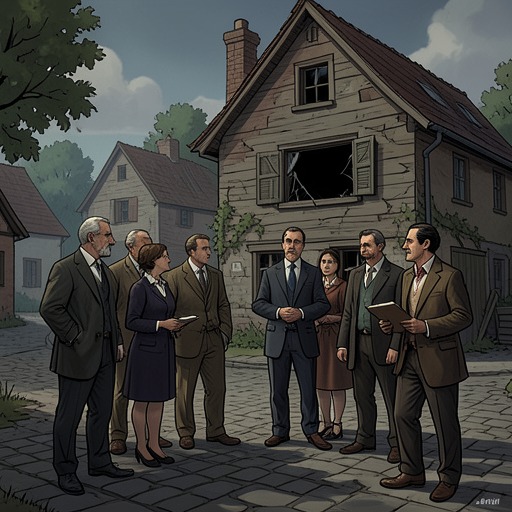
St Cuthbert's Church
Good Morning, Midnight (Reginald Hill Edition)St Cuthbert’s Church is both a landmark in Cothersley and the setting for a quiet, consequential meeting between Dolly Upshott and Kay Kafka. Its clock, whose familiar chimes have been curtailed at night, and a moonlit stained-glass window turn the church into a place where public village life gives way to private reflection.
Setting and Character
The church is associated with a strong local sense of place. Its clock was once a source of civic pride: the old Cothersleyans claimed its splendid chime could guide people working far out in misty fields or tending sick animals at night. After light-sleeping newcomers petitioned for quiet, they outvoted native opponents five to one, and the quarter chimes were silenced between ten in the evening and seven in the morning. David Upshott, facing the first major test of his ministry, proposed the compromise; he joked that anyone still unable to sleep after an hour should consult a doctor or a conscience.
Dolly and Kay’s Meeting
After leaving the Dog and Duck alone, Dolly sits in the church without knowing how long she has been there. She has left the door ajar and remains still when Kay, driving past, notices the opening and comes inside. The church is cold, but its particular mixture of wood, leather, cloth, stone, dampness, and the trace of incense and hyssop remains distinct; Dolly’s brother David is described as quite high-church. Heavy stained glass blocks the starlight, except at a high south-west window where the gibbous moon casts a diffused glow. Kay sits beside Dolly and looks up at the window. Its image shows two haloed figures walking towards each other across water, usually understood as Herbert of Derwentwater visiting his friend Cuthbert of Lindisfarne, or the reverse. One figure appears less certain of his footing, as though a lapse of faith could send him plunging into a weedy grave. The image gives their shared stillness a visual counterpart: crossing the water requires a confidence that the uncertain figure may not possess. They share a brief moment of humour about the possibility of a shark, then retreat into their separate thoughts.
The Clock and the Church’s Role
The church clock marks the scene’s turn. Its quarters have been muted during the hours when Dolly arrives, but at midnight its twelve strokes carry across the green, past cottages, farms, meadows, and streams, fading in the neighbouring valley glades. Neither woman speaks or moves until the final note has sounded. They then rise and walk down the aisle together. The church thus gathers the village’s competing claims to quiet, tradition, and communal memory into one setting, while its midnight chime gives Dolly and Kay’s encounter a measured passage from solitary reflection to shared departure.