Study’s concealed cabinet
Good Morning, Midnight (Reginald Hill Edition)The Study’s concealed cabinet is a hidden chamber built into the study’s gun cabinet, and its discovery exposes the limits of an apparently thorough search. Kay Kafka finds it when she returns to the room where Palinurus Maciver Senior and Palinurus Maciver Junior died. The chamber’s contents become evidence in the investigation, but their presence does not settle whether Kay meant to retrieve them, leave them for discovery, or conceal them from investigators.
Construction and Discovery
The cabinet survives the clearing of the study. Furniture, pictures and books have all been removed, yet the gun cabinet remains attached to the wall. Its ordinary appearance conceals a second space: the gun-retaining clip can be twisted anticlockwise and pulled out, swinging aside on well-oiled hinges to reveal a chamber behind it. The mechanism is neither forced nor difficult to operate once its purpose is known; the concealment depends on the clip being mistaken for, or treated as, only a functional part of the cabinet.
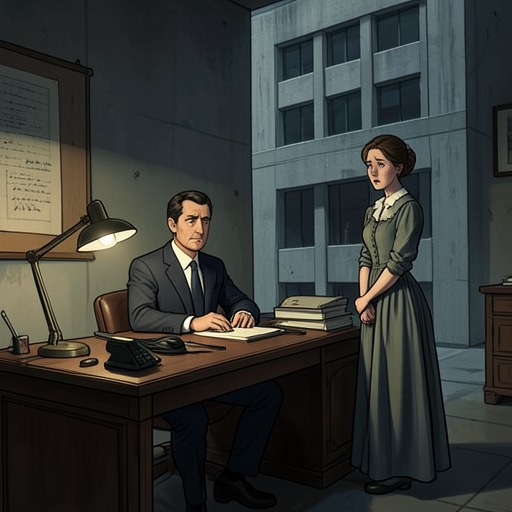
Kay enters the emptied room at night with a torch. She is surprised by how completely it has been cleared, a thoroughness she associates with Peter Pascoe’s attention to detail. The omission of the wall-mounted gun cabinet therefore becomes striking: the search has removed the room’s furnishings but not dismantled this fixed fixture. Kay goes directly to it and opens the hidden section. The dust inside appears undisturbed, a concrete sign that the concealed space has not recently been handled. It does not, by itself, establish when the chamber was last opened or who knew it was there.
The Encounter in the Study
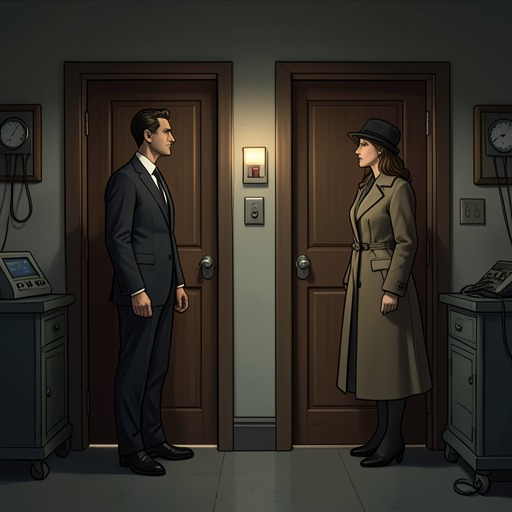
The discovery is interrupted at the instant the hidden chamber is exposed. The central light comes on, and a voice remarks on having seen a film in which one safe is hidden behind another, adding that the possibility should have been considered. The observation names the room’s governing trick without explaining how Kay came to inspect the cabinet. For a moment she freezes; when she turns, however, her face shows the pleasure of a welcoming hostess. Her courteous greeting to the sergeant sharply contrasts with the circumstances: she has been found alone, at night, opening a concealed compartment in a room associated with the deaths of her husband and stepson.
That contrast makes the cabinet more than an overlooked piece of furniture. It is the point where private knowledge and official scrutiny meet. Kay’s calm response does not reveal whether she expected to find anything, and the scene does not confirm why she came back to the study. Her familiarity with the mechanism is consequential, but the available evidence leaves its source unexplained. The hidden space produces an encounter and a suspicion, not a complete account of her intentions.
Contents and Forensic Handling
The chamber contains five distinct items: a silver whisky flask marked with the initials P.M., a silver cigarette lighter bearing the same initials, an empty medicine bottle labelled as having contained Valium capsules prescribed to Mr P. Maciver, a microcassette and a diary stamped with the year 1992. The initials and prescription connect the objects to the Maciver name, while the recording and dated diary suggest that the compartment may preserve material of investigative interest. The contents are not, on the evidence provided, interpreted or authenticated at the moment they are found.
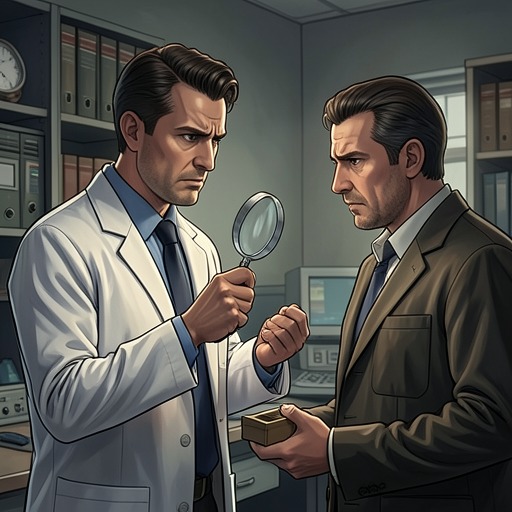
The sergeant reports that the items have been photographed in place and bagged, with no further handling before forensic examination. Tests and print examination are still pending. The possibility that the objects might bear Kay’s prints is raised, but such a result would not alone establish whether she had placed them there earlier or entered the study to recover them. The difference matters: the same objects can be read as material she left behind or as evidence she sought to remove, and the scene does not yet decide between those accounts.
Investigative Significance and Uncertainty
The sergeant rejects the suggestion that Kay simply intended to report the cabinet as a conscientious citizen. The proposed alternative is that she came to inspect its contents and might have removed anything she did not want the police to find, intending to disclose the hidden space later. This is an investigative theory, not a confirmed motive. The question of why she would leave the objects in place if she wanted them concealed remains unresolved, as does the question of whether the items are connected to any offence.
The timing also shapes the discovery’s consequences. The sergeant says there was little to be done before morning and explains that the objects are now at the laboratory; Peter Pascoe reproaches him for not making contact the previous night. Thus the cabinet produces both a potential evidentiary lead and a procedural disagreement about when the discovery should have been reported. Its importance lies partly in what it contains, but also in the uncertainty surrounding access: the room had been stripped, the fixed cabinet overlooked, and Kay found opening the space before its contents could be examined. Until testing and further investigation clarify those circumstances, the concealed cabinet remains a narrow opening into a history the search had not fully reached.