The Avenue
Good Morning, Midnight (Reginald Hill Edition)The Avenue is a broad, tree-lined street in Greenhill, a suburb whose grand houses and shifting uses embody the rise and decline of local wealth. Its historical prestige persists more as an appearance than a reality: behind the trees and long driveways, large houses stand amid a neighbourhood that has lost much of its former status. In the novel, the street’s contrasting uses make it both a remnant of an older social order and a practical setting for the nighttime activity and police inquiry surrounding Moscow House.
From hamlet to suburb
Greenhill began as a hamlet outside the city wall. During the nineteenth century’s industrial expansion it was absorbed into the growing urban area, and its farms, cottages, and muddy lanes gave way to large houses and paved roads. The new residents were industrialists and commercial figures seeking homes that suggested a country life while remaining close to the city. Their preference transformed Greenhill without making it rural: the landscape was made to look spacious and private, but the inconveniences of genuine remoteness were kept at a distance.
From the 1890s through the 1940s, Greenhill served as a stage for the display of Mid-Yorkshire’s prominent residents. The postwar decades altered that pattern. Older fortunes and ways of life faded, and the large houses became less desirable to people making new wealth. By the 1970s, Greenhill was in marked decline. Some mansions were divided into flats, others became small commercial hotels or offices, while others were demolished for speculative development. The Avenue retained enough of its original scale and presence to make the earlier prestige seem almost intact, though that impression coexisted with visible neglect and changed use.
Grandeur and decline
The Avenue’s defining features are its breadth, rows of plane trees, and the screened drives leading to large houses. Those features lend the street a sense of privacy and formality. At night, mist and darkness blur the buildings behind the trees, making them appear remote from ordinary urban life. The effect suggests the persistence of old grandeur, but it is an illusion sustained by architecture and atmosphere rather than by the social world that first gave the houses their status.
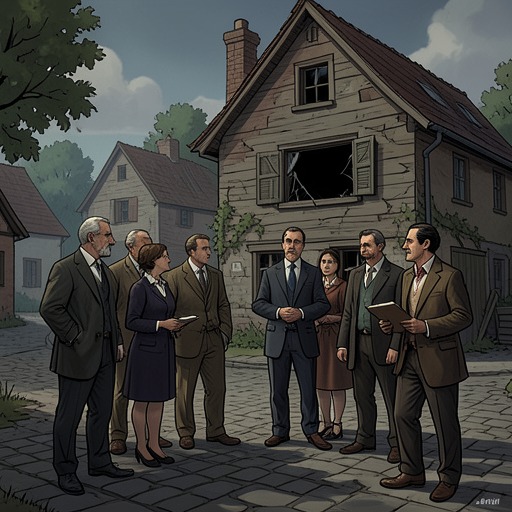
The daylight view exposes the difference. The street appears less imposing, while untrimmed hedges, overgrown trees, untended lawns, peeling paint, and missing tiles register neglect. The Avenue’s houses and gardens have not vanished, but their condition makes the gap between inherited prestige and present circumstances visible. The narrative’s shift between night and day therefore changes how the same place is read: darkness preserves the appearance of grandeur, while daylight makes decline harder to overlook.
Nighttime use and street life
The Avenue’s trees and winding driveways offer cover and privacy, and few residents are present to complain. These conditions have made it a regular place for sex workers and the motorists who seek them. Although the street can look empty from a passing car, women emerge from the trees when a vehicle moves slowly along the kerb. A marked police car produces the opposite response: its presence disrupts the ordinary pattern of business and sends many of the women elsewhere.
That informal street economy sits uneasily beside the Avenue’s stately houses. A street built to display domestic wealth has become a place where people make use of its secluded approaches for very different purposes. The contrast is not simply between respectable houses and nighttime activity; both are shaped by the same spatial features. The drives that once helped give residents privacy also offer concealment, and the trees that enhance the street’s appearance make it harder to see who is there.
Moscow House and the investigation
One of the Avenue’s drives leads to Moscow House. Stone pillars mark its entrance, with the remains of old fittings suggesting a more elaborate former gateway. The house is set back from the road, difficult to see from the street, and screened by its drive and garden. When Constable Jennison and Maycock arrive there before the main investigative party, a sale board advertises the property as available with vacant possession. The dark, shuttered house appears unoccupied, consistent with that notice.
Moscow House becomes a focal point after Pal Maciver is found dead inside. The Avenue then connects the private scene at the house to the public movements around it: police cars enter the drive, an ambulance follows, and people approaching along the street try to learn what has happened. The house’s distance from the road matters. In the mist, a passer-by can travel along the Avenue without being able to see the property clearly, so the entrance and the activity at its gate become more revealing than the building itself.
The street also structures the early response to Pal’s death. Constable Jennison is assigned to the gate, where he speaks with Dolores, a woman working on the Avenue. As the news of a large police presence spreads, most of the other women leave, but Dolores remains to talk with him. Her decision to stay creates a point of contact between the investigation and the street’s ordinary nighttime population. Later, an account of the night describes a visitor driving past Moscow House, seeing a police car turn into the drive, and returning after spotting an ambulance and police lights. The Avenue provides the route by which these clues become visible, even though the house cannot easily be seen from the road.
A changing public space
The Avenue’s importance extends beyond its connection to the death at Moscow House. In daylight, Shirley Novello takes up a position near the house’s entrance and encounters Big Maggie and Crazy Jane, two women associated with the street. Big Maggie has appeared publicly as a self-appointed representative during disputes between residents and sex workers. Their presence shows that the Avenue’s social tensions are not confined to private complaints or nighttime transactions; they also involve competing claims to who belongs in the neighbourhood and how its public space should be used.
The investigation repeatedly turns on the limits of what can be seen and what can be inferred. The Avenue looks empty at certain hours but is not necessarily unoccupied; its houses look imposing at night but reveal neglect by day; and activity at Moscow House may be hidden from the road yet leave traces at the gate. These contrasts give the street a role beyond that of a route to the house. It is where Greenhill’s former status, present decline, street life, and the unfolding inquiry meet, while its screened entrances and changing appearance keep observation uncertain.