Unassisted suicide means no criminal investigation
Good Morning, Midnight (Reginald Hill Edition)Andrew Dalziel’s unassisted-suicide rule is a procedural distinction: if a person ended his own life without help, Dalziel sees no crime and therefore no need for a criminal investigation. Its apparent clarity becomes harder to sustain as the investigation into Palinurus Maciver Senior’s death encounters ambiguous physical evidence, and Palinurus Maciver Junior’s later death repeats the circumstances of his father’s. The rule can define when Dalziel thinks police work should stop; it cannot, by itself, settle what drove either man or what the evidence means.
The rule and its logic
Dalziel reduces the question to whether a suicide was assisted. In his account, a person acting alone has not been hypnotized, put under a spell, or helped by another; if that is what happened, the matter is not a crime and requires no further investigation. He calls the conclusion simple from the police’s point of view, not because suicide itself is emotionally or psychologically simple, but because he treats the criminal inquiry as contingent on another person’s involvement. The rule is thus less an explanation of a death than a proposed limit on the work investigators should undertake.
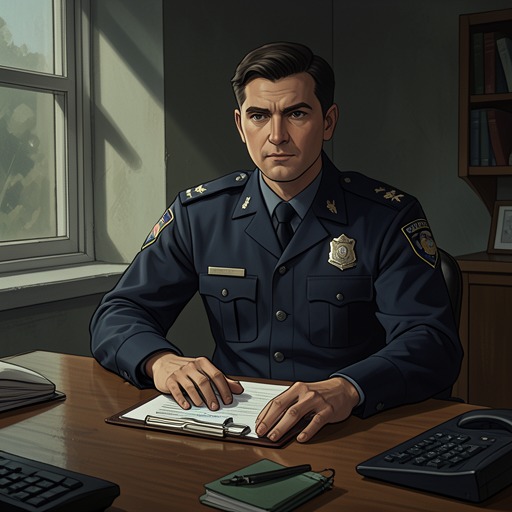
That distinction also shapes Dalziel’s handling of responsibility. When Peter Pascoe asks whether Dalziel is taking control of the case, Dalziel leaves Pascoe in charge, since Pascoe arrived first. Yet he does not treat that transfer of command as a reason to suspend his own judgment: he is already inclined to classify Palinurus Maciver Senior’s death as suicide. The episode shows the rule operating as an interpretive stance before every uncertainty has been resolved, even while formal responsibility for the case remains with Pascoe.
The apparent case for closure
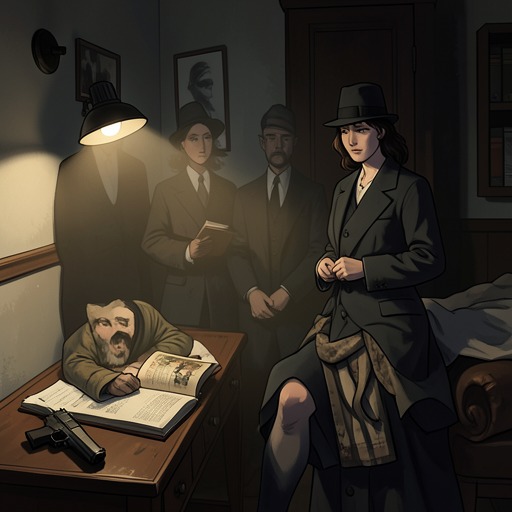
The scene at the house supplies details that support the suicide interpretation. The door is locked and bolted from inside, the windows have substantial shutters, and a gun lies between the dead man’s legs; one shoe and sock have also been removed. Dalziel presents these as converging hints rather than as an account of motive. A blue Laguna estate parked behind the house is registered to Palinurus Maciver Senior, who is also its designated keyholder. Taken together, these circumstances make a self-inflicted death appear plausible, but they do not explain why it happened or establish that every relevant question has been answered.
The wider history gives that unanswered question weight without furnishing a single sufficient cause. Palinurus Maciver Senior inherited a thriving business, devoted himself to it after a climbing accident left his left leg unable to bend, and took pride in its success. After the economic downturn that followed 1979, Maciver’s order book emptied and workers were laid off. He accepted Ashur-Proffitt’s takeover rather than face further redundancies; the business became Ashur-Proffitt-Maciver’s, and he received money and a board position that Dalziel regards as largely symbolic. These losses and changes form part of the circumstances surrounding the death, but the rule deliberately brackets such explanations: for Dalziel, they do not determine whether a crime occurred.
Evidence that unsettles certainty
The later examination of the scene shows why a plausible initial classification is not the same as a conclusive investigation. Arnold Gentry reports that the lock had recently been lubricated with high-grade lubricant, making a key turn with little resistance. Ash was found in the lubricant and on the key. Although the small fire in the waste bin might explain ash on the key, analysis indicated that ash inside the lock, and some on the key, came from another source. This finding raises a question about the scene without, on its own, proving who introduced the ash or what happened.
Other physical details likewise require interpretation rather than a snap verdict. A rope examined at the house showed no signs of having been used to hang or whip anyone. An ice axe bore faint traces of blood beneath dust and rust, but Gentry judged them too old to relate to the current investigation. And a sheet of paper Peter Pascoe had left with the investigators carried the same palm print they had identified elsewhere. The print establishes a connection between the paper and an identified print; its presence does not itself resolve the circumstances of either death. These findings complicate the easy closure implied by a locked room and a gun, while remaining short of a complete alternative account.
The human and narrative limits of the rule
Pascoe’s reflections make explicit what Dalziel’s procedural division leaves outside its frame. He finds murder easier to approach because investigators can reconstruct a perpetrator’s state of mind while pursuing that person. Trying to understand someone who saw death as the only escape, by contrast, turns the inquiry back toward the investigator’s own mind. The distinction does not establish a diagnosis or disprove suicide. It shows why a conclusion about criminal responsibility cannot exhaust the meaning of a death, and why emotional complexity persists even when a case appears administratively closed.
The repeated pattern of the two Maciver deaths puts that limitation under particular pressure. Laurence Waverley later reasons that Palinurus Maciver Junior learned something about the circumstances of his father’s death, possibly through what Jake Gallipot disclosed, but that this knowledge alone did not cause him to take his own life. Waverley instead points to a nearer occasion and says that, once Junior had decided on suicide, his mind was sufficiently deranged for him to reproduce the paternal death as closely as he could, using a garbled version of Gallipot’s account as a template. This is Waverley’s interpretation, not a settled demonstration of every step in the events.
The resemblance between father and son therefore works against any easy equation of repeated circumstances with a simple, fully understood conclusion. Dalziel’s test remains focused on assistance and criminality; Waverley’s account and Pascoe’s unease draw attention to the private causes and distorted understanding that the test cannot settle. The rule marks a threshold for investigation, but the novel’s accumulating clues and repeated death expose the gap between deciding that no crime has been shown and knowing what a death means.