War on Terror
Good Morning, Midnight (Reginald Hill Edition)The War on Terror gives the novel’s arms-trading debates a new urgency: what had once been defended as expedient commerce is now measured against an asserted line between acceptable and unacceptable sides. For Tony Kafka, the conflict makes a pending shipment an ethical question; for Victor Warlove, it is a marketing opportunity. The war therefore operates not only as political background but as a test of whether commercial caution, national belonging, and moral responsibility can be kept separate.
Historical and Political Context
The book sets the War on Terror against an earlier pattern of covert arms dealing. A satirical script Kay reads recounts how American officials sold weapons to Iran and directed the profits to the Contras, while British actors sold arms to Iraq as Iraq fought Iran. Its central image is a cloak of invisibility: people on both sides of the Atlantic act contrary to their countries’ laws, yet those in authority seem unable to see them. The comic, deliberately dated language makes the passage’s political point without softening it: hidden activity and official deniability have already been part of the arms trade.
The script’s closing argument marks a change in the terms of justification. The old logic that an enemy’s enemy could be treated as a friend and armed against a common opponent is presented as no longer sufficient. After the attacks on the United States, the passage imagines a visible line in the sand: anyone sending weapons across it must know where those weapons will point and be prepared to answer for which side they support. This is an argument within a text Kay is reading, not a neutral account of policy, but it supplies the moral vocabulary that later informs the dispute over Ash-Mac’s shipments.
Tony Kafka’s Objection
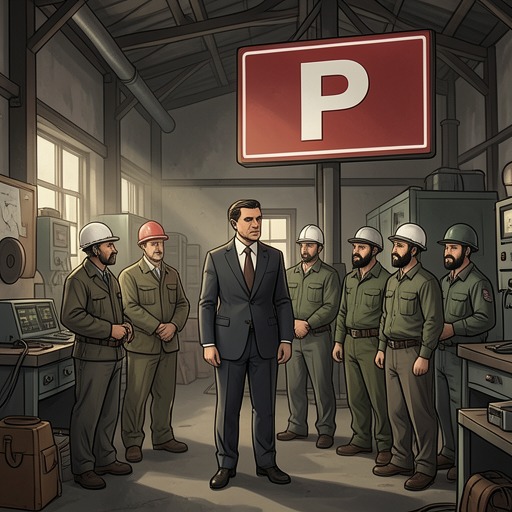
On the first day of spring, Tony meets Victor Warlove and Timothy Gedye over lunch. Warlove has heard about trouble at Tony’s end and asks whether it poses a concern; Tony says the situation is under control. When Warlove turns to business and invokes the prospects opened by the War on Terror, Tony proposes cooling their activities for a while. Warlove treats the conflict as a splendid marketing opportunity and asks whether Tony has a problem he has not disclosed. Tony’s hesitation is not merely about whether the trade can be concealed: he concludes that the question is whether it is right.
Tony gives the objection a concrete form by raising a Gulf shipment due to leave the plant that weekend. He suggests putting it on hold because another war in the region is likely, and Ash-Mac equipment could be left scattered across the battlefield. Warlove answers that the company’s paper trail could be followed around the globe without leading investigators to Ash-Mac. Tony rejects this as beside the point. In his view, the war may already have begun in the eyes of many people, so the decision cannot be reduced to whether the company will be exposed or whether its equipment will look bad later.
Commerce Against Conscience
The exchange separates Tony’s concern from Warlove’s commercial reasoning. Warlove treats the changed political climate as a sales opening and dismisses Tony’s seriousness; Tony asks whether continuing the trade is right in the circumstances. When Warlove jokingly attributes a maxim about war and marketing to Aristotle, then corrects it to Onassis, the joke folds the conflict back into the language of business. He raises a glass of red wine and proposes a toast to war. The scene closes not with agreement but with the contrast made plain: for Warlove, war can be celebrated as opportunity, while for Tony it makes the shipment harder to justify.
The earlier script and the lunch conversation thus present different stages of the same moral problem. The script challenges the old claim that arming one side against another can be excused by strategic convenience; Tony’s proposed pause applies that challenge to an immediate decision about Gulf cargo. Yet his stated concerns also include the prospect of Ash-Mac equipment appearing in a future conflict and the risk that the company will look compromised. The novel preserves this tension rather than making his position a simple public declaration of principle.
National Belonging and Political Power
The War on Terror also touches Tony’s sense of belonging. After reading the script, Kay thinks of his admission that he feels foreign in Britain and wonders whether the birth of the twins might make him more willing to move west. She contrasts his wish to be a good American and return home with her own lack of an emotional pull toward any place in the United States, apart from a small plot of land. For her, Britain is home, made more sacred by the previous night. The juxtaposition connects national allegiance to intimate attachment without making the family’s future a settled decision.
The wider political setting further complicates any sharp boundary between private commerce and state power. Ashur-Proffitt’s takeover of Maciver’s appears to the public as globalization or as part of the sell-off of British industry, but the account describes it instead as a form of covert nationalization: Ash-Mac’s activities and security have become the hidden responsibility of officials in Whitehall and Westminster, with others in Washington watching. This account is not presented as a direct consequence of the War on Terror. It does, however, place the arms business within a world where public and private authority overlap, so that claims of invisibility, responsibility, and national interest remain difficult to disentangle.