Ashur-Proffitt’s acquisition and restructuring of Maciver’s
Good Morning, Midnight (Reginald Hill Edition)Ashur-Proffitt’s acquisition and restructuring of Maciver’s is presented as both a corporate takeover and a rupture in the family and workplace order built around Palinurus Maciver Senior. The business was vulnerable during a recession, but Palinurus Maciver Junior argues that its decline was not inevitable: in his account, the American company used his father’s distracted state to secure an advantage, then replaced the old family firm’s paternal management with a more severe corporate regime. The takeover’s significance lies in that double change: Maciver’s passed into new hands, and the relationships that had governed its work and its family were recast as liabilities or instruments of control.
Background and opportunity
Maciver’s faced a difficult manufacturing climate. Businesses were failing around it, and the company was in poor condition, but Palinurus Maciver Junior insists there was still room for recovery. Looking back at the firm’s later success, he imagines that, with additional financing and his father holding on, Maciver’s might have become a Thatcher-era business success. This is a counterfactual, not proof that survival was assured; it nevertheless establishes the son’s view that the takeover was an opportunity seized from a vulnerable but not hopeless company.
The American Ashur-Proffitt corporation had its eyes on Maciver’s. Palinurus Maciver Junior compares the international commercial environment to a jungle in which a company’s weakness attracts competitors ready to profit. He says his father was preoccupied by personal difficulties and that Ashur-Proffitt’s representatives studied his private life. In the son’s account, the crucial opening came when his father began paying as much attention to Ashur-Proffitt’s senior executive’s personal assistant, Kay Kafka, as to the companies’ financial affairs. He suspects that Ashur-Proffitt acted once it recognized this distraction, though he explicitly does not claim the relationship had been engineered from the outset.
Marriage, leverage, and suspicion
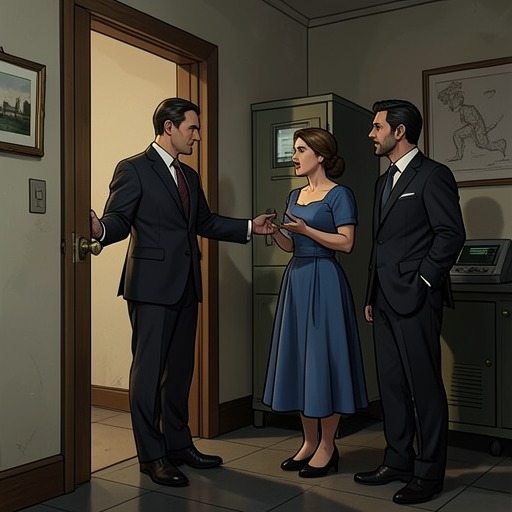
The takeover’s personal dimension is filtered through Palinurus Maciver Junior’s hostility toward Kay Kafka. He recalls first seeing her as a foreign newcomer whom his father wanted the children to accept in place of their recently deceased mother. Her early kindness toward him and Cressida, and her affectionate attention to Helen, did not prepare him for what he later alleges was predatory conduct. His testimony is emphatic, but it remains his testimony: the account makes the family conflict inseparable from his accusation without independently resolving it.
Palinurus Maciver Junior also questions why Kay Kafka married his father. He considers several possibilities rather than claiming to know her motive: Ashur-Proffitt might have wanted someone close to Palinurus Maciver Senior while it reorganized the company; Kay might have been seeking financial security through a future divorce; or she might have anticipated becoming a wealthy widow. He reports that both he and his brother Pal suspected from the beginning that she was acting for herself. Their resentment was bound up with the marriage’s domestic intrusion: Kay occupied their mother’s house, bedroom, and possessions. In this telling, business control and family intimacy overlap, but the proposed motives remain suspicions, not established facts.
The new workplace order
The change in management was visible in everyday dealings with employees. Under Palinurus Maciver Senior, Maciver’s was remembered as a family firm where workers were addressed personally and lateness was noticed, but circumstances mattered. An employee kept awake by a new baby might be offered help, such as being woken for a shift or moved to a different one. The account depicts a paternal system, with its own hierarchy, but one that could respond to individual hardship; the lack of a strong union was attributed to the belief that such representation had not previously been necessary.
Under the new American management, the reported rule was starkly different: a single warning could be followed by dismissal. The company was described as streamlined and efficient, while the new regime was also associated with suppressing union activity. This contrast gives restructuring a human scale. Corporate efficiency did not merely alter ownership or organization; it changed what an employee could expect when personal circumstances interfered with work. The old arrangement’s accommodation gave way to a standardized discipline, and workers bore the consequences directly.
Aftermath and retrospective meaning
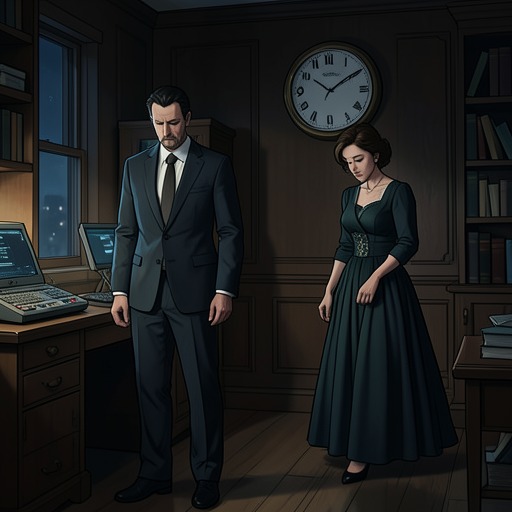
Palinurus Maciver Senior retained what Sergeant Wield calls a token job, but the title did not restore his authority. Wield reasons that it may have taken time for him to understand how little influence he had over the company’s direction. He imagines that Palinurus Maciver Senior might have tried to assert himself, only to be told that he belonged to the past. Wield interprets the loss as a double betrayal: the founder may have felt he had been displaced, and that he had failed the employees whose livelihoods had been tied to the family firm. Wield says he could understand how this might have contributed to the older man’s collapse, while stopping short of presenting that interpretation as a proven cause.
The later emergence of Ash-Mac’s as a large, financially buoyant international group underscores how far the operation had moved from Maciver’s. Wield’s internet research also took him to the Junius site, reached through a link on Ashur-Proffitt’s own website. Junius alleged that an Ashur-Proffitt subsidiary had been involved in the Iran arms scandal and published material concerning Iraq. These allegations add a wider political shadow to the new corporate order, but they are presented as claims on the site, not as independently confirmed findings. Taken together, the takeover is remembered through competing scales of consequence: a company’s expansion, employees’ loss of a more accommodating workplace, and a family’s suspicion that commercial control was gained through the vulnerabilities of its patriarch.