Ashur-Proffitt’s regulatory scrutiny
Good Morning, Midnight (Reginald Hill Edition)Ashur-Proffitt’s regulatory scrutiny is both a threat to the company and a test of the forces that have helped keep its dealings out of view. The story places the post-Enron attention of the U.S. Securities and Exchange Commission beside a covert British and American investigation into the takeover of Maciver’s. In both strands, scrutiny turns on who controls information: the company’s political assurances and business confidence face challenges from shifting war policies, accusations of illegal trading, and evidence that authorities have already been watching.
Public oversight and the appearance of immunity
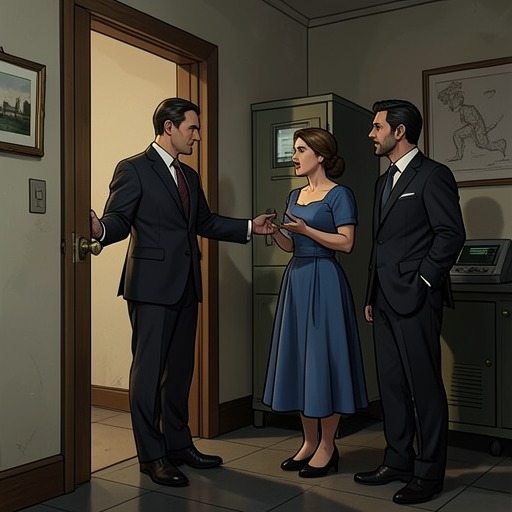
The immediate warning comes from Timothy Gedye, who tells Victor Warlove that the U.S. Securities and Exchange Commission has issued its investigators with fine-tooth combs after Enron and that he has heard Ashur-Proffitt is in their sights. Gedye fears that the agency could move soon. Warlove treats the prospect lightly, confident that Joe Proffitt has no vulnerabilities for investigators to uncover. Gedye’s counterpoint is a conspicuous sign of confidence: Joe has ordered a luxury yacht large enough to include a golf driving range. To Warlove this suggests security; to Gedye it looks like hubris.
The exchange is framed as a dispute about whether institutional scrutiny can penetrate a powerful company’s defenses. Gedye describes a disturbance on the company’s patch as a tremor in a web and says he has someone positioned to keep its vibrations under control. Yet he is less worried about the incident itself than about the possibility that Tony Kafka might try to leave the network. The image makes oversight feel less like a single inspection than a contest over the interconnected relationships that can contain or amplify damaging information.
Kafka’s own position is less assured than Warlove’s. At a meeting on the first day of spring, Warlove asks about trouble in Yorkshire; Kafka says it is under control, then proposes cooling business for a while. He connects his caution to the war on terrorism and to the prospect of another conflict in the Gulf. A shipment due to leave the plant that weekend, he argues, should be held back before Ash-Mac equipment is caught up in a new war. His concern is not simply whether the transaction can proceed, but how it will appear when political conditions change. The possibility of scrutiny gives a future shipment present risk.
Arms trading and the cloak of invisibility
A document on a laptop broadens the issue from a pending investigation to the history of political protection around arms sales. Styled as a modern fairy tale, it recounts American arms sales to Iran and the diversion of profits to the Contras, alongside British sales of arms to Iraq while Iraq fought Iran. Its central irony is that people involved in actions contrary to their countries’ laws could remain effectively invisible to those responsible for oversight. The whimsical style is judged tedious, but the concluding argument holds attention: appeals to strategic convenience and to the idea that an enemy’s enemy is a friend no longer suffice when weapons cross a political line.
That contrast between visibility and concealment gives regulatory scrutiny its larger significance. A company may present its transactions as ordinary business or as part of national policy, while the legal and political consequences remain obscured. The document’s final challenge asks where those who send weapons believe their loyalties lie. It turns the question of compliance into one of accountability: a change in the international climate can make yesterday’s tolerated arrangement newly difficult to defend.
The hidden inquiry into Maciver’s
The eventual account by Laurence Waverley shows that government scrutiny of the business began before the public warning about the Securities and Exchange Commission. Ashur-Proffitt’s takeover of Maciver’s appeared to outsiders to be another act of globalization or part of the sale of British industry. In Waverley’s account, however, the company’s activities and security became, covertly, the responsibility of people in Whitehall and Westminster, with others in Washington, D.C., keeping watch. The apparent transfer into private hands therefore concealed a form of state oversight rather than ending it.
The former owner, Palinurus Maciver Senior, became a concern when he began accusing the company of evading sanctions and engaging in other illegal trading. The danger to those overseeing the business was conditional but serious: if he could produce hard evidence, his claims could become a scandal. Ashur-Proffitt’s American management assured Waverley’s superiors that the situation was under control, but they still sent him to Yorkshire to assess it independently. The inquiry arose from a clash between the company’s assurances and the possibility that its former owner could substantiate his accusations.
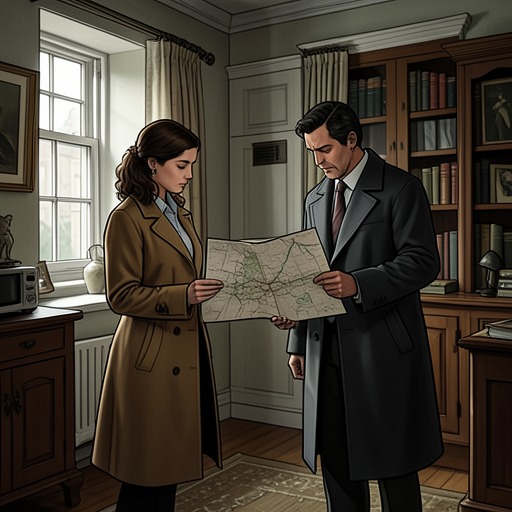
Waverley concealed his role under the cover of a Value Added Tax investigator. That position gave him a plausible reason to approach Maciver about the record-keeping systems used before and after the takeover, and allowed him to present himself as dissatisfied with the new regime. Maciver then shared his concerns and disclosed that he had employed Jake Gallipot to obtain hard evidence. Waverley’s account thus traces the path from suspicion inside the company to an investigation conducted through a carefully chosen official-looking pretext.
Containing evidence and credibility
Waverley describes Gallipot as ruthless, ingenious, and venal, with a dubious past. A combination of threat and bribery brought him onto the investigators’ side. Maciver, by contrast, had been isolated from legitimate access to Ashur-Proffitt’s sensitive areas, which was why he needed Gallipot’s help. Waverley judged that, without supporting evidence, Maciver could be portrayed publicly as a former owner unable to accept his loss of power. His recommendation was to undermine Maciver’s credibility and let events take their course.
The method is revealing: scrutiny does not simply mean collecting evidence and testing allegations. It also means managing the conditions under which evidence can be obtained, deciding whose account will appear credible, and limiting the access of the person making the accusation. The inquiry’s concealed status and its attempt to discredit Maciver complicate any simple division between regulatory oversight and corporate self-protection. The company is watched because its conduct could provoke scandal, yet the watchers also act to prevent that possibility from gaining public force.
Taken together, the SEC warning, Kafka’s proposed pause in shipments, and Waverley’s retrospective account show several kinds of vulnerability at once. Ashur-Proffitt faces the possibility of formal examination, the reputational risk of arms transactions during a changing political crisis, and the danger that a former owner may produce evidence of unlawful conduct. Its apparent security rests partly on relationships and control of information; the company’s cloak of invisibility is not proof that no one is looking, but a condition maintained through secrecy, confidence, and the attempted containment of inconvenient claims.