Dog and Duck
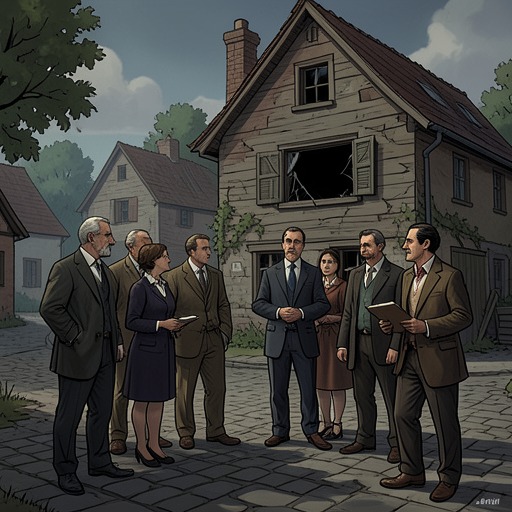
Good Morning, Midnight (Reginald Hill Edition)The Dog and Duck is a Cothersley pub facing the village green, a setting that brings its drinkers within sight of St Cuthbert’s Church and makes the nearby public space part of the pub’s narrative world. It is both a place where private grief becomes local conversation and a landmark beside which police business unfolds. The contrast between a solitary late-night drink and a conspicuous incident on the green gives the pub a modest but useful role in linking village sociability to the wider events of the story.
Setting and the village clock
At eleven, as the last drinkers begin to leave the Dog and Duck, St Cuthbert’s clock strikes. The chime is described as splendid, and the account recalls how Cothersley residents once took pride in a clock whose sound could guide people working far beyond the village, even in mist or darkness. That local boast has, however, been tempered by a dispute between long-standing residents and newer arrivals: after a petition from light-sleeping incomers, the quarters were silenced between ten at night and seven in the morning. The change was carried by a five-to-one vote, leaving the clock’s remaining audible hours as a compromise rather than an unchallenged village tradition.
The compromise had been proposed by David Upshott during what the narrative calls the first major test of his ministry. His answer to the dispute was to suggest that someone still unable to sleep after an hour should consult either a doctor or a conscience. Set beside the closing pub, the clock episode gives the setting a social texture beyond its physical location. The Dog and Duck is part of a village negotiating whose habits and preferences should shape shared space: the public ritual of the clock continues, but its sound is restricted at the request of residents who experience it as a disturbance.
Drinkers, grief, and solitude
Dolly Upshott arrives at ten, unusually late and alone for the pub’s regulars. She orders a large vodka and tonic, chooses a corner, and sits nursing both her drink and her mobile phone. Her replies to attempts at conversation are polite but short, and she gives no sign that she wants company. The account makes her reserved presence especially visible by setting it against the other conversation in the room: the regulars turn their attention to Sue-Lynn Maciver, who is willing to share the sorrows of her recent widowhood with anyone prepared to buy her a drink.
The contrast does not make either woman’s response to grief into a simple spectacle. Sue-Lynn’s sorrow becomes public and conversational, while Dolly keeps to herself; the pub contains both forms of presence without collapsing them into one. Dolly is the last person to leave. Before she goes, the Captain asks whether she is all right. His benevolence is not wholly detached from business: he has realized that the grieving widow’s presence has increased his takings rather than driven customers away. In this brief exchange the Dog and Duck is shown as a place where concern, observation, and the economics of the bar coexist.
Looking beyond the pub
When Dolly answers that she is fine, she looks across the green toward the mass of St Cuthbert’s Church, black against a star-filled sky. She is pleased by the idea that the church is getting in the way of the heavens. The moment briefly shifts attention from the room and its drinkers to the landscape outside. The church is not merely a nearby building: from Dolly’s position it interrupts the view of the sky, and that interruption becomes a private conceit. The pub thus gives the scene a definite point of observation, connecting Dolly’s inward solitude to the visible arrangement of village buildings and open space.
The relationship between pub and green is also clear in a later daytime scene. The Dog and Duck stands beside the green, where a mound resembling a model of Great Gable has been raised. A police car is nearby, and Constables Jennison and Maycock are talking to a visibly unhappy man. Andrew Dalziel approaches and asks what is happening; Constable Jennison explains that someone has delivered a load of nonsense to the Captain. The incident places the pub at the edge of a public disturbance without making the pub itself the source of it. Its exterior, the green, and the Captain’s presence together orient the action in the village.
The church hall and village life
The green also connects the pub to the church hall. In the same daytime passage, Kay Kafka’s attention turns to women gathered at the hall entrance, and she remembers that she promised to look in on the jumble sale. Her attention moves from the police activity by the pub to a separate social gathering on the other side of the green. The spatial arrangement matters: the pub, church, and hall occupy a shared village setting, but they draw different kinds of attention and activity.
Across these scenes, the Dog and Duck functions less as an isolated interior than as one point in a small, legible public landscape. At night it contains drinkers, a widow’s open grief, and Dolly’s chosen distance from company; outside, the church clock and darkened church shape the scene. By day, the green beside the pub accommodates a police presence while the jumble sale brings Kay toward the church hall. The setting’s significance lies in this closeness: private feeling, village custom, commercial interest, and public commotion remain distinct, yet all are visible from the same local centre.